Event submissions
Published
This submission belongs to the session 1. Fermentation and micro-organism/biotechnology of the event The 1st International Online Conference on Fermentation
Published date
07 Nov, 2025
Academic Editor
'%3e%3cpath%20d='M12.6657%2010.9104C12.4185%2010.325%2012.0599%209.79327%2011.6097%209.34482C11.1609%208.89508%2010.6293%208.5365%2010.0442%208.28888C10.0389%208.28626%2010.0337%208.28495%2010.0285%208.28233C10.8446%207.69279%2011.3752%206.73249%2011.3752%205.64904C11.3752%203.8542%209.92103%202.39999%208.1262%202.39999C6.33136%202.39999%204.87715%203.8542%204.87715%205.64904C4.87715%206.73249%205.40774%207.69279%206.22393%208.28364C6.21869%208.28626%206.21345%208.28757%206.20821%208.29019C5.62129%208.5378%205.09463%208.89284%204.64265%209.34613C4.1929%209.79493%203.83432%2010.3266%203.58671%2010.9117C3.34345%2011.4845%203.21226%2012.0987%203.20023%2012.7209C3.19988%2012.7349%203.20233%2012.7488%203.20744%2012.7619C3.21255%2012.7749%203.22022%2012.7867%203.22998%2012.7968C3.23975%2012.8068%203.25142%2012.8147%203.26431%2012.8202C3.2772%2012.8256%203.29105%2012.8284%203.30504%2012.8284H4.09109C4.14874%2012.8284%204.19459%2012.7825%204.1959%2012.7262C4.2221%2011.7148%204.62823%2010.7676%205.34617%2010.0497C6.08899%209.30683%207.0755%208.89808%208.1262%208.89808C9.17689%208.89808%2010.1634%209.30683%2010.9062%2010.0497C11.6242%2010.7676%2012.0303%2011.7148%2012.0565%2012.7262C12.0578%2012.7838%2012.1037%2012.8284%2012.1613%2012.8284H12.9474C12.9613%2012.8284%2012.9752%2012.8256%2012.9881%2012.8202C13.001%2012.8147%2013.0126%2012.8068%2013.0224%2012.7968C13.0322%2012.7867%2013.0398%2012.7749%2013.0449%2012.7619C13.0501%2012.7488%2013.0525%2012.7349%2013.0522%2012.7209C13.0391%2012.0947%2012.9094%2011.4855%2012.6657%2010.9104ZM8.1262%207.9024C7.52486%207.9024%206.9589%207.6679%206.53312%207.24211C6.10733%206.81633%205.87283%206.25037%205.87283%205.64904C5.87283%205.0477%206.10733%204.48174%206.53312%204.05596C6.9589%203.63018%207.52486%203.39567%208.1262%203.39567C8.72753%203.39567%209.29349%203.63018%209.71927%204.05596C10.1451%204.48174%2010.3796%205.0477%2010.3796%205.64904C10.3796%206.25037%2010.1451%206.81633%209.71927%207.24211C9.29349%207.6679%208.72753%207.9024%208.1262%207.9024Z'%20fill='%235D1EE1'/%3e%3c/g%3e%3c/svg%3e) Paola Domizio
Paola DomizioCitation
Valentina Craparo, Marta Cuenca, Enrico Viola, Azzurra Vella, Irene Dolce, Antonino Pirrone, Vincenzo Naselli, Giuseppe Notarbartolo, Daniele Oliva, Amparo Gamero, Nicola Francesca, Mónica Gandía, Antonio Cilla, Impact of novel biotechnological strategies in the fermentation of Sicilian wines on the content of total polyphenols, in Proceedings of The 1st International Online Conference on Fermentation, 12 November–13 November 2025, MDPI: Basel, Switzerland
Share
Email
Facebook
Twitter
LinkedIn
Impact of novel biotechnological strategies in the fermentation of Sicilian wines on the content of total polyphenols
'%3e%3cpath%20d='M12.6647%2010.9104C12.4176%2010.325%2012.0589%209.7933%2011.6088%209.34485C11.16%208.89511%2010.6283%208.53653%2010.0432%208.28891C10.038%208.28629%2010.0327%208.28498%2010.0275%208.28236C10.8437%207.69282%2011.3743%206.73252%2011.3743%205.64907C11.3743%203.85423%209.92005%202.40002%208.12522%202.40002C6.33038%202.40002%204.87618%203.85423%204.87618%205.64907C4.87618%206.73252%205.40677%207.69282%206.22296%208.28367C6.21772%208.28629%206.21248%208.2876%206.20724%208.29022C5.62031%208.53783%205.09365%208.89287%204.64167%209.34616C4.19192%209.79496%203.83334%2010.3266%203.58573%2010.9117C3.34247%2011.4846%203.21128%2012.0987%203.19925%2012.721C3.1989%2012.735%203.20135%2012.7489%203.20646%2012.7619C3.21157%2012.7749%203.21924%2012.7868%203.22901%2012.7968C3.23877%2012.8068%203.25045%2012.8148%203.26334%2012.8202C3.27623%2012.8256%203.29007%2012.8284%203.30406%2012.8284H4.09012C4.14776%2012.8284%204.19362%2012.7825%204.19493%2012.7262C4.22113%2011.7148%204.62726%2010.7676%205.34519%2010.0497C6.08802%209.30686%207.07452%208.89811%208.12522%208.89811C9.17592%208.89811%2010.1624%209.30686%2010.9052%2010.0497C11.6232%2010.7676%2012.0293%2011.7148%2012.0555%2012.7262C12.0568%2012.7839%2012.1027%2012.8284%2012.1603%2012.8284H12.9464C12.9604%2012.8284%2012.9742%2012.8256%2012.9871%2012.8202C13%2012.8148%2013.0117%2012.8068%2013.0214%2012.7968C13.0312%2012.7868%2013.0389%2012.7749%2013.044%2012.7619C13.0491%2012.7489%2013.0515%2012.735%2013.0512%2012.721C13.0381%2012.0947%2012.9084%2011.4856%2012.6647%2010.9104ZM8.12522%207.90243C7.52388%207.90243%206.95792%207.66793%206.53214%207.24215C6.10636%206.81636%205.87185%206.2504%205.87185%205.64907C5.87185%205.04773%206.10636%204.48177%206.53214%204.05599C6.95792%203.63021%207.52388%203.3957%208.12522%203.3957C8.72655%203.3957%209.29252%203.63021%209.7183%204.05599C10.1441%204.48177%2010.3786%205.04773%2010.3786%205.64907C10.3786%206.2504%2010.1441%206.81636%209.7183%207.24215C9.29252%207.66793%208.72655%207.90243%208.12522%207.90243Z'%20fill='%235D1EE1'/%3e%3c/g%3e%3c/svg%3e)
Valentina Craparo 1
Marta Cuenca 2
Enrico Viola 1
Azzurra Vella 1
Irene Dolce 1
Antonino Pirrone 1
Vincenzo Naselli 1
Giuseppe Notarbartolo 3
Daniele Oliva 4

Amparo Gamero 2
Nicola Francesca 1

Mónica Gandía 2

Antonio Cilla 2
1. Department of Agricultural, Food and Forest Sciences, University of Palermo, Viale delle Scienze Bldg. 5, Ent. C., 90128 Palermo (PA), Italy.
2. Bionutest research group. Faculty of Pharmacy and Food Sciences, University of Valencia, Avda. Vicent Andrés Estellés S/N 46100 Burjassot (València), Spain.
3. G. Milazzo agricultural company- Terre Della Baronia S.r.l., Strada Statale 123 - Km 12+700, 92023 Campobello di Licata (AG), Italy
4. Regional Institute of Wine and Oil – Region of Sicily, Via Libertà 66, 90143, Palermo (PA), Italy
Abstract
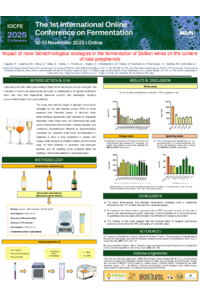
Catarratto is the main white grape variety in Sicily, and enhancing its value is a key goal. This study investigated how different fermentation strategies affect the total phenolic content (TPC) in wines made from Catarratto grapes under different winemaking protocols. Three biotechnological approaches were explored: (i) sequential inoculation using three non-Saccharomyces yeast strains (Starmerella lactis-condensi, Candida oleophila, and Lachancea thermotolerans) followed by Saccharomyces cerevisiae; (ii) Catarratto wines that are non-macerated or subjected to short- or long-term maceration with seeds and peel, with/without sulfites, and fermented using St. lactis-condensi, S. cerevisiae, and lactic-acid bacteria; and (iii) traditional sparkling wines with S. cerevisiae strains. TPC was measured using the Folin–Ciocalteu method. Fermentation generally led to a reduction in TPC compared to must. In approach (i), the highest and lowest TPC values were observed in wines fermented only with S. cerevisiae and in those pre-fermented with St. lactis-condensi and L. thermotolerans, followed by S. cerevisiae, respectively. In approach (ii), maceration increased TPC, particularly when St. lactis-condensi was followed by S. cerevisiae. In sparkling wines (iii), TPC varied significantly depending on the selected non-commercial S. cerevisiae strain. These results suggest that tailored fermentation strategies can enhance the phenolic content and quality of Catarratto-based wines.
Keywords
white wine
sicilian wines
traditional sparkling wine
second fermentation
Saccharomyces cerevisiae
non-Saccharomyces yeasts
lactic-acid bacteria
total phenolic content.
Poster
IOCFE poster 2025 Valentina Craparo.pdf
Optimizing Fermentation Time and pH in Primary Souring of Beer Through Co-Fermentation with Saccharomyces cerevisiae and Lachancea thermotolerans
Impact of nitrogen supplementation, cooling rate, and SO₂ addition timing on yeast viability and acetaldehyde production during the post-fermentation phase of wine