Event submissions
Published
This submission belongs to the session S7. Wearable Sensors and Healthcare Applications of the event The 12th International Electronic Conference on Sensors and Applications
Published date
07 Nov, 2025
Academic Editor
'%3e%3cpath%20d='M12.6657%2010.9104C12.4185%2010.325%2012.0599%209.79327%2011.6097%209.34482C11.1609%208.89508%2010.6293%208.5365%2010.0442%208.28888C10.0389%208.28626%2010.0337%208.28495%2010.0285%208.28233C10.8446%207.69279%2011.3752%206.73249%2011.3752%205.64904C11.3752%203.8542%209.92103%202.39999%208.1262%202.39999C6.33136%202.39999%204.87715%203.8542%204.87715%205.64904C4.87715%206.73249%205.40774%207.69279%206.22393%208.28364C6.21869%208.28626%206.21345%208.28757%206.20821%208.29019C5.62129%208.5378%205.09463%208.89284%204.64265%209.34613C4.1929%209.79493%203.83432%2010.3266%203.58671%2010.9117C3.34345%2011.4845%203.21226%2012.0987%203.20023%2012.7209C3.19988%2012.7349%203.20233%2012.7488%203.20744%2012.7619C3.21255%2012.7749%203.22022%2012.7867%203.22998%2012.7968C3.23975%2012.8068%203.25142%2012.8147%203.26431%2012.8202C3.2772%2012.8256%203.29105%2012.8284%203.30504%2012.8284H4.09109C4.14874%2012.8284%204.19459%2012.7825%204.1959%2012.7262C4.2221%2011.7148%204.62823%2010.7676%205.34617%2010.0497C6.08899%209.30683%207.0755%208.89808%208.1262%208.89808C9.17689%208.89808%2010.1634%209.30683%2010.9062%2010.0497C11.6242%2010.7676%2012.0303%2011.7148%2012.0565%2012.7262C12.0578%2012.7838%2012.1037%2012.8284%2012.1613%2012.8284H12.9474C12.9613%2012.8284%2012.9752%2012.8256%2012.9881%2012.8202C13.001%2012.8147%2013.0126%2012.8068%2013.0224%2012.7968C13.0322%2012.7867%2013.0398%2012.7749%2013.0449%2012.7619C13.0501%2012.7488%2013.0525%2012.7349%2013.0522%2012.7209C13.0391%2012.0947%2012.9094%2011.4855%2012.6657%2010.9104ZM8.1262%207.9024C7.52486%207.9024%206.9589%207.6679%206.53312%207.24211C6.10733%206.81633%205.87283%206.25037%205.87283%205.64904C5.87283%205.0477%206.10733%204.48174%206.53312%204.05596C6.9589%203.63018%207.52486%203.39567%208.1262%203.39567C8.72753%203.39567%209.29349%203.63018%209.71927%204.05596C10.1451%204.48174%2010.3796%205.0477%2010.3796%205.64904C10.3796%206.25037%2010.1451%206.81633%209.71927%207.24211C9.29349%207.6679%208.72753%207.9024%208.1262%207.9024Z'%20fill='%235D1EE1'/%3e%3c/g%3e%3c/svg%3e) Jean-marc Laheurte
Jean-marc LaheurteCitation
Kodai Kitagawa, Yudai Ishikawa, Tadateru Kurosawa, Ryo Uchimura, Shinji Murata, Chikamune Wada, Fundamental Evaluation of a Single Inertial Sensor in Trunk Angle Measurement During Patient Repositioning, in Proceedings of The 12th International Electronic Conference on Sensors and Applications, 12 November–14 November 2025, MDPI: Basel, Switzerland
Share
Email
Facebook
Twitter
LinkedIn
Fundamental Evaluation of a Single Inertial Sensor in Trunk Angle Measurement During Patient Repositioning
'%3e%3cpath%20d='M12.6647%2010.9104C12.4176%2010.325%2012.0589%209.7933%2011.6088%209.34485C11.16%208.89511%2010.6283%208.53653%2010.0432%208.28891C10.038%208.28629%2010.0327%208.28498%2010.0275%208.28236C10.8437%207.69282%2011.3743%206.73252%2011.3743%205.64907C11.3743%203.85423%209.92005%202.40002%208.12522%202.40002C6.33038%202.40002%204.87618%203.85423%204.87618%205.64907C4.87618%206.73252%205.40677%207.69282%206.22296%208.28367C6.21772%208.28629%206.21248%208.2876%206.20724%208.29022C5.62031%208.53783%205.09365%208.89287%204.64167%209.34616C4.19192%209.79496%203.83334%2010.3266%203.58573%2010.9117C3.34247%2011.4846%203.21128%2012.0987%203.19925%2012.721C3.1989%2012.735%203.20135%2012.7489%203.20646%2012.7619C3.21157%2012.7749%203.21924%2012.7868%203.22901%2012.7968C3.23877%2012.8068%203.25045%2012.8148%203.26334%2012.8202C3.27623%2012.8256%203.29007%2012.8284%203.30406%2012.8284H4.09012C4.14776%2012.8284%204.19362%2012.7825%204.19493%2012.7262C4.22113%2011.7148%204.62726%2010.7676%205.34519%2010.0497C6.08802%209.30686%207.07452%208.89811%208.12522%208.89811C9.17592%208.89811%2010.1624%209.30686%2010.9052%2010.0497C11.6232%2010.7676%2012.0293%2011.7148%2012.0555%2012.7262C12.0568%2012.7839%2012.1027%2012.8284%2012.1603%2012.8284H12.9464C12.9604%2012.8284%2012.9742%2012.8256%2012.9871%2012.8202C13%2012.8148%2013.0117%2012.8068%2013.0214%2012.7968C13.0312%2012.7868%2013.0389%2012.7749%2013.044%2012.7619C13.0491%2012.7489%2013.0515%2012.735%2013.0512%2012.721C13.0381%2012.0947%2012.9084%2011.4856%2012.6647%2010.9104ZM8.12522%207.90243C7.52388%207.90243%206.95792%207.66793%206.53214%207.24215C6.10636%206.81636%205.87185%206.2504%205.87185%205.64907C5.87185%205.04773%206.10636%204.48177%206.53214%204.05599C6.95792%203.63021%207.52388%203.3957%208.12522%203.3957C8.72655%203.3957%209.29252%203.63021%209.7183%204.05599C10.1441%204.48177%2010.3786%205.04773%2010.3786%205.64907C10.3786%206.2504%2010.1441%206.81636%209.7183%207.24215C9.29252%207.66793%208.72655%207.90243%208.12522%207.90243Z'%20fill='%235D1EE1'/%3e%3c/g%3e%3c/svg%3e)
Kodai Kitagawa 1
Yudai Ishikawa 1
Tadateru Kurosawa 1
Ryo Uchimura 2
Shinji Murata 2
Chikamune Wada 2
1. Department of Industrial Systems Engineering, National Institute of Technology, Hachinohe College, Hachinohe, Japan
2. Graduate School of Life Science and Systems Engineering, Kyushu Institute of Technology, Kitakyushu, Japan
Abstract
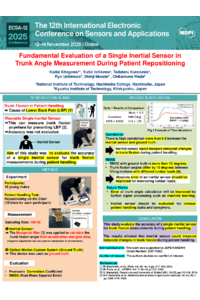
Excessive trunk flexion of caregivers during patient handling causes lower back pain. Thus, the trunk flexion angle of caregivers should be monitored and improved in daily patient handling tasks. A single inertial sensor is considered a suitable wearable sensor for monitoring trunk posture during patient handling because it is installed on popular devices such as smartphones. However, the accuracy of a single inertial sensor has not been evaluated for trunk flexion measurements in patient handling. The objective of this study was to evaluate the accuracy of a single inertial sensor for trunk flexion measurements during patient handling. In the experiment, ten participants performed patient repositioning. The trunk flexion angle during patient repositioning was measured using an optical motion capture system as the ground truth, and a single inertial sensor on the trunk. The Madgwick filter was applied to calculate the trunk flexion angle using the acceleration and gyro data obtained from an inertial sensor. The correlation and root mean square error (RMSE) values between the optical motion capture system and inertial sensor were calculated to evaluate accuracy. The results showed that the correlation values between the inertial sensor and the ground truth were greater than 0.9. These results indicate that a single inertial sensor can be used to monitor temporal changes in trunk flexion during patient handling. On the other hand, the results showed that RMSE values were more than 10 degrees. In future work, these errors should be improved by developing novel signal processing methods.
Keywords
inertial sensor
trunk angle
patient repositioning
caregiver
lower back pain
Manuscript
ECSA2025_patient_repositioning_v2.pdf
Poster
ECSA2025_patient_repositioning_poster_v1.pdf
EMG Sensor-Based Evaluation for Joint Position of Assistive Chopsticks in Food-Serving Task
Prototype of Lifting Posture Monitoring System for Preventing Low Back Pain