Event submissions
Published
This submission belongs to the session S3. Sensor Networks, IoT, Smart Cities and Health Monitoring of the event The 12th International Electronic Conference on Sensors and Applications
Published date
07 Nov, 2025
Academic Editor
'%3e%3cpath%20d='M12.6657%2010.9104C12.4185%2010.325%2012.0599%209.79327%2011.6097%209.34482C11.1609%208.89508%2010.6293%208.5365%2010.0442%208.28888C10.0389%208.28626%2010.0337%208.28495%2010.0285%208.28233C10.8446%207.69279%2011.3752%206.73249%2011.3752%205.64904C11.3752%203.8542%209.92103%202.39999%208.1262%202.39999C6.33136%202.39999%204.87715%203.8542%204.87715%205.64904C4.87715%206.73249%205.40774%207.69279%206.22393%208.28364C6.21869%208.28626%206.21345%208.28757%206.20821%208.29019C5.62129%208.5378%205.09463%208.89284%204.64265%209.34613C4.1929%209.79493%203.83432%2010.3266%203.58671%2010.9117C3.34345%2011.4845%203.21226%2012.0987%203.20023%2012.7209C3.19988%2012.7349%203.20233%2012.7488%203.20744%2012.7619C3.21255%2012.7749%203.22022%2012.7867%203.22998%2012.7968C3.23975%2012.8068%203.25142%2012.8147%203.26431%2012.8202C3.2772%2012.8256%203.29105%2012.8284%203.30504%2012.8284H4.09109C4.14874%2012.8284%204.19459%2012.7825%204.1959%2012.7262C4.2221%2011.7148%204.62823%2010.7676%205.34617%2010.0497C6.08899%209.30683%207.0755%208.89808%208.1262%208.89808C9.17689%208.89808%2010.1634%209.30683%2010.9062%2010.0497C11.6242%2010.7676%2012.0303%2011.7148%2012.0565%2012.7262C12.0578%2012.7838%2012.1037%2012.8284%2012.1613%2012.8284H12.9474C12.9613%2012.8284%2012.9752%2012.8256%2012.9881%2012.8202C13.001%2012.8147%2013.0126%2012.8068%2013.0224%2012.7968C13.0322%2012.7867%2013.0398%2012.7749%2013.0449%2012.7619C13.0501%2012.7488%2013.0525%2012.7349%2013.0522%2012.7209C13.0391%2012.0947%2012.9094%2011.4855%2012.6657%2010.9104ZM8.1262%207.9024C7.52486%207.9024%206.9589%207.6679%206.53312%207.24211C6.10733%206.81633%205.87283%206.25037%205.87283%205.64904C5.87283%205.0477%206.10733%204.48174%206.53312%204.05596C6.9589%203.63018%207.52486%203.39567%208.1262%203.39567C8.72753%203.39567%209.29349%203.63018%209.71927%204.05596C10.1451%204.48174%2010.3796%205.0477%2010.3796%205.64904C10.3796%206.25037%2010.1451%206.81633%209.71927%207.24211C9.29349%207.6679%208.72753%207.9024%208.1262%207.9024Z'%20fill='%235D1EE1'/%3e%3c/g%3e%3c/svg%3e) Francisco Falcone
Francisco FalconeCitation
Kodai Kitagawa, Rintaro Isaka, Arthur Ducoulombier, Prototype of Lifting Posture Monitoring System for Preventing Low Back Pain, in Proceedings of The 12th International Electronic Conference on Sensors and Applications, 12 November–14 November 2025, MDPI: Basel, Switzerland
Share
Email
Facebook
Twitter
LinkedIn
Prototype of Lifting Posture Monitoring System for Preventing Low Back Pain
'%3e%3cpath%20d='M12.6647%2010.9104C12.4176%2010.325%2012.0589%209.7933%2011.6088%209.34485C11.16%208.89511%2010.6283%208.53653%2010.0432%208.28891C10.038%208.28629%2010.0327%208.28498%2010.0275%208.28236C10.8437%207.69282%2011.3743%206.73252%2011.3743%205.64907C11.3743%203.85423%209.92005%202.40002%208.12522%202.40002C6.33038%202.40002%204.87618%203.85423%204.87618%205.64907C4.87618%206.73252%205.40677%207.69282%206.22296%208.28367C6.21772%208.28629%206.21248%208.2876%206.20724%208.29022C5.62031%208.53783%205.09365%208.89287%204.64167%209.34616C4.19192%209.79496%203.83334%2010.3266%203.58573%2010.9117C3.34247%2011.4846%203.21128%2012.0987%203.19925%2012.721C3.1989%2012.735%203.20135%2012.7489%203.20646%2012.7619C3.21157%2012.7749%203.21924%2012.7868%203.22901%2012.7968C3.23877%2012.8068%203.25045%2012.8148%203.26334%2012.8202C3.27623%2012.8256%203.29007%2012.8284%203.30406%2012.8284H4.09012C4.14776%2012.8284%204.19362%2012.7825%204.19493%2012.7262C4.22113%2011.7148%204.62726%2010.7676%205.34519%2010.0497C6.08802%209.30686%207.07452%208.89811%208.12522%208.89811C9.17592%208.89811%2010.1624%209.30686%2010.9052%2010.0497C11.6232%2010.7676%2012.0293%2011.7148%2012.0555%2012.7262C12.0568%2012.7839%2012.1027%2012.8284%2012.1603%2012.8284H12.9464C12.9604%2012.8284%2012.9742%2012.8256%2012.9871%2012.8202C13%2012.8148%2013.0117%2012.8068%2013.0214%2012.7968C13.0312%2012.7868%2013.0389%2012.7749%2013.044%2012.7619C13.0491%2012.7489%2013.0515%2012.735%2013.0512%2012.721C13.0381%2012.0947%2012.9084%2011.4856%2012.6647%2010.9104ZM8.12522%207.90243C7.52388%207.90243%206.95792%207.66793%206.53214%207.24215C6.10636%206.81636%205.87185%206.2504%205.87185%205.64907C5.87185%205.04773%206.10636%204.48177%206.53214%204.05599C6.95792%203.63021%207.52388%203.3957%208.12522%203.3957C8.72655%203.3957%209.29252%203.63021%209.7183%204.05599C10.1441%204.48177%2010.3786%205.04773%2010.3786%205.64907C10.3786%206.2504%2010.1441%206.81636%209.7183%207.24215C9.29252%207.66793%208.72655%207.90243%208.12522%207.90243Z'%20fill='%235D1EE1'/%3e%3c/g%3e%3c/svg%3e)
Kodai Kitagawa 1
Rintaro Isaka 1
Arthur Ducoulombier 2
1. Department of Industrial Systems Engineering, National Institute of Technology, Hachinohe College, Hachinohe, Japan
2. BUT Génie Electrique et Informatique Industrielle, Université de Lille, France
Abstract
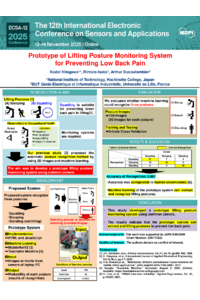
Manual lifting causes low back pain due to lumbar load from an unsuitable posture. In particular, a stooping posture without knee movement is considered an unsuitable posture with large lumbar loads. In contrast, a squatting posture using knee flexion and extension is recommended as a suitable posture with small lumbar loads. From this background, the lifting posture should be continuously monitored and improved to prevent low back pain. Occupational postures are monitored by human observation or specific devices, such as optical motion capture systems. However, human observation has limitations owing to the repeatability and fatigue of the observers. In addition, specific devices, such as optical motion capture systems, are expensive for use in various occupational fields. Therefore, we developed a posture recognition method for stooping and squatting postures during manual lifting using a common monocular camera and machine learning. The purpose of this study was to develop a prototype lifting posture monitoring system using a posture recognition method to prevent low back pain. In addition, to develop the monitoring system, the proposed posture recognition method was modified to extract lifting postures from a movie. A prototype of the lifting posture monitoring system was implemented using HTML and JavaScript. The developed prototype system can recognize and display stooping and squatting lifting postures with different lumbar loads from real-time movies using a monocular camera. A modified posture recognition method was implemented using the MobileNetV2 model trained via Teachable Machine. The modified posture recognition method could recognize stooping lifting, squatting lifting, and standing (not lifting) with greater than 0.85 accuracy. This accuracy was comparable to that of human observations. These results indicate that the prototype lifting posture monitoring system can extract and recognize suitable and unsuitable postures from a movie to prevent low back pain.
Keywords
posture recognition
manual lifting
low back pain
monitoring system
occupational health
Manuscript
ECSA2025_lifting_posture_monitoring_system_v2.pdf
Poster
ECSA2025_lifting_posture_monitoring_system_poster_v2.pdf
Fundamental Evaluation of a Single Inertial Sensor in Trunk Angle Measurement During Patient Repositioning
Biomedical Sensing Approaches to Arterial Pulse Monitoring: Wearable Pressure and Optical Solutions