Event submissions
Published
This submission belongs to the session 2. Fermentation and sensory profiles/impact of the event The 1st International Online Conference on Fermentation
Published date
07 Nov, 2025
Academic Editor
'%3e%3cpath%20d='M12.6657%2010.9104C12.4185%2010.325%2012.0599%209.79327%2011.6097%209.34482C11.1609%208.89508%2010.6293%208.5365%2010.0442%208.28888C10.0389%208.28626%2010.0337%208.28495%2010.0285%208.28233C10.8446%207.69279%2011.3752%206.73249%2011.3752%205.64904C11.3752%203.8542%209.92103%202.39999%208.1262%202.39999C6.33136%202.39999%204.87715%203.8542%204.87715%205.64904C4.87715%206.73249%205.40774%207.69279%206.22393%208.28364C6.21869%208.28626%206.21345%208.28757%206.20821%208.29019C5.62129%208.5378%205.09463%208.89284%204.64265%209.34613C4.1929%209.79493%203.83432%2010.3266%203.58671%2010.9117C3.34345%2011.4845%203.21226%2012.0987%203.20023%2012.7209C3.19988%2012.7349%203.20233%2012.7488%203.20744%2012.7619C3.21255%2012.7749%203.22022%2012.7867%203.22998%2012.7968C3.23975%2012.8068%203.25142%2012.8147%203.26431%2012.8202C3.2772%2012.8256%203.29105%2012.8284%203.30504%2012.8284H4.09109C4.14874%2012.8284%204.19459%2012.7825%204.1959%2012.7262C4.2221%2011.7148%204.62823%2010.7676%205.34617%2010.0497C6.08899%209.30683%207.0755%208.89808%208.1262%208.89808C9.17689%208.89808%2010.1634%209.30683%2010.9062%2010.0497C11.6242%2010.7676%2012.0303%2011.7148%2012.0565%2012.7262C12.0578%2012.7838%2012.1037%2012.8284%2012.1613%2012.8284H12.9474C12.9613%2012.8284%2012.9752%2012.8256%2012.9881%2012.8202C13.001%2012.8147%2013.0126%2012.8068%2013.0224%2012.7968C13.0322%2012.7867%2013.0398%2012.7749%2013.0449%2012.7619C13.0501%2012.7488%2013.0525%2012.7349%2013.0522%2012.7209C13.0391%2012.0947%2012.9094%2011.4855%2012.6657%2010.9104ZM8.1262%207.9024C7.52486%207.9024%206.9589%207.6679%206.53312%207.24211C6.10733%206.81633%205.87283%206.25037%205.87283%205.64904C5.87283%205.0477%206.10733%204.48174%206.53312%204.05596C6.9589%203.63018%207.52486%203.39567%208.1262%203.39567C8.72753%203.39567%209.29349%203.63018%209.71927%204.05596C10.1451%204.48174%2010.3796%205.0477%2010.3796%205.64904C10.3796%206.25037%2010.1451%206.81633%209.71927%207.24211C9.29349%207.6679%208.72753%207.9024%208.1262%207.9024Z'%20fill='%235D1EE1'/%3e%3c/g%3e%3c/svg%3e) Alice Vilela
Alice VilelaCitation
Mariagiovanna Fragasso, Vittorio Capozzi, Giuseppe Spano, Franco Biasioli, Real-Time Volatile Profiling by Direct-Injection Mass Spectrometry: A Sustainable Strategy to Accelerate R&D in Fermentation Studies, in Proceedings of The 1st International Online Conference on Fermentation, 12 November–13 November 2025, MDPI: Basel, Switzerland
Share
Email
Facebook
Twitter
LinkedIn
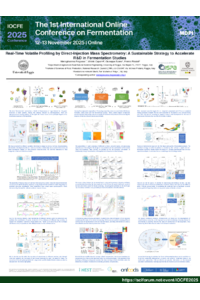
Real-Time Volatile Profiling by Direct-Injection Mass Spectrometry: A Sustainable Strategy to Accelerate R&D in Fermentation Studies
'%3e%3cpath%20d='M12.6647%2010.9104C12.4176%2010.325%2012.0589%209.7933%2011.6088%209.34485C11.16%208.89511%2010.6283%208.53653%2010.0432%208.28891C10.038%208.28629%2010.0327%208.28498%2010.0275%208.28236C10.8437%207.69282%2011.3743%206.73252%2011.3743%205.64907C11.3743%203.85423%209.92005%202.40002%208.12522%202.40002C6.33038%202.40002%204.87618%203.85423%204.87618%205.64907C4.87618%206.73252%205.40677%207.69282%206.22296%208.28367C6.21772%208.28629%206.21248%208.2876%206.20724%208.29022C5.62031%208.53783%205.09365%208.89287%204.64167%209.34616C4.19192%209.79496%203.83334%2010.3266%203.58573%2010.9117C3.34247%2011.4846%203.21128%2012.0987%203.19925%2012.721C3.1989%2012.735%203.20135%2012.7489%203.20646%2012.7619C3.21157%2012.7749%203.21924%2012.7868%203.22901%2012.7968C3.23877%2012.8068%203.25045%2012.8148%203.26334%2012.8202C3.27623%2012.8256%203.29007%2012.8284%203.30406%2012.8284H4.09012C4.14776%2012.8284%204.19362%2012.7825%204.19493%2012.7262C4.22113%2011.7148%204.62726%2010.7676%205.34519%2010.0497C6.08802%209.30686%207.07452%208.89811%208.12522%208.89811C9.17592%208.89811%2010.1624%209.30686%2010.9052%2010.0497C11.6232%2010.7676%2012.0293%2011.7148%2012.0555%2012.7262C12.0568%2012.7839%2012.1027%2012.8284%2012.1603%2012.8284H12.9464C12.9604%2012.8284%2012.9742%2012.8256%2012.9871%2012.8202C13%2012.8148%2013.0117%2012.8068%2013.0214%2012.7968C13.0312%2012.7868%2013.0389%2012.7749%2013.044%2012.7619C13.0491%2012.7489%2013.0515%2012.735%2013.0512%2012.721C13.0381%2012.0947%2012.9084%2011.4856%2012.6647%2010.9104ZM8.12522%207.90243C7.52388%207.90243%206.95792%207.66793%206.53214%207.24215C6.10636%206.81636%205.87185%206.2504%205.87185%205.64907C5.87185%205.04773%206.10636%204.48177%206.53214%204.05599C6.95792%203.63021%207.52388%203.3957%208.12522%203.3957C8.72655%203.3957%209.29252%203.63021%209.7183%204.05599C10.1441%204.48177%2010.3786%205.04773%2010.3786%205.64907C10.3786%206.2504%2010.1441%206.81636%209.7183%207.24215C9.29252%207.66793%208.72655%207.90243%208.12522%207.90243Z'%20fill='%235D1EE1'/%3e%3c/g%3e%3c/svg%3e)
Mariagiovanna Fragasso 1

Vittorio Capozzi 2
Giuseppe Spano 1

Franco Biasioli 3
1. Department of Sciences of Agriculture, Food, Natural Resources, and Engineering (DAFNE), University of Foggia, Via Napoli, 25, Foggia, 71122, Italy
2. Institute of Sciences of Food Production, National Research Council (CNR) of Italy, via Protano (c/o CS-DAT), Foggia, 71121, Italy
3. Research and Innovation Centre, Edmund Mach Foundation, Via E. Mach, San Michele all’Adige (TN), 38098, Italy
Abstract
Fermented foods represent a wide array of products with substantial cultural, ecological, and economic importance. Advancing research and innovation in this domain requires analytical techniques that are efficient, eco-friendly, and cost-effective. Volatile organic compounds (VOCs), which are generated as a result of microbial metabolism during fermentation, serve as indicators of bioprocess dynamics and are closely linked to sensory attributes. Monitoring these volatiles in real-time can reveal critical information regarding fermentation progress, product safety, and aromatic profiles. Direct-Injection Mass Spectrometry (DIMS) is a sustainable analytical method that facilitates rapid, high-sensitivity VOC detection without the need for labor-intensive preparation or separation procedures. This technique has proven effective in tracking fermentation-related microbial activities, even in microbiologically complex environments of alimentary interest. In this study, we present a series of case studies overviewing the use of DIMS in characterizing VOCs across diverse fermented matrices, including dairy (e.g., yoghurt, kefir), cereal-based items (e.g., sourdough), and fermented beverages (e.g., wine, beer, kombucha). FB and VC were supported by Investment 1.3 – Award Number: Project code PE00000003. GS and MG by Investment 1.4—D.D. 1032 17 June 2022, CN00000022] CN00000022] within the Agritech National Research Centre for Agricultural Technologies.
Keywords
fermentation
lactic acid bacteria
yeast
microbiomes
foods
volatile organic compounds
Direct Injection Mass Spectrometry (DIMS)
Poster
Fragasso et al_IOCF2025.pdf
Thermostable Hemicellulolytic Enzymes Secreted by a Microbiome Isolated from a Local Anaerobic Digester
Integrated Characterization of Lactic Acid Bacteria from Subappennino Dauno Sheep Milk (Gentile di Puglia) for Pecorino Cheese Production and Cereal-Based Fermented Beverage Development: a Case Study from Italian Marginal Areas