Event submissions
Published
This submission belongs to the session S7. Wearable Sensors and Healthcare Applications of the event The 12th International Electronic Conference on Sensors and Applications
Published date
07 Nov, 2025
Academic Editor
'%3e%3cpath%20d='M12.6657%2010.9104C12.4185%2010.325%2012.0599%209.79327%2011.6097%209.34482C11.1609%208.89508%2010.6293%208.5365%2010.0442%208.28888C10.0389%208.28626%2010.0337%208.28495%2010.0285%208.28233C10.8446%207.69279%2011.3752%206.73249%2011.3752%205.64904C11.3752%203.8542%209.92103%202.39999%208.1262%202.39999C6.33136%202.39999%204.87715%203.8542%204.87715%205.64904C4.87715%206.73249%205.40774%207.69279%206.22393%208.28364C6.21869%208.28626%206.21345%208.28757%206.20821%208.29019C5.62129%208.5378%205.09463%208.89284%204.64265%209.34613C4.1929%209.79493%203.83432%2010.3266%203.58671%2010.9117C3.34345%2011.4845%203.21226%2012.0987%203.20023%2012.7209C3.19988%2012.7349%203.20233%2012.7488%203.20744%2012.7619C3.21255%2012.7749%203.22022%2012.7867%203.22998%2012.7968C3.23975%2012.8068%203.25142%2012.8147%203.26431%2012.8202C3.2772%2012.8256%203.29105%2012.8284%203.30504%2012.8284H4.09109C4.14874%2012.8284%204.19459%2012.7825%204.1959%2012.7262C4.2221%2011.7148%204.62823%2010.7676%205.34617%2010.0497C6.08899%209.30683%207.0755%208.89808%208.1262%208.89808C9.17689%208.89808%2010.1634%209.30683%2010.9062%2010.0497C11.6242%2010.7676%2012.0303%2011.7148%2012.0565%2012.7262C12.0578%2012.7838%2012.1037%2012.8284%2012.1613%2012.8284H12.9474C12.9613%2012.8284%2012.9752%2012.8256%2012.9881%2012.8202C13.001%2012.8147%2013.0126%2012.8068%2013.0224%2012.7968C13.0322%2012.7867%2013.0398%2012.7749%2013.0449%2012.7619C13.0501%2012.7488%2013.0525%2012.7349%2013.0522%2012.7209C13.0391%2012.0947%2012.9094%2011.4855%2012.6657%2010.9104ZM8.1262%207.9024C7.52486%207.9024%206.9589%207.6679%206.53312%207.24211C6.10733%206.81633%205.87283%206.25037%205.87283%205.64904C5.87283%205.0477%206.10733%204.48174%206.53312%204.05596C6.9589%203.63018%207.52486%203.39567%208.1262%203.39567C8.72753%203.39567%209.29349%203.63018%209.71927%204.05596C10.1451%204.48174%2010.3796%205.0477%2010.3796%205.64904C10.3796%206.25037%2010.1451%206.81633%209.71927%207.24211C9.29349%207.6679%208.72753%207.9024%208.1262%207.9024Z'%20fill='%235D1EE1'/%3e%3c/g%3e%3c/svg%3e) Stefano Mariani
Stefano MarianiCitation
Shubham Kumar, Rashi Kedia, Arti Bisht, Amit Soni, Bijender ., Ruchi K. Sharma, Sanjay Yadav, Asit Patra, Sanjay K. Srivastava, Ashok Kumar, Biomedical Sensing Approaches to Arterial Pulse Monitoring: Wearable Pressure and Optical Solutions, in Proceedings of The 12th International Electronic Conference on Sensors and Applications, 12 November–14 November 2025, MDPI: Basel, Switzerland
Share
Email
Facebook
Twitter
LinkedIn
Biomedical Sensing Approaches to Arterial Pulse Monitoring: Wearable Pressure and Optical Solutions
'%3e%3cpath%20d='M12.6647%2010.9104C12.4176%2010.325%2012.0589%209.7933%2011.6088%209.34485C11.16%208.89511%2010.6283%208.53653%2010.0432%208.28891C10.038%208.28629%2010.0327%208.28498%2010.0275%208.28236C10.8437%207.69282%2011.3743%206.73252%2011.3743%205.64907C11.3743%203.85423%209.92005%202.40002%208.12522%202.40002C6.33038%202.40002%204.87618%203.85423%204.87618%205.64907C4.87618%206.73252%205.40677%207.69282%206.22296%208.28367C6.21772%208.28629%206.21248%208.2876%206.20724%208.29022C5.62031%208.53783%205.09365%208.89287%204.64167%209.34616C4.19192%209.79496%203.83334%2010.3266%203.58573%2010.9117C3.34247%2011.4846%203.21128%2012.0987%203.19925%2012.721C3.1989%2012.735%203.20135%2012.7489%203.20646%2012.7619C3.21157%2012.7749%203.21924%2012.7868%203.22901%2012.7968C3.23877%2012.8068%203.25045%2012.8148%203.26334%2012.8202C3.27623%2012.8256%203.29007%2012.8284%203.30406%2012.8284H4.09012C4.14776%2012.8284%204.19362%2012.7825%204.19493%2012.7262C4.22113%2011.7148%204.62726%2010.7676%205.34519%2010.0497C6.08802%209.30686%207.07452%208.89811%208.12522%208.89811C9.17592%208.89811%2010.1624%209.30686%2010.9052%2010.0497C11.6232%2010.7676%2012.0293%2011.7148%2012.0555%2012.7262C12.0568%2012.7839%2012.1027%2012.8284%2012.1603%2012.8284H12.9464C12.9604%2012.8284%2012.9742%2012.8256%2012.9871%2012.8202C13%2012.8148%2013.0117%2012.8068%2013.0214%2012.7968C13.0312%2012.7868%2013.0389%2012.7749%2013.044%2012.7619C13.0491%2012.7489%2013.0515%2012.735%2013.0512%2012.721C13.0381%2012.0947%2012.9084%2011.4856%2012.6647%2010.9104ZM8.12522%207.90243C7.52388%207.90243%206.95792%207.66793%206.53214%207.24215C6.10636%206.81636%205.87185%206.2504%205.87185%205.64907C5.87185%205.04773%206.10636%204.48177%206.53214%204.05599C6.95792%203.63021%207.52388%203.3957%208.12522%203.3957C8.72655%203.3957%209.29252%203.63021%209.7183%204.05599C10.1441%204.48177%2010.3786%205.04773%2010.3786%205.64907C10.3786%206.2504%2010.1441%206.81636%209.7183%207.24215C9.29252%207.66793%208.72655%207.90243%208.12522%207.90243Z'%20fill='%235D1EE1'/%3e%3c/g%3e%3c/svg%3e)
Shubham Kumar 1,2
Rashi Kedia 1,2
Arti Bisht 3
Amit Soni 1,2
Bijender . 1,2
Ruchi K. Sharma 1,2
Sanjay Yadav 1,2
Asit Patra 1,2
Sanjay K. Srivastava 1,2
Ashok Kumar 1,2
1. CSIR-National Physical Laboratory, Dr. K. S. Krishnan Marg, New Delhi 110012, India
2. Academy of Scientific and Innovative Research (AcSIR), Ghaziabad-201002, India
3. Chemistry and Physics of Materials Unit, Jawaharlal Nehru Centre for Advanced Scientific Research, Jakkur, Bengaluru 560064, India
Abstract
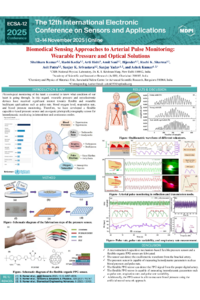
Physiological monitoring of the heart is essential to know what condition our heart is going through. In this regard, wearable pressure and optoelectronic devices have received significant interest towards flexible and wearable healthcare applications such as pulse rate, blood oxygen level, and blood pressure monitoring. Therefore, we have developed a flexible capacitive-based pressure sensor for hemodynamic monitoring through an oscillometric waveform. This pressure sensor shows the potential to replace the existing rigid pressure sensor used in automated blood pressure devices currently available in the market. Since oscillometric techniques are operated intermittently, the photoplethysmography technique has emerged for continuous signal monitoring. However, available devices currently utilize inorganic photodetectors, which have limitations, such as rigid and high-cost manufacturing. As an alternative, organic photodiodes (OPDs) can also compensate for traditional inorganic photodetectors and provide additional features such as flexibility, low-cost manufacturing, and large-area scalability. This work also presents the design, development, and characterization of flexible OPD and their application in physiological monitoring through a comfortable and non-invasive technique. The photoplethysmogram (PPG) is recorded from the index finger in the transmission as well as reflection mode using red (630 nm) and green (530 nm) light, respectively. The collected PPG signals are used to calculate the hemodynamic parameters. Ultimately, this work demonstrates a flexible pressure sensor and an organic photodetector for arterial pulse monitoring and hemodynamic monitoring.
Keywords
Organic
Pressure
Photodetector
Sensor
Photoplethysmography
Manuscript
ECSA_12.pdf
Poster
ECSA-12.pdf
Prototype of Lifting Posture Monitoring System for Preventing Low Back Pain
The Construction of 2D Pd/h-BNNSs/rGO Composite and Its Application in Ethanol Fuel Sensors