Event submissions
Published
This submission belongs to the session S6. Electronic Sensors, Devices, and Systems of the event The 12th International Electronic Conference on Sensors and Applications
Published date
07 Nov, 2025
Academic Editor
'%3e%3cpath%20d='M12.6657%2010.9104C12.4185%2010.325%2012.0599%209.79327%2011.6097%209.34482C11.1609%208.89508%2010.6293%208.5365%2010.0442%208.28888C10.0389%208.28626%2010.0337%208.28495%2010.0285%208.28233C10.8446%207.69279%2011.3752%206.73249%2011.3752%205.64904C11.3752%203.8542%209.92103%202.39999%208.1262%202.39999C6.33136%202.39999%204.87715%203.8542%204.87715%205.64904C4.87715%206.73249%205.40774%207.69279%206.22393%208.28364C6.21869%208.28626%206.21345%208.28757%206.20821%208.29019C5.62129%208.5378%205.09463%208.89284%204.64265%209.34613C4.1929%209.79493%203.83432%2010.3266%203.58671%2010.9117C3.34345%2011.4845%203.21226%2012.0987%203.20023%2012.7209C3.19988%2012.7349%203.20233%2012.7488%203.20744%2012.7619C3.21255%2012.7749%203.22022%2012.7867%203.22998%2012.7968C3.23975%2012.8068%203.25142%2012.8147%203.26431%2012.8202C3.2772%2012.8256%203.29105%2012.8284%203.30504%2012.8284H4.09109C4.14874%2012.8284%204.19459%2012.7825%204.1959%2012.7262C4.2221%2011.7148%204.62823%2010.7676%205.34617%2010.0497C6.08899%209.30683%207.0755%208.89808%208.1262%208.89808C9.17689%208.89808%2010.1634%209.30683%2010.9062%2010.0497C11.6242%2010.7676%2012.0303%2011.7148%2012.0565%2012.7262C12.0578%2012.7838%2012.1037%2012.8284%2012.1613%2012.8284H12.9474C12.9613%2012.8284%2012.9752%2012.8256%2012.9881%2012.8202C13.001%2012.8147%2013.0126%2012.8068%2013.0224%2012.7968C13.0322%2012.7867%2013.0398%2012.7749%2013.0449%2012.7619C13.0501%2012.7488%2013.0525%2012.7349%2013.0522%2012.7209C13.0391%2012.0947%2012.9094%2011.4855%2012.6657%2010.9104ZM8.1262%207.9024C7.52486%207.9024%206.9589%207.6679%206.53312%207.24211C6.10733%206.81633%205.87283%206.25037%205.87283%205.64904C5.87283%205.0477%206.10733%204.48174%206.53312%204.05596C6.9589%203.63018%207.52486%203.39567%208.1262%203.39567C8.72753%203.39567%209.29349%203.63018%209.71927%204.05596C10.1451%204.48174%2010.3796%205.0477%2010.3796%205.64904C10.3796%206.25037%2010.1451%206.81633%209.71927%207.24211C9.29349%207.6679%208.72753%207.9024%208.1262%207.9024Z'%20fill='%235D1EE1'/%3e%3c/g%3e%3c/svg%3e) Stefano Mariani
Stefano MarianiCitation
Dimitris Barmpakos, Apostolos Apostolakis, Vassiliki Belessi, Vasilios Georgakilas, Grigoris Kaltsas, Development of Paper-Based Thermal Devices Using Graphene and Carbon Black Composite Inks for Flexible Printed Electronics, in Proceedings of The 12th International Electronic Conference on Sensors and Applications, 12 November–14 November 2025, MDPI: Basel, Switzerland
Share
Email
Facebook
Twitter
LinkedIn
Development of Paper-Based Thermal Devices Using Graphene and Carbon Black Composite Inks for Flexible Printed Electronics

Dimitris Barmpakos 1

Apostolos Apostolakis 1

Vassiliki Belessi 2
'%3e%3cpath%20d='M12.6647%2010.9104C12.4176%2010.325%2012.0589%209.7933%2011.6088%209.34485C11.16%208.89511%2010.6283%208.53653%2010.0432%208.28891C10.038%208.28629%2010.0327%208.28498%2010.0275%208.28236C10.8437%207.69282%2011.3743%206.73252%2011.3743%205.64907C11.3743%203.85423%209.92005%202.40002%208.12522%202.40002C6.33038%202.40002%204.87618%203.85423%204.87618%205.64907C4.87618%206.73252%205.40677%207.69282%206.22296%208.28367C6.21772%208.28629%206.21248%208.2876%206.20724%208.29022C5.62031%208.53783%205.09365%208.89287%204.64167%209.34616C4.19192%209.79496%203.83334%2010.3266%203.58573%2010.9117C3.34247%2011.4846%203.21128%2012.0987%203.19925%2012.721C3.1989%2012.735%203.20135%2012.7489%203.20646%2012.7619C3.21157%2012.7749%203.21924%2012.7868%203.22901%2012.7968C3.23877%2012.8068%203.25045%2012.8148%203.26334%2012.8202C3.27623%2012.8256%203.29007%2012.8284%203.30406%2012.8284H4.09012C4.14776%2012.8284%204.19362%2012.7825%204.19493%2012.7262C4.22113%2011.7148%204.62726%2010.7676%205.34519%2010.0497C6.08802%209.30686%207.07452%208.89811%208.12522%208.89811C9.17592%208.89811%2010.1624%209.30686%2010.9052%2010.0497C11.6232%2010.7676%2012.0293%2011.7148%2012.0555%2012.7262C12.0568%2012.7839%2012.1027%2012.8284%2012.1603%2012.8284H12.9464C12.9604%2012.8284%2012.9742%2012.8256%2012.9871%2012.8202C13%2012.8148%2013.0117%2012.8068%2013.0214%2012.7968C13.0312%2012.7868%2013.0389%2012.7749%2013.044%2012.7619C13.0491%2012.7489%2013.0515%2012.735%2013.0512%2012.721C13.0381%2012.0947%2012.9084%2011.4856%2012.6647%2010.9104ZM8.12522%207.90243C7.52388%207.90243%206.95792%207.66793%206.53214%207.24215C6.10636%206.81636%205.87185%206.2504%205.87185%205.64907C5.87185%205.04773%206.10636%204.48177%206.53214%204.05599C6.95792%203.63021%207.52388%203.3957%208.12522%203.3957C8.72655%203.3957%209.29252%203.63021%209.7183%204.05599C10.1441%204.48177%2010.3786%205.04773%2010.3786%205.64907C10.3786%206.2504%2010.1441%206.81636%209.7183%207.24215C9.29252%207.66793%208.72655%207.90243%208.12522%207.90243Z'%20fill='%235D1EE1'/%3e%3c/g%3e%3c/svg%3e)
Vasilios Georgakilas 3

Grigoris Kaltsas 1
1. microSENSES Laboratory, Department of Electrical and Electronics Engineering, University of West Attica, Athens, Greece
2. Department of Graphic Design and Visual Communication, University of West Attica, Athens, Greece
3. Department of Materials Science, University of Patras, Rio, Greece
Abstract
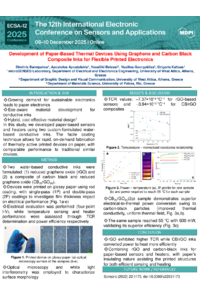
This study reports the development of two innovative paper-based thermal devices—temperature sensors and microheaters—fabricated using two custom-formulated, water-based conductive inks. The first ink consisted of reduced graphene oxide (rGO), while the second comprised a composite of carbon black (CB) and reduced graphene oxide (CB/rGO). Both inks were deposited onto glossy paper substrates via the rod coating technique, with variations in the number of coating passes (single and double) implemented to investigate the influence of film thickness on device performance. Electrical characterization revealed stable, ohmic behavior across all samples, with double-pass coatings exhibiting significantly lower sheet resistance, indicative of improved electrical conductivity. The temperature-sensing capabilities were evaluated through determination of the temperature coefficient of resistance (TCR), yielding values of –7.37×10⁻³ °C-1 for rGO-based sensors and –3.94×10⁻³ °C-1 for CB/rGO composites, both of which are consistent with theoretical predictions. The CB/rGO ink demonstrated enhanced performance as a printed microheater, exhibiting improved power efficiency and superior thermal uniformity. This enhancement is attributed to the incorporation of larger carbon black particles, which contribute to more effective thermal management and uniform heat distribution. These results underscore the potential of hybrid carbon-based inks for the fabrication of cost-effective, disposable, and environmentally sustainable thermal devices. The utilization of cellulose-based paper substrates in conjunction with graphene-derived functional materials presents a scalable, eco-friendly platform for the development of flexible, printed thermal electronics. The fabrication approach is compatible with large-area, low-cost production methods, thereby advancing the field of printed electronics with respect to performance, environmental compatibility, and manufacturability.
Keywords
Printed thermal devices
reduced graphene oxide–carbon black hybrid
paper-based heater
paper-based temperature sensor
Manuscript
abstract.pdf
Poster
ink-ECSA12.pdf
A Copper Ion Sensitive Hdrogel Photonic Crystal Fim
PVA/SA Hydrogel Photonic Crystals as Visual Sensors