Event submissions
Published
This submission belongs to the session S1. Chemo- and Biosensors of the event The 12th International Electronic Conference on Sensors and Applications
Published date
07 Nov, 2025
Academic Editor
'%3e%3cpath%20d='M12.6657%2010.9104C12.4185%2010.325%2012.0599%209.79327%2011.6097%209.34482C11.1609%208.89508%2010.6293%208.5365%2010.0442%208.28888C10.0389%208.28626%2010.0337%208.28495%2010.0285%208.28233C10.8446%207.69279%2011.3752%206.73249%2011.3752%205.64904C11.3752%203.8542%209.92103%202.39999%208.1262%202.39999C6.33136%202.39999%204.87715%203.8542%204.87715%205.64904C4.87715%206.73249%205.40774%207.69279%206.22393%208.28364C6.21869%208.28626%206.21345%208.28757%206.20821%208.29019C5.62129%208.5378%205.09463%208.89284%204.64265%209.34613C4.1929%209.79493%203.83432%2010.3266%203.58671%2010.9117C3.34345%2011.4845%203.21226%2012.0987%203.20023%2012.7209C3.19988%2012.7349%203.20233%2012.7488%203.20744%2012.7619C3.21255%2012.7749%203.22022%2012.7867%203.22998%2012.7968C3.23975%2012.8068%203.25142%2012.8147%203.26431%2012.8202C3.2772%2012.8256%203.29105%2012.8284%203.30504%2012.8284H4.09109C4.14874%2012.8284%204.19459%2012.7825%204.1959%2012.7262C4.2221%2011.7148%204.62823%2010.7676%205.34617%2010.0497C6.08899%209.30683%207.0755%208.89808%208.1262%208.89808C9.17689%208.89808%2010.1634%209.30683%2010.9062%2010.0497C11.6242%2010.7676%2012.0303%2011.7148%2012.0565%2012.7262C12.0578%2012.7838%2012.1037%2012.8284%2012.1613%2012.8284H12.9474C12.9613%2012.8284%2012.9752%2012.8256%2012.9881%2012.8202C13.001%2012.8147%2013.0126%2012.8068%2013.0224%2012.7968C13.0322%2012.7867%2013.0398%2012.7749%2013.0449%2012.7619C13.0501%2012.7488%2013.0525%2012.7349%2013.0522%2012.7209C13.0391%2012.0947%2012.9094%2011.4855%2012.6657%2010.9104ZM8.1262%207.9024C7.52486%207.9024%206.9589%207.6679%206.53312%207.24211C6.10733%206.81633%205.87283%206.25037%205.87283%205.64904C5.87283%205.0477%206.10733%204.48174%206.53312%204.05596C6.9589%203.63018%207.52486%203.39567%208.1262%203.39567C8.72753%203.39567%209.29349%203.63018%209.71927%204.05596C10.1451%204.48174%2010.3796%205.0477%2010.3796%205.64904C10.3796%206.25037%2010.1451%206.81633%209.71927%207.24211C9.29349%207.6679%208.72753%207.9024%208.1262%207.9024Z'%20fill='%235D1EE1'/%3e%3c/g%3e%3c/svg%3e) Stefano Mariani
Stefano MarianiCitation
Sergey Buzovkin, Arina Rybina, Cong Doan Bui, Svetlana Nalimova, Impedance-based analysis of gas sensing using MoS2 nanostructures, in Proceedings of The 12th International Electronic Conference on Sensors and Applications, 12 November–14 November 2025, MDPI: Basel, Switzerland
Share
Email
Facebook
Twitter
LinkedIn
Impedance-based analysis of gas sensing using MoS2 nanostructures
'%3e%3cpath%20d='M12.6647%2010.9104C12.4176%2010.325%2012.0589%209.7933%2011.6088%209.34485C11.16%208.89511%2010.6283%208.53653%2010.0432%208.28891C10.038%208.28629%2010.0327%208.28498%2010.0275%208.28236C10.8437%207.69282%2011.3743%206.73252%2011.3743%205.64907C11.3743%203.85423%209.92005%202.40002%208.12522%202.40002C6.33038%202.40002%204.87618%203.85423%204.87618%205.64907C4.87618%206.73252%205.40677%207.69282%206.22296%208.28367C6.21772%208.28629%206.21248%208.2876%206.20724%208.29022C5.62031%208.53783%205.09365%208.89287%204.64167%209.34616C4.19192%209.79496%203.83334%2010.3266%203.58573%2010.9117C3.34247%2011.4846%203.21128%2012.0987%203.19925%2012.721C3.1989%2012.735%203.20135%2012.7489%203.20646%2012.7619C3.21157%2012.7749%203.21924%2012.7868%203.22901%2012.7968C3.23877%2012.8068%203.25045%2012.8148%203.26334%2012.8202C3.27623%2012.8256%203.29007%2012.8284%203.30406%2012.8284H4.09012C4.14776%2012.8284%204.19362%2012.7825%204.19493%2012.7262C4.22113%2011.7148%204.62726%2010.7676%205.34519%2010.0497C6.08802%209.30686%207.07452%208.89811%208.12522%208.89811C9.17592%208.89811%2010.1624%209.30686%2010.9052%2010.0497C11.6232%2010.7676%2012.0293%2011.7148%2012.0555%2012.7262C12.0568%2012.7839%2012.1027%2012.8284%2012.1603%2012.8284H12.9464C12.9604%2012.8284%2012.9742%2012.8256%2012.9871%2012.8202C13%2012.8148%2013.0117%2012.8068%2013.0214%2012.7968C13.0312%2012.7868%2013.0389%2012.7749%2013.044%2012.7619C13.0491%2012.7489%2013.0515%2012.735%2013.0512%2012.721C13.0381%2012.0947%2012.9084%2011.4856%2012.6647%2010.9104ZM8.12522%207.90243C7.52388%207.90243%206.95792%207.66793%206.53214%207.24215C6.10636%206.81636%205.87185%206.2504%205.87185%205.64907C5.87185%205.04773%206.10636%204.48177%206.53214%204.05599C6.95792%203.63021%207.52388%203.3957%208.12522%203.3957C8.72655%203.3957%209.29252%203.63021%209.7183%204.05599C10.1441%204.48177%2010.3786%205.04773%2010.3786%205.64907C10.3786%206.2504%2010.1441%206.81636%209.7183%207.24215C9.29252%207.66793%208.72655%207.90243%208.12522%207.90243Z'%20fill='%235D1EE1'/%3e%3c/g%3e%3c/svg%3e)
Sergey Buzovkin 1
Arina Rybina 1
Cong Doan Bui 1
Svetlana Nalimova 1
1. Saint Petersburg Electrotechnical University, St. Petersburg, Russia
Abstract
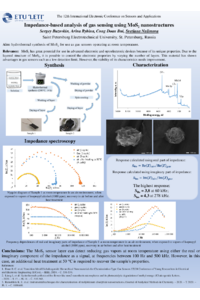
2D molybdenum disulfide has great potential for use in advanced electronic and optoelectronic devices because of its unique properties. Due to the layered structure of MoS2, it is possible to control the electronic properties by varying the number of layers. This material has shown advantages in gas sensors such as a low detection limit. However, the stability of its characteristics needs improvement. One common method for creating 2D structures is mechanical exfoliation, which has low reproducibility. A different method used in this study is hydrothermal synthesis.
Sodium molybdate dihydrate, oxalic acid dihydrate and thiourea were used as precursors. The precursors were dissolved in distilled water and placed in an autoclave for 14 hours at 200°C. Chemical exfoliation of the produced particles was performed using zinc nitrate hexahydrate and hydrochloric acid. The nanoparticles were analyzed using scanning electron microscopy and X-ray photoelectron spectroscopy. The resulting powders were deposited onto sensor platform by spin-coating.
The gas-sensitive properties were studied using impedance spectroscopy. Sensitivity to isopropyl alcohol vapors was studied at room temperature, at different gas concentrations. The value of the sensor response was calculated using the formula for the real and imaginary components separately. It was found that, when 500 ppm of isopropyl alcohol vapor was applied, the maximum response in the real component was 2.6. With an increase in frequency above 4 kHz a decrease in sensitivity was observed. For the imaginary component, the maximum value was 5.3. A decrease in sensitivity is observed after 9kHz. The same parameters were measured at concentrations of 1000 ppm and 2000 ppm.
Thus, MoS2 flower-like nanoparticles were synthesized using the hydrothermal method. By impedance spectroscopy, it was shown that the produced sensor layers can detect volatile organic compounds in air at room temperature.
Keywords
MoS2
gas sensor
impedance spectroscopy
hydrothermal synthesis
Manuscript
Nalimova_et_al_ECSA_12_2025.pdf
Poster
Nalimova_et_al_ECSA_12_2025.pdf
PVA/SA Hydrogel Photonic Crystals as Visual Sensors
Impact of Position Sensor Faults on the Control Performance of PMSM Drives