Event submissions
Published
This submission belongs to the session 1. Fermentation and micro-organism/biotechnology of the event The 1st International Online Conference on Fermentation
Published date
07 Nov, 2025
Academic Editor
'%3e%3cpath%20d='M12.6657%2010.9104C12.4185%2010.325%2012.0599%209.79327%2011.6097%209.34482C11.1609%208.89508%2010.6293%208.5365%2010.0442%208.28888C10.0389%208.28626%2010.0337%208.28495%2010.0285%208.28233C10.8446%207.69279%2011.3752%206.73249%2011.3752%205.64904C11.3752%203.8542%209.92103%202.39999%208.1262%202.39999C6.33136%202.39999%204.87715%203.8542%204.87715%205.64904C4.87715%206.73249%205.40774%207.69279%206.22393%208.28364C6.21869%208.28626%206.21345%208.28757%206.20821%208.29019C5.62129%208.5378%205.09463%208.89284%204.64265%209.34613C4.1929%209.79493%203.83432%2010.3266%203.58671%2010.9117C3.34345%2011.4845%203.21226%2012.0987%203.20023%2012.7209C3.19988%2012.7349%203.20233%2012.7488%203.20744%2012.7619C3.21255%2012.7749%203.22022%2012.7867%203.22998%2012.7968C3.23975%2012.8068%203.25142%2012.8147%203.26431%2012.8202C3.2772%2012.8256%203.29105%2012.8284%203.30504%2012.8284H4.09109C4.14874%2012.8284%204.19459%2012.7825%204.1959%2012.7262C4.2221%2011.7148%204.62823%2010.7676%205.34617%2010.0497C6.08899%209.30683%207.0755%208.89808%208.1262%208.89808C9.17689%208.89808%2010.1634%209.30683%2010.9062%2010.0497C11.6242%2010.7676%2012.0303%2011.7148%2012.0565%2012.7262C12.0578%2012.7838%2012.1037%2012.8284%2012.1613%2012.8284H12.9474C12.9613%2012.8284%2012.9752%2012.8256%2012.9881%2012.8202C13.001%2012.8147%2013.0126%2012.8068%2013.0224%2012.7968C13.0322%2012.7867%2013.0398%2012.7749%2013.0449%2012.7619C13.0501%2012.7488%2013.0525%2012.7349%2013.0522%2012.7209C13.0391%2012.0947%2012.9094%2011.4855%2012.6657%2010.9104ZM8.1262%207.9024C7.52486%207.9024%206.9589%207.6679%206.53312%207.24211C6.10733%206.81633%205.87283%206.25037%205.87283%205.64904C5.87283%205.0477%206.10733%204.48174%206.53312%204.05596C6.9589%203.63018%207.52486%203.39567%208.1262%203.39567C8.72753%203.39567%209.29349%203.63018%209.71927%204.05596C10.1451%204.48174%2010.3796%205.0477%2010.3796%205.64904C10.3796%206.25037%2010.1451%206.81633%209.71927%207.24211C9.29349%207.6679%208.72753%207.9024%208.1262%207.9024Z'%20fill='%235D1EE1'/%3e%3c/g%3e%3c/svg%3e) Paola Domizio
Paola DomizioCitation
Oleg Frumuzachi, Alexandru Nicolescu, Gheorghe Adrian Martău, Răzvan Odocheanu, Floricuța Ranga, Andrei Mocan, Dan Cristian Cristian Vodnar, Solid-State Fermentation of Corn Silk by Aspergillus niger Improves Phenolic Profile and Antioxidant Capacity, in Proceedings of The 1st International Online Conference on Fermentation, 12 November–13 November 2025, MDPI: Basel, Switzerland
Share
Email
Facebook
Twitter
LinkedIn
Solid-State Fermentation of Corn Silk by Aspergillus niger Improves Phenolic Profile and Antioxidant Capacity
'%3e%3cpath%20d='M12.6647%2010.9104C12.4176%2010.325%2012.0589%209.7933%2011.6088%209.34485C11.16%208.89511%2010.6283%208.53653%2010.0432%208.28891C10.038%208.28629%2010.0327%208.28498%2010.0275%208.28236C10.8437%207.69282%2011.3743%206.73252%2011.3743%205.64907C11.3743%203.85423%209.92005%202.40002%208.12522%202.40002C6.33038%202.40002%204.87618%203.85423%204.87618%205.64907C4.87618%206.73252%205.40677%207.69282%206.22296%208.28367C6.21772%208.28629%206.21248%208.2876%206.20724%208.29022C5.62031%208.53783%205.09365%208.89287%204.64167%209.34616C4.19192%209.79496%203.83334%2010.3266%203.58573%2010.9117C3.34247%2011.4846%203.21128%2012.0987%203.19925%2012.721C3.1989%2012.735%203.20135%2012.7489%203.20646%2012.7619C3.21157%2012.7749%203.21924%2012.7868%203.22901%2012.7968C3.23877%2012.8068%203.25045%2012.8148%203.26334%2012.8202C3.27623%2012.8256%203.29007%2012.8284%203.30406%2012.8284H4.09012C4.14776%2012.8284%204.19362%2012.7825%204.19493%2012.7262C4.22113%2011.7148%204.62726%2010.7676%205.34519%2010.0497C6.08802%209.30686%207.07452%208.89811%208.12522%208.89811C9.17592%208.89811%2010.1624%209.30686%2010.9052%2010.0497C11.6232%2010.7676%2012.0293%2011.7148%2012.0555%2012.7262C12.0568%2012.7839%2012.1027%2012.8284%2012.1603%2012.8284H12.9464C12.9604%2012.8284%2012.9742%2012.8256%2012.9871%2012.8202C13%2012.8148%2013.0117%2012.8068%2013.0214%2012.7968C13.0312%2012.7868%2013.0389%2012.7749%2013.044%2012.7619C13.0491%2012.7489%2013.0515%2012.735%2013.0512%2012.721C13.0381%2012.0947%2012.9084%2011.4856%2012.6647%2010.9104ZM8.12522%207.90243C7.52388%207.90243%206.95792%207.66793%206.53214%207.24215C6.10636%206.81636%205.87185%206.2504%205.87185%205.64907C5.87185%205.04773%206.10636%204.48177%206.53214%204.05599C6.95792%203.63021%207.52388%203.3957%208.12522%203.3957C8.72655%203.3957%209.29252%203.63021%209.7183%204.05599C10.1441%204.48177%2010.3786%205.04773%2010.3786%205.64907C10.3786%206.2504%2010.1441%206.81636%209.7183%207.24215C9.29252%207.66793%208.72655%207.90243%208.12522%207.90243Z'%20fill='%235D1EE1'/%3e%3c/g%3e%3c/svg%3e)
Oleg Frumuzachi 1

Alexandru Nicolescu 2

Gheorghe Adrian Martău 3,4
Răzvan Odocheanu 3,4
Floricuța Ranga 3

Andrei Mocan 1

Dan Cristian Cristian Vodnar 3,4
1. Department of Pharmaceutical Botany, “Iuliu Hațieganu” University of Medicine and Pharmacy, Gheorghe Marinescu Street 23, 400337, Cluj-Napoca, Romania
2. Laboratory of Chromatography, Institute of Advanced Horticulture Research of Transylvania, University of Agricultural Sciences and Veterinary Medicine, Calea Mănăştur 3-5, 400372, Cluj-Napoca, Romania
3. Institute of Life Sciences, University of Agricultural Sciences and Veterinary Medicine, Calea Mănăştur 3-5, 400372 Cluj-Napoca, Romania
4. Faculty of Food Science and Technology, University of Agricultural Sciences and Veterinary Medicine, Calea Mănăştur 3-5, 400372 Cluj-Napoca, Romania
Abstract
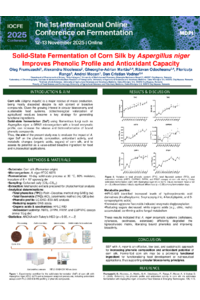
Corn silk (CS), a residue of maize cultivation, represents an underutilized source of bioactive compounds, particularly phenolics. In this context, the present study investigated the effect of solid-state fermentation (SsF) using Aspergillus niger ATCC-6275 on increasing the phenolic profile and antioxidant activity of CS over a 10-day period. Total phenolic and flavonoid contents increased by approximately 73% and 37%, respectively. HPLC-DAD-ESI-MS analysis revealed substantial enrichment of hydroxycinnamic acids, particularly 4-caffeoylquinic (20-fold), 5-synapoylquinic (9-fold), and 4-feruloylquinic (5-fold) acids, suggesting enzymatic release of bound phenolic compounds. Enzymatic hydrolysis of flavonoid glycosides resulted in aglycone accumulation, such as methoxyluteolin and luteolin. The antioxidant activity of fermented CS significantly improved, with DPPH, ABTS, and FRAP assays indicating increases of 23%, 50%, and 44%, respectively. These biochemical transformations occurred alongside organic acid production and sugar depletion, confirming active fungal metabolism. Overall, this work supports SsF as an eco-friendly strategy for converting corn silk into a high-value functional ingredient for food, pharmaceutical, or nutraceutical applications.
Keywords
Aspergillus niger
solid-state fermentation
corn silk
phenolic compounds
antioxidant activity.
Poster
Poster_Oleg Frumuzachi.pdf
Turning Stress Into Color: Enhancing Pyocyanin Yield via Solvent-Induced Responses in Pseudomonas aeruginosa
Yeast diversity during spontaneous fermentation of Tostado wine