Event submissions
Published
This submission belongs to the session 1. Fermentation and micro-organism/biotechnology of the event The 1st International Online Conference on Fermentation
Published date
07 Nov, 2025
Academic Editor
'%3e%3cpath%20d='M12.6657%2010.9104C12.4185%2010.325%2012.0599%209.79327%2011.6097%209.34482C11.1609%208.89508%2010.6293%208.5365%2010.0442%208.28888C10.0389%208.28626%2010.0337%208.28495%2010.0285%208.28233C10.8446%207.69279%2011.3752%206.73249%2011.3752%205.64904C11.3752%203.8542%209.92103%202.39999%208.1262%202.39999C6.33136%202.39999%204.87715%203.8542%204.87715%205.64904C4.87715%206.73249%205.40774%207.69279%206.22393%208.28364C6.21869%208.28626%206.21345%208.28757%206.20821%208.29019C5.62129%208.5378%205.09463%208.89284%204.64265%209.34613C4.1929%209.79493%203.83432%2010.3266%203.58671%2010.9117C3.34345%2011.4845%203.21226%2012.0987%203.20023%2012.7209C3.19988%2012.7349%203.20233%2012.7488%203.20744%2012.7619C3.21255%2012.7749%203.22022%2012.7867%203.22998%2012.7968C3.23975%2012.8068%203.25142%2012.8147%203.26431%2012.8202C3.2772%2012.8256%203.29105%2012.8284%203.30504%2012.8284H4.09109C4.14874%2012.8284%204.19459%2012.7825%204.1959%2012.7262C4.2221%2011.7148%204.62823%2010.7676%205.34617%2010.0497C6.08899%209.30683%207.0755%208.89808%208.1262%208.89808C9.17689%208.89808%2010.1634%209.30683%2010.9062%2010.0497C11.6242%2010.7676%2012.0303%2011.7148%2012.0565%2012.7262C12.0578%2012.7838%2012.1037%2012.8284%2012.1613%2012.8284H12.9474C12.9613%2012.8284%2012.9752%2012.8256%2012.9881%2012.8202C13.001%2012.8147%2013.0126%2012.8068%2013.0224%2012.7968C13.0322%2012.7867%2013.0398%2012.7749%2013.0449%2012.7619C13.0501%2012.7488%2013.0525%2012.7349%2013.0522%2012.7209C13.0391%2012.0947%2012.9094%2011.4855%2012.6657%2010.9104ZM8.1262%207.9024C7.52486%207.9024%206.9589%207.6679%206.53312%207.24211C6.10733%206.81633%205.87283%206.25037%205.87283%205.64904C5.87283%205.0477%206.10733%204.48174%206.53312%204.05596C6.9589%203.63018%207.52486%203.39567%208.1262%203.39567C8.72753%203.39567%209.29349%203.63018%209.71927%204.05596C10.1451%204.48174%2010.3796%205.0477%2010.3796%205.64904C10.3796%206.25037%2010.1451%206.81633%209.71927%207.24211C9.29349%207.6679%208.72753%207.9024%208.1262%207.9024Z'%20fill='%235D1EE1'/%3e%3c/g%3e%3c/svg%3e) Paola Domizio
Paola DomizioCitation
Jose Luis Padilla Agudelo, María Hernández-Fernández, María Paz Villanueva-Llanes, Jesús Manuel Cantoral, Gianluigi Cardinali, Ileana Vigentini, Gustavo Cordero-Bueso, Comparative Methodology for Assessing Natural Antifungal Metabolites Compared to Synthetic Compounds in Grapevine, in Proceedings of The 1st International Online Conference on Fermentation, 12 November–13 November 2025, MDPI: Basel, Switzerland
Share
Email
Facebook
Twitter
LinkedIn
Comparative Methodology for Assessing Natural Antifungal Metabolites Compared to Synthetic Compounds in Grapevine
'%3e%3cpath%20d='M12.6647%2010.9104C12.4176%2010.325%2012.0589%209.7933%2011.6088%209.34485C11.16%208.89511%2010.6283%208.53653%2010.0432%208.28891C10.038%208.28629%2010.0327%208.28498%2010.0275%208.28236C10.8437%207.69282%2011.3743%206.73252%2011.3743%205.64907C11.3743%203.85423%209.92005%202.40002%208.12522%202.40002C6.33038%202.40002%204.87618%203.85423%204.87618%205.64907C4.87618%206.73252%205.40677%207.69282%206.22296%208.28367C6.21772%208.28629%206.21248%208.2876%206.20724%208.29022C5.62031%208.53783%205.09365%208.89287%204.64167%209.34616C4.19192%209.79496%203.83334%2010.3266%203.58573%2010.9117C3.34247%2011.4846%203.21128%2012.0987%203.19925%2012.721C3.1989%2012.735%203.20135%2012.7489%203.20646%2012.7619C3.21157%2012.7749%203.21924%2012.7868%203.22901%2012.7968C3.23877%2012.8068%203.25045%2012.8148%203.26334%2012.8202C3.27623%2012.8256%203.29007%2012.8284%203.30406%2012.8284H4.09012C4.14776%2012.8284%204.19362%2012.7825%204.19493%2012.7262C4.22113%2011.7148%204.62726%2010.7676%205.34519%2010.0497C6.08802%209.30686%207.07452%208.89811%208.12522%208.89811C9.17592%208.89811%2010.1624%209.30686%2010.9052%2010.0497C11.6232%2010.7676%2012.0293%2011.7148%2012.0555%2012.7262C12.0568%2012.7839%2012.1027%2012.8284%2012.1603%2012.8284H12.9464C12.9604%2012.8284%2012.9742%2012.8256%2012.9871%2012.8202C13%2012.8148%2013.0117%2012.8068%2013.0214%2012.7968C13.0312%2012.7868%2013.0389%2012.7749%2013.044%2012.7619C13.0491%2012.7489%2013.0515%2012.735%2013.0512%2012.721C13.0381%2012.0947%2012.9084%2011.4856%2012.6647%2010.9104ZM8.12522%207.90243C7.52388%207.90243%206.95792%207.66793%206.53214%207.24215C6.10636%206.81636%205.87185%206.2504%205.87185%205.64907C5.87185%205.04773%206.10636%204.48177%206.53214%204.05599C6.95792%203.63021%207.52388%203.3957%208.12522%203.3957C8.72655%203.3957%209.29252%203.63021%209.7183%204.05599C10.1441%204.48177%2010.3786%205.04773%2010.3786%205.64907C10.3786%206.2504%2010.1441%206.81636%209.7183%207.24215C9.29252%207.66793%208.72655%207.90243%208.12522%207.90243Z'%20fill='%235D1EE1'/%3e%3c/g%3e%3c/svg%3e)
Jose Luis Padilla Agudelo 1
María Hernández-Fernández 1
María Paz Villanueva-Llanes 1
Jesús Manuel Cantoral 1

Gianluigi Cardinali 2

Ileana Vigentini 3
Gustavo Cordero-Bueso 1
1. Department of Biomedicine, Biotechnology and Health public. University of Cádiz, Microbiology Laboratory. Av. De la Republica Saharaui s/n 11510 Puerto real, Cádiz. Spain
2. Agricultural, food and environmental microbiology. University of Perugia, Piazza dell'Università, 1, 06123 Perugia PG, Italy.
3. Department of Biomedical, Surgical and Dental Sciences-One Health Unit. Vía Vanvitelli, 32 20129 Milan, Italy.
Abstract
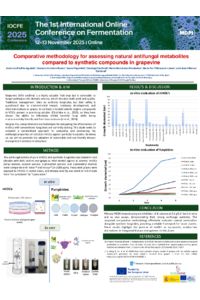
Grapevine (Vitis vinifera) is one of the most economically important fruit crops worldwide, but its high susceptibility to fungal diseases threatens yield and quality. Traditionally, disease management relies heavily on synthetic fungicides. Management typically depends on synthetic fungicides, which, although effective, raise concerns about environmental contamination, pathogen resistance, and chemical residues in grapes. In this context, natural antifungal compounds from native biocontrol agents represent a promising alternative. Notably, microbial volatile organic compounds (mVOCs) have attracted interest due totheir ability to suppress phytopathogenic fungi without harmful residues. However, methodologies directly comparing the efficacy of these natural metabolites with conventional fungicides remain scarce.
This study establishes a comparative methodology to evaluate the antifungal potential of mVOCs versus synthetic fungicides. mVOCs previously identified via GC-MS include ethyl acetate, isoamyl acetate, 2-phenethyl acetate (PEA), and 2-phenethyl alcohol (PEOH). These compounds were tested using double-petri dish assays and ex vivo grape models. Antifungal activity against Botrytis cinerea was assessed through disease severity scales. Preliminary findings show that 0.5 g/L concentrations of PEA and PEOH achieved complete fungal inhibition in both assays. This work provides a structured approach to evaluating mVOCs, contributing valuable insights into integrated disease management and the advancement of eco-friendly strategies in viticulture.
Keywords
Antifungal activity
mVOCs
Bicontrol
Viticulture sustainability.
Poster
Template_Congress_Jose_Padilla.pdf
Yeast diversity during spontaneous fermentation of Tostado wine
Impact of Climatic Conditions on the Growth and Population Dynamics of Flor Yeasts in Biologically Aged Sherry Wines