Event submissions
Published

This submission belongs to the session b. Information Theory of the event 1st International Electronic Conference on Entropy and Its Applications
Published date
05 Nov, 2014
Citation
Russell Kim Standish, Mechanical Generation of Networks with Surplus Complexity, in Proceedings of 1st International Electronic Conference on Entropy and Its Applications, 3 November–21 November 2014, MDPI: Basel, Switzerland, doi: 10.3390/ecea-1-b006
Share
Email
Facebook
Twitter
LinkedIn
Mechanical Generation of Networks with Surplus Complexity
'%3e%3cpath%20d='M12.6647%2010.9104C12.4176%2010.325%2012.0589%209.7933%2011.6088%209.34485C11.16%208.89511%2010.6283%208.53653%2010.0432%208.28891C10.038%208.28629%2010.0327%208.28498%2010.0275%208.28236C10.8437%207.69282%2011.3743%206.73252%2011.3743%205.64907C11.3743%203.85423%209.92005%202.40002%208.12522%202.40002C6.33038%202.40002%204.87618%203.85423%204.87618%205.64907C4.87618%206.73252%205.40677%207.69282%206.22296%208.28367C6.21772%208.28629%206.21248%208.2876%206.20724%208.29022C5.62031%208.53783%205.09365%208.89287%204.64167%209.34616C4.19192%209.79496%203.83334%2010.3266%203.58573%2010.9117C3.34247%2011.4846%203.21128%2012.0987%203.19925%2012.721C3.1989%2012.735%203.20135%2012.7489%203.20646%2012.7619C3.21157%2012.7749%203.21924%2012.7868%203.22901%2012.7968C3.23877%2012.8068%203.25045%2012.8148%203.26334%2012.8202C3.27623%2012.8256%203.29007%2012.8284%203.30406%2012.8284H4.09012C4.14776%2012.8284%204.19362%2012.7825%204.19493%2012.7262C4.22113%2011.7148%204.62726%2010.7676%205.34519%2010.0497C6.08802%209.30686%207.07452%208.89811%208.12522%208.89811C9.17592%208.89811%2010.1624%209.30686%2010.9052%2010.0497C11.6232%2010.7676%2012.0293%2011.7148%2012.0555%2012.7262C12.0568%2012.7839%2012.1027%2012.8284%2012.1603%2012.8284H12.9464C12.9604%2012.8284%2012.9742%2012.8256%2012.9871%2012.8202C13%2012.8148%2013.0117%2012.8068%2013.0214%2012.7968C13.0312%2012.7868%2013.0389%2012.7749%2013.044%2012.7619C13.0491%2012.7489%2013.0515%2012.735%2013.0512%2012.721C13.0381%2012.0947%2012.9084%2011.4856%2012.6647%2010.9104ZM8.12522%207.90243C7.52388%207.90243%206.95792%207.66793%206.53214%207.24215C6.10636%206.81636%205.87185%206.2504%205.87185%205.64907C5.87185%205.04773%206.10636%204.48177%206.53214%204.05599C6.95792%203.63021%207.52388%203.3957%208.12522%203.3957C8.72655%203.3957%209.29252%203.63021%209.7183%204.05599C10.1441%204.48177%2010.3786%205.04773%2010.3786%205.64907C10.3786%206.2504%2010.1441%206.81636%209.7183%207.24215C9.29252%207.66793%208.72655%207.90243%208.12522%207.90243Z'%20fill='%235D1EE1'/%3e%3c/g%3e%3c/svg%3e)
Russell Kim Standish 1
1. Mathematics and Statistics, University of New South Wales
Abstract
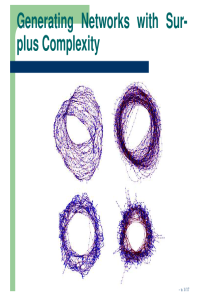
In previous work I examined an information based complexity measureof networks with weighted links. The measure was compared with thatobtained from by randomly shuffling the original network, forming anErd\"os-R\'enyi random network preserving the original link weightdistribution. It was found that real world networks almost invariablyhad higher complexity than their shuffled counterparts, whereasnetworks mechanically generated via preferential attachment didnot. The same experiment was performed on foodwebs generated by anartificial life system, Tierra, and a couple of evolutionary ecologysystems, \EcoLab{} and WebWorld. These latter systems often exhibitedthe same complexity excess shown by real world networks, suggestingthat the {\em complexity surplus} indicates the presence ofevolutionary dynamics.In this paper, I report on a mechanical network generation systemthat does produce this complexity surplus. The heart of the idea isconstruct the network of state transitions of a chaotic dynamicalsystem, such as the Lorenz equation. This indicates that complexitysurplus is a more fundamental trait than that of being an evolutionary system.
Keywords
Complexity
graph entropy
networks
dynamical systems
chaos
cellular automata
Manuscript
ECEA-1_Mechanical Generation of Networks_Standish.pdf
Poster
ECEA-1_Mechanical Generation_Presenation_Standish.pdf
Size Distribution of Portuguese Firms between 2006 and 2012
A Quantitative Theory of Cognition with Applications