Event submissions
Published

This submission belongs to the session S9. Student Session of the event The 12th International Electronic Conference on Sensors and Applications
Published date
07 Nov, 2025
Academic Editor
'%3e%3cpath%20d='M12.6657%2010.9104C12.4185%2010.325%2012.0599%209.79327%2011.6097%209.34482C11.1609%208.89508%2010.6293%208.5365%2010.0442%208.28888C10.0389%208.28626%2010.0337%208.28495%2010.0285%208.28233C10.8446%207.69279%2011.3752%206.73249%2011.3752%205.64904C11.3752%203.8542%209.92103%202.39999%208.1262%202.39999C6.33136%202.39999%204.87715%203.8542%204.87715%205.64904C4.87715%206.73249%205.40774%207.69279%206.22393%208.28364C6.21869%208.28626%206.21345%208.28757%206.20821%208.29019C5.62129%208.5378%205.09463%208.89284%204.64265%209.34613C4.1929%209.79493%203.83432%2010.3266%203.58671%2010.9117C3.34345%2011.4845%203.21226%2012.0987%203.20023%2012.7209C3.19988%2012.7349%203.20233%2012.7488%203.20744%2012.7619C3.21255%2012.7749%203.22022%2012.7867%203.22998%2012.7968C3.23975%2012.8068%203.25142%2012.8147%203.26431%2012.8202C3.2772%2012.8256%203.29105%2012.8284%203.30504%2012.8284H4.09109C4.14874%2012.8284%204.19459%2012.7825%204.1959%2012.7262C4.2221%2011.7148%204.62823%2010.7676%205.34617%2010.0497C6.08899%209.30683%207.0755%208.89808%208.1262%208.89808C9.17689%208.89808%2010.1634%209.30683%2010.9062%2010.0497C11.6242%2010.7676%2012.0303%2011.7148%2012.0565%2012.7262C12.0578%2012.7838%2012.1037%2012.8284%2012.1613%2012.8284H12.9474C12.9613%2012.8284%2012.9752%2012.8256%2012.9881%2012.8202C13.001%2012.8147%2013.0126%2012.8068%2013.0224%2012.7968C13.0322%2012.7867%2013.0398%2012.7749%2013.0449%2012.7619C13.0501%2012.7488%2013.0525%2012.7349%2013.0522%2012.7209C13.0391%2012.0947%2012.9094%2011.4855%2012.6657%2010.9104ZM8.1262%207.9024C7.52486%207.9024%206.9589%207.6679%206.53312%207.24211C6.10733%206.81633%205.87283%206.25037%205.87283%205.64904C5.87283%205.0477%206.10733%204.48174%206.53312%204.05596C6.9589%203.63018%207.52486%203.39567%208.1262%203.39567C8.72753%203.39567%209.29349%203.63018%209.71927%204.05596C10.1451%204.48174%2010.3796%205.0477%2010.3796%205.64904C10.3796%206.25037%2010.1451%206.81633%209.71927%207.24211C9.29349%207.6679%208.72753%207.9024%208.1262%207.9024Z'%20fill='%235D1EE1'/%3e%3c/g%3e%3c/svg%3e) Stefano Mariani
Stefano MarianiCitation
Bardia Baraeinejad, Maryam Forouzesh, Saba Babaei, Yasin Naghshbandi, Yasaman Torabi, Shabnam Fazliani, Design and Implementation of an IoT-Based Respiratory Motion Sensor, in Proceedings of The 12th International Electronic Conference on Sensors and Applications, 12 November–14 November 2025, MDPI: Basel, Switzerland, doi: 10.3390/ECSA-12-26582
Share
Email
Facebook
Twitter
LinkedIn
Design and Implementation of an IoT-Based Respiratory Motion Sensor
'%3e%3cpath%20d='M12.6647%2010.9104C12.4176%2010.325%2012.0589%209.7933%2011.6088%209.34485C11.16%208.89511%2010.6283%208.53653%2010.0432%208.28891C10.038%208.28629%2010.0327%208.28498%2010.0275%208.28236C10.8437%207.69282%2011.3743%206.73252%2011.3743%205.64907C11.3743%203.85423%209.92005%202.40002%208.12522%202.40002C6.33038%202.40002%204.87618%203.85423%204.87618%205.64907C4.87618%206.73252%205.40677%207.69282%206.22296%208.28367C6.21772%208.28629%206.21248%208.2876%206.20724%208.29022C5.62031%208.53783%205.09365%208.89287%204.64167%209.34616C4.19192%209.79496%203.83334%2010.3266%203.58573%2010.9117C3.34247%2011.4846%203.21128%2012.0987%203.19925%2012.721C3.1989%2012.735%203.20135%2012.7489%203.20646%2012.7619C3.21157%2012.7749%203.21924%2012.7868%203.22901%2012.7968C3.23877%2012.8068%203.25045%2012.8148%203.26334%2012.8202C3.27623%2012.8256%203.29007%2012.8284%203.30406%2012.8284H4.09012C4.14776%2012.8284%204.19362%2012.7825%204.19493%2012.7262C4.22113%2011.7148%204.62726%2010.7676%205.34519%2010.0497C6.08802%209.30686%207.07452%208.89811%208.12522%208.89811C9.17592%208.89811%2010.1624%209.30686%2010.9052%2010.0497C11.6232%2010.7676%2012.0293%2011.7148%2012.0555%2012.7262C12.0568%2012.7839%2012.1027%2012.8284%2012.1603%2012.8284H12.9464C12.9604%2012.8284%2012.9742%2012.8256%2012.9871%2012.8202C13%2012.8148%2013.0117%2012.8068%2013.0214%2012.7968C13.0312%2012.7868%2013.0389%2012.7749%2013.044%2012.7619C13.0491%2012.7489%2013.0515%2012.735%2013.0512%2012.721C13.0381%2012.0947%2012.9084%2011.4856%2012.6647%2010.9104ZM8.12522%207.90243C7.52388%207.90243%206.95792%207.66793%206.53214%207.24215C6.10636%206.81636%205.87185%206.2504%205.87185%205.64907C5.87185%205.04773%206.10636%204.48177%206.53214%204.05599C6.95792%203.63021%207.52388%203.3957%208.12522%203.3957C8.72655%203.3957%209.29252%203.63021%209.7183%204.05599C10.1441%204.48177%2010.3786%205.04773%2010.3786%205.64907C10.3786%206.2504%2010.1441%206.81636%209.7183%207.24215C9.29252%207.66793%208.72655%207.90243%208.12522%207.90243Z'%20fill='%235D1EE1'/%3e%3c/g%3e%3c/svg%3e)
Bardia Baraeinejad 1
Maryam Forouzesh 2
Saba Babaei 1
Yasin Naghshbandi 3

Yasaman Torabi 4
Shabnam Fazliani 5
1. BIOSEN Group, No. 15, Nafisi Street, Tehran, Iran
2. Department of Electrical and Software Engineering, University of Calgary, Calgary, AB T2N 1N4, Canada
3. Industrial Designer at BIOSEN Group, No. 15, Nafisi Street, Tehran, Iran
4. Department of Electrical and Computer Engineering, McMaster University, Hamilton, ON L8S 4L7, Canada
5. Department of Electrical Engineering and Computer Science, University of California-Irvine, Irvine, CA 92697, USA
Abstract
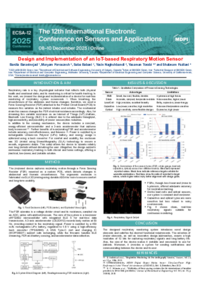
In the last few decades, several wearable devices have been designed to monitor respiration rate to capture pulmonary signals with higher accuracy and reduce patients’ discomfort during use. In this article, we present the design and implementation of a device for real-time monitoring of respiratory system movements. When breathing, the circumference of the abdomen and thorax changes; therefore, we used a Force Sensing Resistor (FSR) attached to the Printed Circuit Board (PCB) to measure this variation as the patient inhales and exhales. The mechanical strain this causes changes the FSR electrical resistance accordingly. Also, for streaming this variable resistance on an Internet of Things (IoT) platform, Bluetooth Low Energy (BLE) 5 is utilized due to the adequate throughput, high accessibility, and possibility of power consumption reduction. In addition to the sensing mechanism, the device includes a compact, energy-efficient microcontroller and a 3-axis accelerometer that captures body movement. Power is supplied by a rechargeable Lithium-ion Polymer (LiPo) battery, and energy usage is optimized using a buck converter. For comfort and usability, the enclosure was 3D printed using Stereolithography (SLA) technology to ensure a smooth, ergonomic shape. This setup allows the device to operate reliably over long periods without disturbing the user. Altogether, the design supports continuous respiratory tracking in both clinical and home settings, offering a practical, low-power, and portable solution.
Keywords
Wearable Sensors
Pulmonary Signals
Force Sensing Resistor (FSR)
Internet of Things (IoT)
Non-Invasive Respiration Measurement
Long-Term Real-Time Monitoring
Manuscript
engproc-sciforum_125756_S9_original_FSR_Manuscript-done.pdf
Poster
FSR_Poster.pdf
Defence Pal: A Prototype of Smart Wireless Robotic Sensing System for Landmine and Hazard Detection
Systematic Analysis of Distribution Shifts in Cross-Subject Glucose Prediction Using Wearable Physiological Data