Event submissions
Published
This submission belongs to the session 3. Fermented foods, drinks, and food safety of the event The 1st International Online Conference on Fermentation
Published date
07 Nov, 2025
Academic Editor
'%3e%3cpath%20d='M12.6657%2010.9104C12.4185%2010.325%2012.0599%209.79327%2011.6097%209.34482C11.1609%208.89508%2010.6293%208.5365%2010.0442%208.28888C10.0389%208.28626%2010.0337%208.28495%2010.0285%208.28233C10.8446%207.69279%2011.3752%206.73249%2011.3752%205.64904C11.3752%203.8542%209.92103%202.39999%208.1262%202.39999C6.33136%202.39999%204.87715%203.8542%204.87715%205.64904C4.87715%206.73249%205.40774%207.69279%206.22393%208.28364C6.21869%208.28626%206.21345%208.28757%206.20821%208.29019C5.62129%208.5378%205.09463%208.89284%204.64265%209.34613C4.1929%209.79493%203.83432%2010.3266%203.58671%2010.9117C3.34345%2011.4845%203.21226%2012.0987%203.20023%2012.7209C3.19988%2012.7349%203.20233%2012.7488%203.20744%2012.7619C3.21255%2012.7749%203.22022%2012.7867%203.22998%2012.7968C3.23975%2012.8068%203.25142%2012.8147%203.26431%2012.8202C3.2772%2012.8256%203.29105%2012.8284%203.30504%2012.8284H4.09109C4.14874%2012.8284%204.19459%2012.7825%204.1959%2012.7262C4.2221%2011.7148%204.62823%2010.7676%205.34617%2010.0497C6.08899%209.30683%207.0755%208.89808%208.1262%208.89808C9.17689%208.89808%2010.1634%209.30683%2010.9062%2010.0497C11.6242%2010.7676%2012.0303%2011.7148%2012.0565%2012.7262C12.0578%2012.7838%2012.1037%2012.8284%2012.1613%2012.8284H12.9474C12.9613%2012.8284%2012.9752%2012.8256%2012.9881%2012.8202C13.001%2012.8147%2013.0126%2012.8068%2013.0224%2012.7968C13.0322%2012.7867%2013.0398%2012.7749%2013.0449%2012.7619C13.0501%2012.7488%2013.0525%2012.7349%2013.0522%2012.7209C13.0391%2012.0947%2012.9094%2011.4855%2012.6657%2010.9104ZM8.1262%207.9024C7.52486%207.9024%206.9589%207.6679%206.53312%207.24211C6.10733%206.81633%205.87283%206.25037%205.87283%205.64904C5.87283%205.0477%206.10733%204.48174%206.53312%204.05596C6.9589%203.63018%207.52486%203.39567%208.1262%203.39567C8.72753%203.39567%209.29349%203.63018%209.71927%204.05596C10.1451%204.48174%2010.3796%205.0477%2010.3796%205.64904C10.3796%206.25037%2010.1451%206.81633%209.71927%207.24211C9.29349%207.6679%208.72753%207.9024%208.1262%207.9024Z'%20fill='%235D1EE1'/%3e%3c/g%3e%3c/svg%3e) Iris Loira
Iris LoiraCitation
Chunyu Tian, Daniel Martín-Vertedor, Ismael Montero-Fernández, Manuel Martínez, Francisco Perez Nevado, Effect of Pathogenic Bacteria on Volatile and Sensory Characteristics of Table Olive Brines, in Proceedings of The 1st International Online Conference on Fermentation, 12 November–13 November 2025, MDPI: Basel, Switzerland
Share
Email
Facebook
Twitter
LinkedIn
Effect of Pathogenic Bacteria on Volatile and Sensory Characteristics of Table Olive Brines
'%3e%3cpath%20d='M12.6647%2010.9104C12.4176%2010.325%2012.0589%209.7933%2011.6088%209.34485C11.16%208.89511%2010.6283%208.53653%2010.0432%208.28891C10.038%208.28629%2010.0327%208.28498%2010.0275%208.28236C10.8437%207.69282%2011.3743%206.73252%2011.3743%205.64907C11.3743%203.85423%209.92005%202.40002%208.12522%202.40002C6.33038%202.40002%204.87618%203.85423%204.87618%205.64907C4.87618%206.73252%205.40677%207.69282%206.22296%208.28367C6.21772%208.28629%206.21248%208.2876%206.20724%208.29022C5.62031%208.53783%205.09365%208.89287%204.64167%209.34616C4.19192%209.79496%203.83334%2010.3266%203.58573%2010.9117C3.34247%2011.4846%203.21128%2012.0987%203.19925%2012.721C3.1989%2012.735%203.20135%2012.7489%203.20646%2012.7619C3.21157%2012.7749%203.21924%2012.7868%203.22901%2012.7968C3.23877%2012.8068%203.25045%2012.8148%203.26334%2012.8202C3.27623%2012.8256%203.29007%2012.8284%203.30406%2012.8284H4.09012C4.14776%2012.8284%204.19362%2012.7825%204.19493%2012.7262C4.22113%2011.7148%204.62726%2010.7676%205.34519%2010.0497C6.08802%209.30686%207.07452%208.89811%208.12522%208.89811C9.17592%208.89811%2010.1624%209.30686%2010.9052%2010.0497C11.6232%2010.7676%2012.0293%2011.7148%2012.0555%2012.7262C12.0568%2012.7839%2012.1027%2012.8284%2012.1603%2012.8284H12.9464C12.9604%2012.8284%2012.9742%2012.8256%2012.9871%2012.8202C13%2012.8148%2013.0117%2012.8068%2013.0214%2012.7968C13.0312%2012.7868%2013.0389%2012.7749%2013.044%2012.7619C13.0491%2012.7489%2013.0515%2012.735%2013.0512%2012.721C13.0381%2012.0947%2012.9084%2011.4856%2012.6647%2010.9104ZM8.12522%207.90243C7.52388%207.90243%206.95792%207.66793%206.53214%207.24215C6.10636%206.81636%205.87185%206.2504%205.87185%205.64907C5.87185%205.04773%206.10636%204.48177%206.53214%204.05599C6.95792%203.63021%207.52388%203.3957%208.12522%203.3957C8.72655%203.3957%209.29252%203.63021%209.7183%204.05599C10.1441%204.48177%2010.3786%205.04773%2010.3786%205.64907C10.3786%206.2504%2010.1441%206.81636%209.7183%207.24215C9.29252%207.66793%208.72655%207.90243%208.12522%207.90243Z'%20fill='%235D1EE1'/%3e%3c/g%3e%3c/svg%3e)
Chunyu Tian 1

Daniel Martín-Vertedor 2,3
Ismael Montero-Fernández 3,4
Manuel Martínez 3,5
Francisco Perez Nevado 3,6
1. School of Biological and Chemical Engineering, University of Education of Chonqing, China
2. Aquaculture Center ‘Las Vegas del Guadiana’, Regional Government of Extremadura, N-5, km 391.7, Villafranco del Guadiana, 06195 Badajoz, Spain
3. Instituto Universitario de Recursos Agrarios (INURA), Avda de la Investigación, s/n, 06006 Universidad de Extremadura, Badajoz, Spain
4. Departamento de Química Analítica, Facultad de Ciencias, Universidad de Extremadura, Avda. de Elvas, s/n, 06071 Badajoz, España.
5. Departamento de Ingeniería Ambiental, Agronómica y Forestal, Escuela de Ingenierías Agrarias, Avda. Adolfo Suárez s/n 06007, Universidad de Extremadura, Badajoz, España
6. Departamento de Producción Animal y Ciencia de los Alimentos, Escuela de Ingenierías Agrarias, Avda. Adolfo Suárez s/n 06007, Universidad de Extremadura, Badajoz, Spain
Abstract
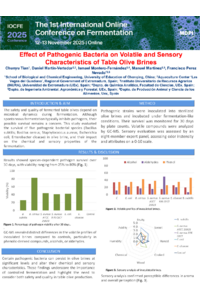
The safety and quality of fermented table olives depend on microbial dynamics during fermentation. Although spontaneous fermentation typically inhibits pathogens, their possible survival remains a concern. This study evaluated the survival of five pathogenic bacterial species (Bacillus subtilis; Bacillus cereus; Staphylococcus aureus; Escherichia coli; Enterobacter cloacae) in olive brine, and their impact on the chemical and sensory properties of the fermentation. Pathogenic strains were inoculated into sterilized olive brines and incubated under fermentation-like conditions. Their survival was monitored for 3 days by plate counts. Volatile compounds were analyzed by GC-MS. Sensory evaluation was assessed by an eight-member expert panel, assessing odor instensity and attributes on a 0-10 scale. Results showed species-dependent pathogen survival over 30 days, with viability ranging from 25% to 80%. GC-MS revealed distinct differences in the volatile profiles of inoculated brines compared to controls, particularly in phenolic-derived compounds, alcohols, or aldehydes. Sensory analysis confirmed perceptible differences in aroma and overall perception. In conclusion, certain pathogenic bacteria can persist in olive brines at significant levels and alter their chemical and sensory characteristics. These findings underscore the importance of controlled fermentation and highlight the need to consider both safety and quality in table olive production.
Keywords
Table olives
Pathogenic bacteria
Volatile compounds
Sensory analysis
Food safety
Brine
Poster
8. Poster presenter sciforum-135660 Francisco Perez Nevado.pdf
Valorization of Orange Peel By-Products in Kefir Cream Cheese and Its Impact on Their Physicochemical, Microbiological, and Functional Properties
Unlocking the Potential of Agro-Waste: Cucurbita pepo Peel as a Superior Fermentation Medium for Yeast Production