Event submissions
Published
This submission belongs to the session 3. Fermented foods, drinks, and food safety of the event The 1st International Online Conference on Fermentation
Published date
07 Nov, 2025
Academic Editor
'%3e%3cpath%20d='M12.6657%2010.9104C12.4185%2010.325%2012.0599%209.79327%2011.6097%209.34482C11.1609%208.89508%2010.6293%208.5365%2010.0442%208.28888C10.0389%208.28626%2010.0337%208.28495%2010.0285%208.28233C10.8446%207.69279%2011.3752%206.73249%2011.3752%205.64904C11.3752%203.8542%209.92103%202.39999%208.1262%202.39999C6.33136%202.39999%204.87715%203.8542%204.87715%205.64904C4.87715%206.73249%205.40774%207.69279%206.22393%208.28364C6.21869%208.28626%206.21345%208.28757%206.20821%208.29019C5.62129%208.5378%205.09463%208.89284%204.64265%209.34613C4.1929%209.79493%203.83432%2010.3266%203.58671%2010.9117C3.34345%2011.4845%203.21226%2012.0987%203.20023%2012.7209C3.19988%2012.7349%203.20233%2012.7488%203.20744%2012.7619C3.21255%2012.7749%203.22022%2012.7867%203.22998%2012.7968C3.23975%2012.8068%203.25142%2012.8147%203.26431%2012.8202C3.2772%2012.8256%203.29105%2012.8284%203.30504%2012.8284H4.09109C4.14874%2012.8284%204.19459%2012.7825%204.1959%2012.7262C4.2221%2011.7148%204.62823%2010.7676%205.34617%2010.0497C6.08899%209.30683%207.0755%208.89808%208.1262%208.89808C9.17689%208.89808%2010.1634%209.30683%2010.9062%2010.0497C11.6242%2010.7676%2012.0303%2011.7148%2012.0565%2012.7262C12.0578%2012.7838%2012.1037%2012.8284%2012.1613%2012.8284H12.9474C12.9613%2012.8284%2012.9752%2012.8256%2012.9881%2012.8202C13.001%2012.8147%2013.0126%2012.8068%2013.0224%2012.7968C13.0322%2012.7867%2013.0398%2012.7749%2013.0449%2012.7619C13.0501%2012.7488%2013.0525%2012.7349%2013.0522%2012.7209C13.0391%2012.0947%2012.9094%2011.4855%2012.6657%2010.9104ZM8.1262%207.9024C7.52486%207.9024%206.9589%207.6679%206.53312%207.24211C6.10733%206.81633%205.87283%206.25037%205.87283%205.64904C5.87283%205.0477%206.10733%204.48174%206.53312%204.05596C6.9589%203.63018%207.52486%203.39567%208.1262%203.39567C8.72753%203.39567%209.29349%203.63018%209.71927%204.05596C10.1451%204.48174%2010.3796%205.0477%2010.3796%205.64904C10.3796%206.25037%2010.1451%206.81633%209.71927%207.24211C9.29349%207.6679%208.72753%207.9024%208.1262%207.9024Z'%20fill='%235D1EE1'/%3e%3c/g%3e%3c/svg%3e) Iris Loira
Iris LoiraCitation
Fernando Astudillo-Melgar, Adelfo Escalante, Adrian Ochoa-Leyva, Agustín López-Munguía, Georgina Hernández-Chávez, María Elena Rodríguez-Alegría, Pulque Microbiota Core: Stability and Functional Role Across the Fermentation Process., in Proceedings of The 1st International Online Conference on Fermentation, 12 November–13 November 2025, MDPI: Basel, Switzerland
Share
Email
Facebook
Twitter
LinkedIn
Pulque Microbiota Core: Stability and Functional Role Across the Fermentation Process.
'%3e%3cpath%20d='M12.6647%2010.9104C12.4176%2010.325%2012.0589%209.7933%2011.6088%209.34485C11.16%208.89511%2010.6283%208.53653%2010.0432%208.28891C10.038%208.28629%2010.0327%208.28498%2010.0275%208.28236C10.8437%207.69282%2011.3743%206.73252%2011.3743%205.64907C11.3743%203.85423%209.92005%202.40002%208.12522%202.40002C6.33038%202.40002%204.87618%203.85423%204.87618%205.64907C4.87618%206.73252%205.40677%207.69282%206.22296%208.28367C6.21772%208.28629%206.21248%208.2876%206.20724%208.29022C5.62031%208.53783%205.09365%208.89287%204.64167%209.34616C4.19192%209.79496%203.83334%2010.3266%203.58573%2010.9117C3.34247%2011.4846%203.21128%2012.0987%203.19925%2012.721C3.1989%2012.735%203.20135%2012.7489%203.20646%2012.7619C3.21157%2012.7749%203.21924%2012.7868%203.22901%2012.7968C3.23877%2012.8068%203.25045%2012.8148%203.26334%2012.8202C3.27623%2012.8256%203.29007%2012.8284%203.30406%2012.8284H4.09012C4.14776%2012.8284%204.19362%2012.7825%204.19493%2012.7262C4.22113%2011.7148%204.62726%2010.7676%205.34519%2010.0497C6.08802%209.30686%207.07452%208.89811%208.12522%208.89811C9.17592%208.89811%2010.1624%209.30686%2010.9052%2010.0497C11.6232%2010.7676%2012.0293%2011.7148%2012.0555%2012.7262C12.0568%2012.7839%2012.1027%2012.8284%2012.1603%2012.8284H12.9464C12.9604%2012.8284%2012.9742%2012.8256%2012.9871%2012.8202C13%2012.8148%2013.0117%2012.8068%2013.0214%2012.7968C13.0312%2012.7868%2013.0389%2012.7749%2013.044%2012.7619C13.0491%2012.7489%2013.0515%2012.735%2013.0512%2012.721C13.0381%2012.0947%2012.9084%2011.4856%2012.6647%2010.9104ZM8.12522%207.90243C7.52388%207.90243%206.95792%207.66793%206.53214%207.24215C6.10636%206.81636%205.87185%206.2504%205.87185%205.64907C5.87185%205.04773%206.10636%204.48177%206.53214%204.05599C6.95792%203.63021%207.52388%203.3957%208.12522%203.3957C8.72655%203.3957%209.29252%203.63021%209.7183%204.05599C10.1441%204.48177%2010.3786%205.04773%2010.3786%205.64907C10.3786%206.2504%2010.1441%206.81636%209.7183%207.24215C9.29252%207.66793%208.72655%207.90243%208.12522%207.90243Z'%20fill='%235D1EE1'/%3e%3c/g%3e%3c/svg%3e)
Fernando Astudillo-Melgar 1
Adelfo Escalante 1
Adrian Ochoa-Leyva 2
Agustín López-Munguía 1
Georgina Hernández-Chávez 1
María Elena Rodríguez-Alegría 1
1. Department of Cellular Engineering and Biocatalysis, Institute of Biotechnology, National Autonomous University of Mexico (UNAM), Cuernavaca, Morelos, 62210, Mexico.
2. Department of Molecular Microbiology, Institute of Biotechnology, National Autonomous University of Mexico (UNAM), Cuernavaca, Morelos, 62210, Mexico.
Abstract
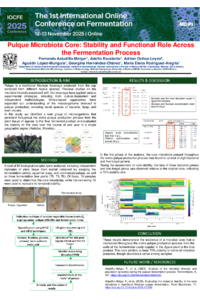
Introduction. Pulque is a traditional Mexican beverage made from Agave sap, involving complex microbial communities. This study used omics-based approaches to identify a core microbiota present throughout the production process from agave tissue to the final beverage and assessed its temporal stability over one year in Huitzilac, Morelos. Methodology. A total of 90 biological samples were analyzed, including triplicates of agave tissue, aguamiel (sap), and commercial pulque at three fermentation stages (T0, T3, T6). Sequencing of the 16S rRNA (V3–V4) and ITS1 regions was performed via Illumina NovaSeq. Taxonomic assignment and diversity metrics were conducted using QIIME with SILVA and UNITE databases. Metabolites were profiled using HPLC and UPLC. Results A microbial core of eight bacterial and five fungal genera was identified. Zymomonas (~58%) and Saccharomyces (~70%) were the most abundant. Core stability over the year was ~70%. Conserved genera were associated with sugar hydrolysis, metabolite production, and aroma biosynthesis. Sucrose (52 g/L), fructose (12 g/L), and glucose (17 g/L) were detected as carbon sources. Ethanol (30 g/L), and organic acids (average 4.0 g/L) increased in later stages (pulque T6), while early stages (aguamiel) were richer in carbohydrates. Conclusion. A stable and functionally relevant microbial core persists throughout pulque fermentation.
Keywords
Microbiota
Pulque
Agave
Amplicon sequencing
Poster
Astudillo Melgar_Poster.pdf
Effect of Lactococcus lactis on the survival of Listeria monocytogenes and Staphylococcus aureus in yoghurt
Safety enhancement of soybean straw silage via co-fermentation with lactic acid bacteria and cellulase: Microbial community dynamics and pH control