Event submissions
Published
This submission belongs to the session 3. Fermented foods, drinks, and food safety of the event The 1st International Online Conference on Fermentation
Published date
07 Nov, 2025
Academic Editor
'%3e%3cpath%20d='M12.6657%2010.9104C12.4185%2010.325%2012.0599%209.79327%2011.6097%209.34482C11.1609%208.89508%2010.6293%208.5365%2010.0442%208.28888C10.0389%208.28626%2010.0337%208.28495%2010.0285%208.28233C10.8446%207.69279%2011.3752%206.73249%2011.3752%205.64904C11.3752%203.8542%209.92103%202.39999%208.1262%202.39999C6.33136%202.39999%204.87715%203.8542%204.87715%205.64904C4.87715%206.73249%205.40774%207.69279%206.22393%208.28364C6.21869%208.28626%206.21345%208.28757%206.20821%208.29019C5.62129%208.5378%205.09463%208.89284%204.64265%209.34613C4.1929%209.79493%203.83432%2010.3266%203.58671%2010.9117C3.34345%2011.4845%203.21226%2012.0987%203.20023%2012.7209C3.19988%2012.7349%203.20233%2012.7488%203.20744%2012.7619C3.21255%2012.7749%203.22022%2012.7867%203.22998%2012.7968C3.23975%2012.8068%203.25142%2012.8147%203.26431%2012.8202C3.2772%2012.8256%203.29105%2012.8284%203.30504%2012.8284H4.09109C4.14874%2012.8284%204.19459%2012.7825%204.1959%2012.7262C4.2221%2011.7148%204.62823%2010.7676%205.34617%2010.0497C6.08899%209.30683%207.0755%208.89808%208.1262%208.89808C9.17689%208.89808%2010.1634%209.30683%2010.9062%2010.0497C11.6242%2010.7676%2012.0303%2011.7148%2012.0565%2012.7262C12.0578%2012.7838%2012.1037%2012.8284%2012.1613%2012.8284H12.9474C12.9613%2012.8284%2012.9752%2012.8256%2012.9881%2012.8202C13.001%2012.8147%2013.0126%2012.8068%2013.0224%2012.7968C13.0322%2012.7867%2013.0398%2012.7749%2013.0449%2012.7619C13.0501%2012.7488%2013.0525%2012.7349%2013.0522%2012.7209C13.0391%2012.0947%2012.9094%2011.4855%2012.6657%2010.9104ZM8.1262%207.9024C7.52486%207.9024%206.9589%207.6679%206.53312%207.24211C6.10733%206.81633%205.87283%206.25037%205.87283%205.64904C5.87283%205.0477%206.10733%204.48174%206.53312%204.05596C6.9589%203.63018%207.52486%203.39567%208.1262%203.39567C8.72753%203.39567%209.29349%203.63018%209.71927%204.05596C10.1451%204.48174%2010.3796%205.0477%2010.3796%205.64904C10.3796%206.25037%2010.1451%206.81633%209.71927%207.24211C9.29349%207.6679%208.72753%207.9024%208.1262%207.9024Z'%20fill='%235D1EE1'/%3e%3c/g%3e%3c/svg%3e) Iris Loira
Iris LoiraCitation
Dayana Montero Rodríguez, Adriana Ferreira de Souza, Rafael de Souza Mendonça, Rosileide Fontenele da Silva Andrade, Josimar Gurgel Fernandes, Galba Maria de Campos Takaki, Eco-friendly production of biosurfactants by Penicillium rubens applied to sustainable onion cultivation, in Proceedings of The 1st International Online Conference on Fermentation, 12 November–13 November 2025, MDPI: Basel, Switzerland
Share
Email
Facebook
Twitter
LinkedIn
Eco-friendly production of biosurfactants by Penicillium rubens applied to sustainable onion cultivation

Dayana Montero Rodríguez 1
'%3e%3cpath%20d='M12.6647%2010.9104C12.4176%2010.325%2012.0589%209.7933%2011.6088%209.34485C11.16%208.89511%2010.6283%208.53653%2010.0432%208.28891C10.038%208.28629%2010.0327%208.28498%2010.0275%208.28236C10.8437%207.69282%2011.3743%206.73252%2011.3743%205.64907C11.3743%203.85423%209.92005%202.40002%208.12522%202.40002C6.33038%202.40002%204.87618%203.85423%204.87618%205.64907C4.87618%206.73252%205.40677%207.69282%206.22296%208.28367C6.21772%208.28629%206.21248%208.2876%206.20724%208.29022C5.62031%208.53783%205.09365%208.89287%204.64167%209.34616C4.19192%209.79496%203.83334%2010.3266%203.58573%2010.9117C3.34247%2011.4846%203.21128%2012.0987%203.19925%2012.721C3.1989%2012.735%203.20135%2012.7489%203.20646%2012.7619C3.21157%2012.7749%203.21924%2012.7868%203.22901%2012.7968C3.23877%2012.8068%203.25045%2012.8148%203.26334%2012.8202C3.27623%2012.8256%203.29007%2012.8284%203.30406%2012.8284H4.09012C4.14776%2012.8284%204.19362%2012.7825%204.19493%2012.7262C4.22113%2011.7148%204.62726%2010.7676%205.34519%2010.0497C6.08802%209.30686%207.07452%208.89811%208.12522%208.89811C9.17592%208.89811%2010.1624%209.30686%2010.9052%2010.0497C11.6232%2010.7676%2012.0293%2011.7148%2012.0555%2012.7262C12.0568%2012.7839%2012.1027%2012.8284%2012.1603%2012.8284H12.9464C12.9604%2012.8284%2012.9742%2012.8256%2012.9871%2012.8202C13%2012.8148%2013.0117%2012.8068%2013.0214%2012.7968C13.0312%2012.7868%2013.0389%2012.7749%2013.044%2012.7619C13.0491%2012.7489%2013.0515%2012.735%2013.0512%2012.721C13.0381%2012.0947%2012.9084%2011.4856%2012.6647%2010.9104ZM8.12522%207.90243C7.52388%207.90243%206.95792%207.66793%206.53214%207.24215C6.10636%206.81636%205.87185%206.2504%205.87185%205.64907C5.87185%205.04773%206.10636%204.48177%206.53214%204.05599C6.95792%203.63021%207.52388%203.3957%208.12522%203.3957C8.72655%203.3957%209.29252%203.63021%209.7183%204.05599C10.1441%204.48177%2010.3786%205.04773%2010.3786%205.64907C10.3786%206.2504%2010.1441%206.81636%209.7183%207.24215C9.29252%207.66793%208.72655%207.90243%208.12522%207.90243Z'%20fill='%235D1EE1'/%3e%3c/g%3e%3c/svg%3e)
Adriana Ferreira de Souza 1
Rafael de Souza Mendonça 1,2
Rosileide Fontenele da Silva Andrade 1
Josimar Gurgel Fernandes 3
Galba Maria de Campos Takaki 1
1. Multiuser Center for Analysis and Characterization of Biomolecules and Material Surface (CEMACBIOS), Catholic University of Pernambuco, Recife, Brazil
2. Northeast Network of Biotechnology (RENORBIO), Federal Rural University of Pernambuco, Recife, Brazil
3. Agronomic Institute of Pernambuco (IPA), Recife, Brazil
Abstract
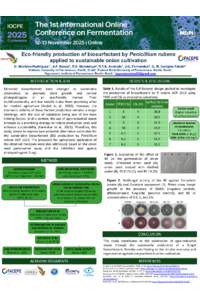
Microbial biosurfactants have emerged as sustainable alternatives to promote plant growth and control phytopathogens in an eco-friendly manner. Their multifunctionality and low toxicity make them promising allies for modern agriculture. This study investigated the production of a biosurfactant by Penicillium rubens UCP 1213 using post-frying soybean oil (PFSO) and corn steep liquor (CSL) as low-cost substrates. A 2² full-factorial design was used to evaluate the effects of substrate concentration on biosurfactant production, assessed by the reduction in surface tension. The best result was achieved in a medium containing 3% PFSO and 4% CSL, resulting in a surface tension of 26.8 mN/m. A reduction in the interfacial tension against n-hexadecane was also verified (1.8 mN/m). The biosurfactant was isolated with ethanol at 70% (2,40 g/L) and exhibited a critical micelle concentration (CMC) of 500 mg/L, indicating its effectiveness. In vitro assays demonstrated that the biosurfactant significantly enhanced the germination and vigor of onion seeds (Allium cepa L.) and inhibited the growth of phytopathogenic fungi Curvularia lunata and Fusarium oxysporum. These findings reinforce this biosurfactant's potential as a biostimulant and biocontrol agent. Therefore, the production of biosurfactants from agro-industrial waste represents a promising strategy for more sustainable agricultural practices in onion cultivation.
Keywords
fungal biosurfactant
agro-industrial waste valorization
Allium cepa
seed germination
phytopathogen control
sustainable agriculture
Poster
poster Dayana.pdf
Enhancing the Nutritional Quality of Fermented Milk Set Yogurt with Date Syrup as a Conservative and a Natural Substitute for White Sugar
Friendly Fermenters or Toxic Triggers? Metabolic mapping and phylogenetic analysis of biogenic amine-producing and degrading lactic acid bacteria