Event submissions
Published
This submission belongs to the session 4. Fermentation and health (nutraceutical impact) of the event The 1st International Online Conference on Fermentation
Published date
07 Nov, 2025
Academic Editor
'%3e%3cpath%20d='M12.6657%2010.9104C12.4185%2010.325%2012.0599%209.79327%2011.6097%209.34482C11.1609%208.89508%2010.6293%208.5365%2010.0442%208.28888C10.0389%208.28626%2010.0337%208.28495%2010.0285%208.28233C10.8446%207.69279%2011.3752%206.73249%2011.3752%205.64904C11.3752%203.8542%209.92103%202.39999%208.1262%202.39999C6.33136%202.39999%204.87715%203.8542%204.87715%205.64904C4.87715%206.73249%205.40774%207.69279%206.22393%208.28364C6.21869%208.28626%206.21345%208.28757%206.20821%208.29019C5.62129%208.5378%205.09463%208.89284%204.64265%209.34613C4.1929%209.79493%203.83432%2010.3266%203.58671%2010.9117C3.34345%2011.4845%203.21226%2012.0987%203.20023%2012.7209C3.19988%2012.7349%203.20233%2012.7488%203.20744%2012.7619C3.21255%2012.7749%203.22022%2012.7867%203.22998%2012.7968C3.23975%2012.8068%203.25142%2012.8147%203.26431%2012.8202C3.2772%2012.8256%203.29105%2012.8284%203.30504%2012.8284H4.09109C4.14874%2012.8284%204.19459%2012.7825%204.1959%2012.7262C4.2221%2011.7148%204.62823%2010.7676%205.34617%2010.0497C6.08899%209.30683%207.0755%208.89808%208.1262%208.89808C9.17689%208.89808%2010.1634%209.30683%2010.9062%2010.0497C11.6242%2010.7676%2012.0303%2011.7148%2012.0565%2012.7262C12.0578%2012.7838%2012.1037%2012.8284%2012.1613%2012.8284H12.9474C12.9613%2012.8284%2012.9752%2012.8256%2012.9881%2012.8202C13.001%2012.8147%2013.0126%2012.8068%2013.0224%2012.7968C13.0322%2012.7867%2013.0398%2012.7749%2013.0449%2012.7619C13.0501%2012.7488%2013.0525%2012.7349%2013.0522%2012.7209C13.0391%2012.0947%2012.9094%2011.4855%2012.6657%2010.9104ZM8.1262%207.9024C7.52486%207.9024%206.9589%207.6679%206.53312%207.24211C6.10733%206.81633%205.87283%206.25037%205.87283%205.64904C5.87283%205.0477%206.10733%204.48174%206.53312%204.05596C6.9589%203.63018%207.52486%203.39567%208.1262%203.39567C8.72753%203.39567%209.29349%203.63018%209.71927%204.05596C10.1451%204.48174%2010.3796%205.0477%2010.3796%205.64904C10.3796%206.25037%2010.1451%206.81633%209.71927%207.24211C9.29349%207.6679%208.72753%207.9024%208.1262%207.9024Z'%20fill='%235D1EE1'/%3e%3c/g%3e%3c/svg%3e) Manuel Malfeito-Ferreira
Manuel Malfeito-FerreiraCitation
Isabel Rodrigues, Fernanda Cosme, Virgílio Falco, António Inês, To What Extent Do Particle Film Applications on Grapes Affect Yeast Populations During Alcoholic Fermentation?, in Proceedings of The 1st International Online Conference on Fermentation, 12 November–13 November 2025, MDPI: Basel, Switzerland
Share
Email
Facebook
Twitter
LinkedIn
To What Extent Do Particle Film Applications on Grapes Affect Yeast Populations During Alcoholic Fermentation?
'%3e%3cpath%20d='M12.6647%2010.9104C12.4176%2010.325%2012.0589%209.7933%2011.6088%209.34485C11.16%208.89511%2010.6283%208.53653%2010.0432%208.28891C10.038%208.28629%2010.0327%208.28498%2010.0275%208.28236C10.8437%207.69282%2011.3743%206.73252%2011.3743%205.64907C11.3743%203.85423%209.92005%202.40002%208.12522%202.40002C6.33038%202.40002%204.87618%203.85423%204.87618%205.64907C4.87618%206.73252%205.40677%207.69282%206.22296%208.28367C6.21772%208.28629%206.21248%208.2876%206.20724%208.29022C5.62031%208.53783%205.09365%208.89287%204.64167%209.34616C4.19192%209.79496%203.83334%2010.3266%203.58573%2010.9117C3.34247%2011.4846%203.21128%2012.0987%203.19925%2012.721C3.1989%2012.735%203.20135%2012.7489%203.20646%2012.7619C3.21157%2012.7749%203.21924%2012.7868%203.22901%2012.7968C3.23877%2012.8068%203.25045%2012.8148%203.26334%2012.8202C3.27623%2012.8256%203.29007%2012.8284%203.30406%2012.8284H4.09012C4.14776%2012.8284%204.19362%2012.7825%204.19493%2012.7262C4.22113%2011.7148%204.62726%2010.7676%205.34519%2010.0497C6.08802%209.30686%207.07452%208.89811%208.12522%208.89811C9.17592%208.89811%2010.1624%209.30686%2010.9052%2010.0497C11.6232%2010.7676%2012.0293%2011.7148%2012.0555%2012.7262C12.0568%2012.7839%2012.1027%2012.8284%2012.1603%2012.8284H12.9464C12.9604%2012.8284%2012.9742%2012.8256%2012.9871%2012.8202C13%2012.8148%2013.0117%2012.8068%2013.0214%2012.7968C13.0312%2012.7868%2013.0389%2012.7749%2013.044%2012.7619C13.0491%2012.7489%2013.0515%2012.735%2013.0512%2012.721C13.0381%2012.0947%2012.9084%2011.4856%2012.6647%2010.9104ZM8.12522%207.90243C7.52388%207.90243%206.95792%207.66793%206.53214%207.24215C6.10636%206.81636%205.87185%206.2504%205.87185%205.64907C5.87185%205.04773%206.10636%204.48177%206.53214%204.05599C6.95792%203.63021%207.52388%203.3957%208.12522%203.3957C8.72655%203.3957%209.29252%203.63021%209.7183%204.05599C10.1441%204.48177%2010.3786%205.04773%2010.3786%205.64907C10.3786%206.2504%2010.1441%206.81636%209.7183%207.24215C9.29252%207.66793%208.72655%207.90243%208.12522%207.90243Z'%20fill='%235D1EE1'/%3e%3c/g%3e%3c/svg%3e)
Isabel Rodrigues 1

Fernanda Cosme 2,3
Virgílio Falco 4,5
António Inês 2,3
1. Centro de Investigação de Montanha (CIMO), ESA, Instituto Politécnico de Bragança, Campus de Santa Apolónia, Bragança, 5300-253, Portugal
2. Centro de Química de Vila Real (CQ-VR), Universidade de Trás-os-Montes e Alto Douro (UTAD), 5000-801, Vila Real, Portugal
3. Departamento de Biologia e Ambiente (DEBA), Escola de Ciências da Vida e do Ambiente (ECVA) Universidade de Trás-os-Montes e Alto Douro, 5000-801, Vila Real, Portugal
4. Centre for the Research and Technology of Agro-Environmental and Biological Sciences (CITAB), Universidade de Trás-os-Montes e Alto Douro (UTAD)
5. Laboratory for Green Chemistry (LAQV) of the Network of Chemistry and Technology (REQUIMTE), Universidade do Porto (UP)
Abstract
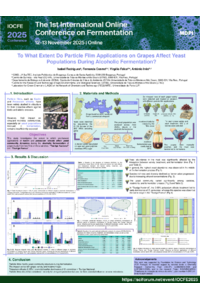
Particle films are widely used in viticulture to protect vines from environmental stresses, but their effects on vineyard microbial communities, especially fermentation yeasts, are not well understood. This study assessed how pre-harvest applications of kaolin (5%) and potassium silicate (Si) at 0.05% and 0.10% influence yeast dynamics during spontaneous fermentation of Vitis vinifera “Touriga Nacional” and “Touriga Franca” musts. Grapes were harvested from a commercial vineyard in the Douro Region, and microvinifications were conducted under controlled conditions. Fermentations occurred in custom-designed fermenters, with daily monitoring. Yeast populations were analyzed at three stages (beginning, middle, and end) using culture-dependent methods and 26S rDNA sequencing. Particle film treatments affected yeast density, diversity, and composition, particularly in early and mid-fermentation. Non-Saccharomyces yeasts dominated initial stages, with marked differences in Saccharomyces cerevisiae presence across treatments. In “Touriga Nacional”, the 0.05% Si treatment promoted early S. cerevisiae dominance, unlike in “Touriga Franca”, where it was absent at the same stage. Kaolin-treated musts showed the lowest yeast diversity, while 0.05% Si-treated musts showed the highest. These results indicate that particle films significantly influence yeast communities during fermentation, with effects dependent on grape variety and treatment, reinforcing the need to consider microbial impacts in vineyard management.
Keywords
Grape must fermentation
Kaolin
Potassium silicate
Saccharomyces cerevisiae
Vineyard
Yeast diversity
Poster
Rodrigues et al., 2025.pdf
Friendly Fermenters or Toxic Triggers? Metabolic mapping and phylogenetic analysis of biogenic amine-producing and degrading lactic acid bacteria
Bioactivity of Green Tea Kombucha: Polyphenol-Rich Ferment for Oxidative and Inflammatory Stress Modulation