Event submissions
Published
This submission belongs to the session 4. Fermentation and health (nutraceutical impact) of the event The 1st International Online Conference on Fermentation
Published date
07 Nov, 2025
Academic Editor
'%3e%3cpath%20d='M12.6657%2010.9104C12.4185%2010.325%2012.0599%209.79327%2011.6097%209.34482C11.1609%208.89508%2010.6293%208.5365%2010.0442%208.28888C10.0389%208.28626%2010.0337%208.28495%2010.0285%208.28233C10.8446%207.69279%2011.3752%206.73249%2011.3752%205.64904C11.3752%203.8542%209.92103%202.39999%208.1262%202.39999C6.33136%202.39999%204.87715%203.8542%204.87715%205.64904C4.87715%206.73249%205.40774%207.69279%206.22393%208.28364C6.21869%208.28626%206.21345%208.28757%206.20821%208.29019C5.62129%208.5378%205.09463%208.89284%204.64265%209.34613C4.1929%209.79493%203.83432%2010.3266%203.58671%2010.9117C3.34345%2011.4845%203.21226%2012.0987%203.20023%2012.7209C3.19988%2012.7349%203.20233%2012.7488%203.20744%2012.7619C3.21255%2012.7749%203.22022%2012.7867%203.22998%2012.7968C3.23975%2012.8068%203.25142%2012.8147%203.26431%2012.8202C3.2772%2012.8256%203.29105%2012.8284%203.30504%2012.8284H4.09109C4.14874%2012.8284%204.19459%2012.7825%204.1959%2012.7262C4.2221%2011.7148%204.62823%2010.7676%205.34617%2010.0497C6.08899%209.30683%207.0755%208.89808%208.1262%208.89808C9.17689%208.89808%2010.1634%209.30683%2010.9062%2010.0497C11.6242%2010.7676%2012.0303%2011.7148%2012.0565%2012.7262C12.0578%2012.7838%2012.1037%2012.8284%2012.1613%2012.8284H12.9474C12.9613%2012.8284%2012.9752%2012.8256%2012.9881%2012.8202C13.001%2012.8147%2013.0126%2012.8068%2013.0224%2012.7968C13.0322%2012.7867%2013.0398%2012.7749%2013.0449%2012.7619C13.0501%2012.7488%2013.0525%2012.7349%2013.0522%2012.7209C13.0391%2012.0947%2012.9094%2011.4855%2012.6657%2010.9104ZM8.1262%207.9024C7.52486%207.9024%206.9589%207.6679%206.53312%207.24211C6.10733%206.81633%205.87283%206.25037%205.87283%205.64904C5.87283%205.0477%206.10733%204.48174%206.53312%204.05596C6.9589%203.63018%207.52486%203.39567%208.1262%203.39567C8.72753%203.39567%209.29349%203.63018%209.71927%204.05596C10.1451%204.48174%2010.3796%205.0477%2010.3796%205.64904C10.3796%206.25037%2010.1451%206.81633%209.71927%207.24211C9.29349%207.6679%208.72753%207.9024%208.1262%207.9024Z'%20fill='%235D1EE1'/%3e%3c/g%3e%3c/svg%3e) Manuel Malfeito-Ferreira
Manuel Malfeito-FerreiraCitation
Renan E. A. Piraine, Neida L. Conrad, Vitória S. Gonçalves, Jeferson V. Ramos, Júlia L. Froldi, Fausto Almeida, Fábio P. L. Leite, Hacking gut–immune axis with non-Saccharomyces yeasts: effects of Candida intermedia supplementation in SARS-CoV-2-vaccinated animals, in Proceedings of The 1st International Online Conference on Fermentation, 12 November–13 November 2025, MDPI: Basel, Switzerland
Share
Email
Facebook
Twitter
LinkedIn
Hacking gut–immune axis with non-Saccharomyces yeasts: effects of Candida intermedia supplementation in SARS-CoV-2-vaccinated animals
'%3e%3cpath%20d='M12.6647%2010.9104C12.4176%2010.325%2012.0589%209.7933%2011.6088%209.34485C11.16%208.89511%2010.6283%208.53653%2010.0432%208.28891C10.038%208.28629%2010.0327%208.28498%2010.0275%208.28236C10.8437%207.69282%2011.3743%206.73252%2011.3743%205.64907C11.3743%203.85423%209.92005%202.40002%208.12522%202.40002C6.33038%202.40002%204.87618%203.85423%204.87618%205.64907C4.87618%206.73252%205.40677%207.69282%206.22296%208.28367C6.21772%208.28629%206.21248%208.2876%206.20724%208.29022C5.62031%208.53783%205.09365%208.89287%204.64167%209.34616C4.19192%209.79496%203.83334%2010.3266%203.58573%2010.9117C3.34247%2011.4846%203.21128%2012.0987%203.19925%2012.721C3.1989%2012.735%203.20135%2012.7489%203.20646%2012.7619C3.21157%2012.7749%203.21924%2012.7868%203.22901%2012.7968C3.23877%2012.8068%203.25045%2012.8148%203.26334%2012.8202C3.27623%2012.8256%203.29007%2012.8284%203.30406%2012.8284H4.09012C4.14776%2012.8284%204.19362%2012.7825%204.19493%2012.7262C4.22113%2011.7148%204.62726%2010.7676%205.34519%2010.0497C6.08802%209.30686%207.07452%208.89811%208.12522%208.89811C9.17592%208.89811%2010.1624%209.30686%2010.9052%2010.0497C11.6232%2010.7676%2012.0293%2011.7148%2012.0555%2012.7262C12.0568%2012.7839%2012.1027%2012.8284%2012.1603%2012.8284H12.9464C12.9604%2012.8284%2012.9742%2012.8256%2012.9871%2012.8202C13%2012.8148%2013.0117%2012.8068%2013.0214%2012.7968C13.0312%2012.7868%2013.0389%2012.7749%2013.044%2012.7619C13.0491%2012.7489%2013.0515%2012.735%2013.0512%2012.721C13.0381%2012.0947%2012.9084%2011.4856%2012.6647%2010.9104ZM8.12522%207.90243C7.52388%207.90243%206.95792%207.66793%206.53214%207.24215C6.10636%206.81636%205.87185%206.2504%205.87185%205.64907C5.87185%205.04773%206.10636%204.48177%206.53214%204.05599C6.95792%203.63021%207.52388%203.3957%208.12522%203.3957C8.72655%203.3957%209.29252%203.63021%209.7183%204.05599C10.1441%204.48177%2010.3786%205.04773%2010.3786%205.64907C10.3786%206.2504%2010.1441%206.81636%209.7183%207.24215C9.29252%207.66793%208.72655%207.90243%208.12522%207.90243Z'%20fill='%235D1EE1'/%3e%3c/g%3e%3c/svg%3e)
Renan E. A. Piraine 1,2
Neida L. Conrad 1
Vitória S. Gonçalves 1
Jeferson V. Ramos 1
Júlia L. Froldi 2

Fausto Almeida 2
Fábio P. L. Leite 1
1. Microbiology laboratory, Technological Development Center, Federal University of Pelotas, Pelotas, Brazil
2. Department of Biochemistry and Immunology, Ribeirão Preto Medical School, University of São Paulo, Ribeirão Preto, São Paulo, Brazil
Abstract
Non-Saccharomyces yeasts are promising new probiotics, with effects comparable to the reference probiotic yeast, Saccharomyces boulardii. Candida intermedia, a non-albicans species not considered a common human pathogen, previously demonstrated probiotic potential. This study aimed to evaluate the immunomodulatory effects of C. intermedia in mice vaccinated with inactivated SARS-CoV-2, seeking additional evidence of its probiotic activity. Murine macrophages were stimulated with C. intermedia, followed by mRNA transcription analysis via qPCR. Mice were supplemented with C. intermedia prior to SARS-CoV-2 vaccination. Antibody production was assessed by ELISA, and fecal microbiomes were analyzed using next-generation sequencing. C. intermedia significantly increased Il4 and Il13 expression while decreasing Stat3 in macrophages. Splenocytes from supplemented mice exhibited elevated transcription levels of Tnf, Ifng, Il4, Bcl6, and Stat3 after exposure to stimulatory molecules. These mice showed increased levels of anti-SARS-CoV-2 IgG and sIgA isotypes, along with higher abundances of Bacteroides spp. and Clostridium spp. in their gut microbiome. In conclusion, C. intermedia supplementation modulated the expression of key immune-related genes and enhanced humoral responses in mice. Furthermore, its influence on gastrointestinal microbiota suggests a synergistic effect on vaccine immunogenicity. These findings support the potential of C. intermedia as a novel probiotic candidate with immunomodulatory properties.
Keywords
probiotics
immunomodulation
vaccines
immune system
gut microbiome
fungi
Poster
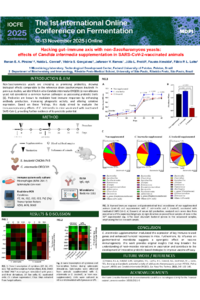
Poster IOCFE2025 Renan Piraine.pdf
Optimization of solid-state fermentation process of Angelicae Pubescentis Radix stems and leaves by probiotics
Effect of Certain Food Additives on Lactococcus lactis Strains Intended to be Used for Dairy Food Fermentation