Event submissions
Published
This submission belongs to the session 4. Fermentation and health (nutraceutical impact) of the event The 1st International Online Conference on Fermentation
Published date
07 Nov, 2025
Academic Editor
'%3e%3cpath%20d='M12.6657%2010.9104C12.4185%2010.325%2012.0599%209.79327%2011.6097%209.34482C11.1609%208.89508%2010.6293%208.5365%2010.0442%208.28888C10.0389%208.28626%2010.0337%208.28495%2010.0285%208.28233C10.8446%207.69279%2011.3752%206.73249%2011.3752%205.64904C11.3752%203.8542%209.92103%202.39999%208.1262%202.39999C6.33136%202.39999%204.87715%203.8542%204.87715%205.64904C4.87715%206.73249%205.40774%207.69279%206.22393%208.28364C6.21869%208.28626%206.21345%208.28757%206.20821%208.29019C5.62129%208.5378%205.09463%208.89284%204.64265%209.34613C4.1929%209.79493%203.83432%2010.3266%203.58671%2010.9117C3.34345%2011.4845%203.21226%2012.0987%203.20023%2012.7209C3.19988%2012.7349%203.20233%2012.7488%203.20744%2012.7619C3.21255%2012.7749%203.22022%2012.7867%203.22998%2012.7968C3.23975%2012.8068%203.25142%2012.8147%203.26431%2012.8202C3.2772%2012.8256%203.29105%2012.8284%203.30504%2012.8284H4.09109C4.14874%2012.8284%204.19459%2012.7825%204.1959%2012.7262C4.2221%2011.7148%204.62823%2010.7676%205.34617%2010.0497C6.08899%209.30683%207.0755%208.89808%208.1262%208.89808C9.17689%208.89808%2010.1634%209.30683%2010.9062%2010.0497C11.6242%2010.7676%2012.0303%2011.7148%2012.0565%2012.7262C12.0578%2012.7838%2012.1037%2012.8284%2012.1613%2012.8284H12.9474C12.9613%2012.8284%2012.9752%2012.8256%2012.9881%2012.8202C13.001%2012.8147%2013.0126%2012.8068%2013.0224%2012.7968C13.0322%2012.7867%2013.0398%2012.7749%2013.0449%2012.7619C13.0501%2012.7488%2013.0525%2012.7349%2013.0522%2012.7209C13.0391%2012.0947%2012.9094%2011.4855%2012.6657%2010.9104ZM8.1262%207.9024C7.52486%207.9024%206.9589%207.6679%206.53312%207.24211C6.10733%206.81633%205.87283%206.25037%205.87283%205.64904C5.87283%205.0477%206.10733%204.48174%206.53312%204.05596C6.9589%203.63018%207.52486%203.39567%208.1262%203.39567C8.72753%203.39567%209.29349%203.63018%209.71927%204.05596C10.1451%204.48174%2010.3796%205.0477%2010.3796%205.64904C10.3796%206.25037%2010.1451%206.81633%209.71927%207.24211C9.29349%207.6679%208.72753%207.9024%208.1262%207.9024Z'%20fill='%235D1EE1'/%3e%3c/g%3e%3c/svg%3e) Manuel Malfeito-Ferreira
Manuel Malfeito-FerreiraCitation
Mayrene Sarai Flores, Jose Adelfo Escalante, Fernando Astudillo-Melgar, Leonor Perez, Martín Gustavo Pedraza, Tomás Villaseñor, Effect of pulque-derived microbiota with probiotic potential on metabolism and gut microbiota composition in a murine model., in Proceedings of The 1st International Online Conference on Fermentation, 12 November–13 November 2025, MDPI: Basel, Switzerland
Share
Email
Facebook
Twitter
LinkedIn
Effect of pulque-derived microbiota with probiotic potential on metabolism and gut microbiota composition in a murine model.
'%3e%3cpath%20d='M12.6647%2010.9104C12.4176%2010.325%2012.0589%209.7933%2011.6088%209.34485C11.16%208.89511%2010.6283%208.53653%2010.0432%208.28891C10.038%208.28629%2010.0327%208.28498%2010.0275%208.28236C10.8437%207.69282%2011.3743%206.73252%2011.3743%205.64907C11.3743%203.85423%209.92005%202.40002%208.12522%202.40002C6.33038%202.40002%204.87618%203.85423%204.87618%205.64907C4.87618%206.73252%205.40677%207.69282%206.22296%208.28367C6.21772%208.28629%206.21248%208.2876%206.20724%208.29022C5.62031%208.53783%205.09365%208.89287%204.64167%209.34616C4.19192%209.79496%203.83334%2010.3266%203.58573%2010.9117C3.34247%2011.4846%203.21128%2012.0987%203.19925%2012.721C3.1989%2012.735%203.20135%2012.7489%203.20646%2012.7619C3.21157%2012.7749%203.21924%2012.7868%203.22901%2012.7968C3.23877%2012.8068%203.25045%2012.8148%203.26334%2012.8202C3.27623%2012.8256%203.29007%2012.8284%203.30406%2012.8284H4.09012C4.14776%2012.8284%204.19362%2012.7825%204.19493%2012.7262C4.22113%2011.7148%204.62726%2010.7676%205.34519%2010.0497C6.08802%209.30686%207.07452%208.89811%208.12522%208.89811C9.17592%208.89811%2010.1624%209.30686%2010.9052%2010.0497C11.6232%2010.7676%2012.0293%2011.7148%2012.0555%2012.7262C12.0568%2012.7839%2012.1027%2012.8284%2012.1603%2012.8284H12.9464C12.9604%2012.8284%2012.9742%2012.8256%2012.9871%2012.8202C13%2012.8148%2013.0117%2012.8068%2013.0214%2012.7968C13.0312%2012.7868%2013.0389%2012.7749%2013.044%2012.7619C13.0491%2012.7489%2013.0515%2012.735%2013.0512%2012.721C13.0381%2012.0947%2012.9084%2011.4856%2012.6647%2010.9104ZM8.12522%207.90243C7.52388%207.90243%206.95792%207.66793%206.53214%207.24215C6.10636%206.81636%205.87185%206.2504%205.87185%205.64907C5.87185%205.04773%206.10636%204.48177%206.53214%204.05599C6.95792%203.63021%207.52388%203.3957%208.12522%203.3957C8.72655%203.3957%209.29252%203.63021%209.7183%204.05599C10.1441%204.48177%2010.3786%205.04773%2010.3786%205.64907C10.3786%206.2504%2010.1441%206.81636%209.7183%207.24215C9.29252%207.66793%208.72655%207.90243%208.12522%207.90243Z'%20fill='%235D1EE1'/%3e%3c/g%3e%3c/svg%3e)
Mayrene Sarai Flores 1
Jose Adelfo Escalante 1
Fernando Astudillo-Melgar 1
Leonor Perez 2
Martín Gustavo Pedraza 2
Tomás Villaseñor 2
1. Department of Cellular Engineering and Biocatalysis, Institute of Biotechnology, National Autonomous University of Mexico (UNAM), Av. Universidad 2001, Chamilpa, Cuernavaca, Morelos, 62210, Mexico.
2. Department of Molecular Medicine and Bioprocesses, Institute of Biotechnology, National Autonomous University of Mexico (UNAM), Av. Universidad 2001, Chamilpa, Cuernavaca, Morelos, 62210, Mexico.
Abstract
Pulque is a traditional Mexican fermented beverage that harbors a diverse microbial community with potential probiotic properties. However, its functional impact in animal models remains underexplored. This study aimed to evaluate the effects of pulque-derived microbiota on host metabolism and gut microbial composition in a high-fat diet (HFD) mouse model. C57BL/6 mice were divided into groups fed either a normal diet or an HFD, with or without pulque microbiota supplementation for 8 weeks. Metabolic parameters such as glucose tolerance, insulin resistance, and body weight were assessed, along with gut microbiota diversity and composition through 16S rRNA gene sequencing. Results indicated that pulque microbiota exerted a protective effect by promoting the persistence of beneficial families such as Lactobacillaceae and Akkermansiaceae, while moderating shifts in Lachnospiraceae, a family associated with inflammation. Moreover, it attenuated HFD-induced metabolic impairments. In conclusion, pulque-derived microbiota demonstrated a potential probiotic effect by improving metabolic outcomes, limiting the expansion of dysbiosis-associated taxa, and enhancing the presence of beneficial microbial groups. These findings support its potential use in dietary strategies aimed at preventing metabolic disorders related to high-calorie diets.
Keywords
Pulque
Fermented beverage
Gut microbiota
High-fat diet
Metabolic parameters
Poster
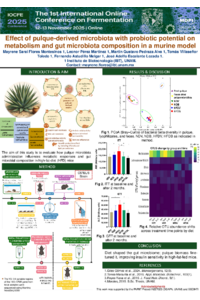
Cartel IOCFE.pdf
Enhanced Carotenoid Production by Rhodotorula mucilaginosa Cultivated Under LED Illumination in a Photobioreactor
Microbiological tools to explore LAB–Propionibacteria synergy in view of dairy by-product valorisation