Event submissions
Published
This submission belongs to the session 4. Fermentation and health (nutraceutical impact) of the event The 1st International Online Conference on Fermentation
Published date
07 Nov, 2025
Academic Editor
'%3e%3cpath%20d='M12.6657%2010.9104C12.4185%2010.325%2012.0599%209.79327%2011.6097%209.34482C11.1609%208.89508%2010.6293%208.5365%2010.0442%208.28888C10.0389%208.28626%2010.0337%208.28495%2010.0285%208.28233C10.8446%207.69279%2011.3752%206.73249%2011.3752%205.64904C11.3752%203.8542%209.92103%202.39999%208.1262%202.39999C6.33136%202.39999%204.87715%203.8542%204.87715%205.64904C4.87715%206.73249%205.40774%207.69279%206.22393%208.28364C6.21869%208.28626%206.21345%208.28757%206.20821%208.29019C5.62129%208.5378%205.09463%208.89284%204.64265%209.34613C4.1929%209.79493%203.83432%2010.3266%203.58671%2010.9117C3.34345%2011.4845%203.21226%2012.0987%203.20023%2012.7209C3.19988%2012.7349%203.20233%2012.7488%203.20744%2012.7619C3.21255%2012.7749%203.22022%2012.7867%203.22998%2012.7968C3.23975%2012.8068%203.25142%2012.8147%203.26431%2012.8202C3.2772%2012.8256%203.29105%2012.8284%203.30504%2012.8284H4.09109C4.14874%2012.8284%204.19459%2012.7825%204.1959%2012.7262C4.2221%2011.7148%204.62823%2010.7676%205.34617%2010.0497C6.08899%209.30683%207.0755%208.89808%208.1262%208.89808C9.17689%208.89808%2010.1634%209.30683%2010.9062%2010.0497C11.6242%2010.7676%2012.0303%2011.7148%2012.0565%2012.7262C12.0578%2012.7838%2012.1037%2012.8284%2012.1613%2012.8284H12.9474C12.9613%2012.8284%2012.9752%2012.8256%2012.9881%2012.8202C13.001%2012.8147%2013.0126%2012.8068%2013.0224%2012.7968C13.0322%2012.7867%2013.0398%2012.7749%2013.0449%2012.7619C13.0501%2012.7488%2013.0525%2012.7349%2013.0522%2012.7209C13.0391%2012.0947%2012.9094%2011.4855%2012.6657%2010.9104ZM8.1262%207.9024C7.52486%207.9024%206.9589%207.6679%206.53312%207.24211C6.10733%206.81633%205.87283%206.25037%205.87283%205.64904C5.87283%205.0477%206.10733%204.48174%206.53312%204.05596C6.9589%203.63018%207.52486%203.39567%208.1262%203.39567C8.72753%203.39567%209.29349%203.63018%209.71927%204.05596C10.1451%204.48174%2010.3796%205.0477%2010.3796%205.64904C10.3796%206.25037%2010.1451%206.81633%209.71927%207.24211C9.29349%207.6679%208.72753%207.9024%208.1262%207.9024Z'%20fill='%235D1EE1'/%3e%3c/g%3e%3c/svg%3e) Manuel Malfeito-Ferreira
Manuel Malfeito-FerreiraCitation
Elizabeth T. Adesemoye, Abiodun I. Sanni, Omotade R. Ogunremi, Pasquale Russo, Giuseppe Spano, Vittorio Capozzi, Lactic acid bacteria from Nigerian traditional fermented foods screened for the production of selected B-vitamins in beverages, in Proceedings of The 1st International Online Conference on Fermentation, 12 November–13 November 2025, MDPI: Basel, Switzerland
Share
Email
Facebook
Twitter
LinkedIn
Lactic acid bacteria from Nigerian traditional fermented foods screened for the production of selected B-vitamins in beverages
'%3e%3cpath%20d='M12.6647%2010.9104C12.4176%2010.325%2012.0589%209.7933%2011.6088%209.34485C11.16%208.89511%2010.6283%208.53653%2010.0432%208.28891C10.038%208.28629%2010.0327%208.28498%2010.0275%208.28236C10.8437%207.69282%2011.3743%206.73252%2011.3743%205.64907C11.3743%203.85423%209.92005%202.40002%208.12522%202.40002C6.33038%202.40002%204.87618%203.85423%204.87618%205.64907C4.87618%206.73252%205.40677%207.69282%206.22296%208.28367C6.21772%208.28629%206.21248%208.2876%206.20724%208.29022C5.62031%208.53783%205.09365%208.89287%204.64167%209.34616C4.19192%209.79496%203.83334%2010.3266%203.58573%2010.9117C3.34247%2011.4846%203.21128%2012.0987%203.19925%2012.721C3.1989%2012.735%203.20135%2012.7489%203.20646%2012.7619C3.21157%2012.7749%203.21924%2012.7868%203.22901%2012.7968C3.23877%2012.8068%203.25045%2012.8148%203.26334%2012.8202C3.27623%2012.8256%203.29007%2012.8284%203.30406%2012.8284H4.09012C4.14776%2012.8284%204.19362%2012.7825%204.19493%2012.7262C4.22113%2011.7148%204.62726%2010.7676%205.34519%2010.0497C6.08802%209.30686%207.07452%208.89811%208.12522%208.89811C9.17592%208.89811%2010.1624%209.30686%2010.9052%2010.0497C11.6232%2010.7676%2012.0293%2011.7148%2012.0555%2012.7262C12.0568%2012.7839%2012.1027%2012.8284%2012.1603%2012.8284H12.9464C12.9604%2012.8284%2012.9742%2012.8256%2012.9871%2012.8202C13%2012.8148%2013.0117%2012.8068%2013.0214%2012.7968C13.0312%2012.7868%2013.0389%2012.7749%2013.044%2012.7619C13.0491%2012.7489%2013.0515%2012.735%2013.0512%2012.721C13.0381%2012.0947%2012.9084%2011.4856%2012.6647%2010.9104ZM8.12522%207.90243C7.52388%207.90243%206.95792%207.66793%206.53214%207.24215C6.10636%206.81636%205.87185%206.2504%205.87185%205.64907C5.87185%205.04773%206.10636%204.48177%206.53214%204.05599C6.95792%203.63021%207.52388%203.3957%208.12522%203.3957C8.72655%203.3957%209.29252%203.63021%209.7183%204.05599C10.1441%204.48177%2010.3786%205.04773%2010.3786%205.64907C10.3786%206.2504%2010.1441%206.81636%209.7183%207.24215C9.29252%207.66793%208.72655%207.90243%208.12522%207.90243Z'%20fill='%235D1EE1'/%3e%3c/g%3e%3c/svg%3e)
Elizabeth T. Adesemoye 1
Abiodun I. Sanni 2
Omotade R. Ogunremi 3
Pasquale Russo 4
Giuseppe Spano 5

Vittorio Capozzi 6
1. Department of Microbiology, Faculty of Life Sciences, Federal University Oye Ekiti, Oye 370112, Ekiti State, Nigeria
2. Department of Microbiology, University of Ibadan, Ibadan 200005, Oyo State, Nigeria
3. Department of Biological Sciences, First Technical University, Ibadan, Oyo State. Nigeria
4. Department of Food, Environmental and Nutritional Sciences (DeFENS), University of Milan, Milan, Italy
5. Department of Sciences of Agriculture, Food, Natural Resources, and Engineering (DAFNE), University of Foggia, via Napoli, 25, 71122 Foggia, Italy
6. Institute of Sciences of Food Production, National Research Council (CNR) of Italy, C/O CS-DAT, 71121 Foggia, Italy.
Abstract
The reduction of B-vitamins during food processing necessitates the need for an adequate supply through natural sources. This study aimed to characterise LAB that produce B-vitamins and employ them as starter cultures in milk. LAB were isolated from Nigerian fermented foods and screened for the production of B-vitamins (particularly B2 and B12). Riboflavin overproducers were obtained by selection of natural mutants with roseoflavin. LAB were identified using 16S rRNA gene sequencing and also screened for probiotic and technological characteristics. The best cobalamin and riboflavin producers with probiotic characteristics were used as starters (singly and in a co-culture) to ferment cow milk. The cobalamin and riboflavin content of the milk increased from 2.0 to 7.9 mg/L and from 1.7 to 4.4 mg/L, respectively, using W. cibaria TA94, while L. plantarum KC62 increased the cobalamin and riboflavin levels from 2.0 to 6.9 and 1.7 to 4.4 mg/L, respectively. As combined starter cultures, the cobalamin and riboflavin levels in the cow milk increased from 2.0 to 42.2 mg/L and from 1.7 to 23.8 mg/L, respectively. Lactiplantibacillus plantarum KC62 and Weissella cibaria TA94 are good candidates for designing starter cultures to be used for modulating B-vitamins in specific food applications.
Keywords
Keywords: fermented foods
lactic acid bacteria
probiotics
B-vitamins
functional food
Poster
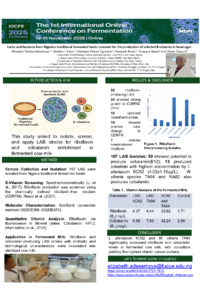
sciforum-137013 Elizabeth T. Adesemoye.pdf
Functional Properties of Camel Milk Fermented by Their Probiotic Lactic Acid Bacteria
Use of Weissella cibaria BAL3C-5 B2 to produce functional breads enriched in vitamin B2 and fortified with dextran