Event submissions
Published
This submission belongs to the session 4. Fermentation and health (nutraceutical impact) of the event The 1st International Online Conference on Fermentation
Published date
07 Nov, 2025
Academic Editor
'%3e%3cpath%20d='M12.6657%2010.9104C12.4185%2010.325%2012.0599%209.79327%2011.6097%209.34482C11.1609%208.89508%2010.6293%208.5365%2010.0442%208.28888C10.0389%208.28626%2010.0337%208.28495%2010.0285%208.28233C10.8446%207.69279%2011.3752%206.73249%2011.3752%205.64904C11.3752%203.8542%209.92103%202.39999%208.1262%202.39999C6.33136%202.39999%204.87715%203.8542%204.87715%205.64904C4.87715%206.73249%205.40774%207.69279%206.22393%208.28364C6.21869%208.28626%206.21345%208.28757%206.20821%208.29019C5.62129%208.5378%205.09463%208.89284%204.64265%209.34613C4.1929%209.79493%203.83432%2010.3266%203.58671%2010.9117C3.34345%2011.4845%203.21226%2012.0987%203.20023%2012.7209C3.19988%2012.7349%203.20233%2012.7488%203.20744%2012.7619C3.21255%2012.7749%203.22022%2012.7867%203.22998%2012.7968C3.23975%2012.8068%203.25142%2012.8147%203.26431%2012.8202C3.2772%2012.8256%203.29105%2012.8284%203.30504%2012.8284H4.09109C4.14874%2012.8284%204.19459%2012.7825%204.1959%2012.7262C4.2221%2011.7148%204.62823%2010.7676%205.34617%2010.0497C6.08899%209.30683%207.0755%208.89808%208.1262%208.89808C9.17689%208.89808%2010.1634%209.30683%2010.9062%2010.0497C11.6242%2010.7676%2012.0303%2011.7148%2012.0565%2012.7262C12.0578%2012.7838%2012.1037%2012.8284%2012.1613%2012.8284H12.9474C12.9613%2012.8284%2012.9752%2012.8256%2012.9881%2012.8202C13.001%2012.8147%2013.0126%2012.8068%2013.0224%2012.7968C13.0322%2012.7867%2013.0398%2012.7749%2013.0449%2012.7619C13.0501%2012.7488%2013.0525%2012.7349%2013.0522%2012.7209C13.0391%2012.0947%2012.9094%2011.4855%2012.6657%2010.9104ZM8.1262%207.9024C7.52486%207.9024%206.9589%207.6679%206.53312%207.24211C6.10733%206.81633%205.87283%206.25037%205.87283%205.64904C5.87283%205.0477%206.10733%204.48174%206.53312%204.05596C6.9589%203.63018%207.52486%203.39567%208.1262%203.39567C8.72753%203.39567%209.29349%203.63018%209.71927%204.05596C10.1451%204.48174%2010.3796%205.0477%2010.3796%205.64904C10.3796%206.25037%2010.1451%206.81633%209.71927%207.24211C9.29349%207.6679%208.72753%207.9024%208.1262%207.9024Z'%20fill='%235D1EE1'/%3e%3c/g%3e%3c/svg%3e) Manuel Malfeito-Ferreira
Manuel Malfeito-FerreiraCitation
José Ángel Ruiz-Masó, Annel Magdalena Hernández-Alcántara, Rosana Chiva, Pilar Gómez, Elisa Gallego, Alicia Bellanco, Mª Teresa Dueñas, Lidia Tomás-Cobos, Teresa Requena, Mª Carmen Martínez-Cuesta, Mercedes Tamame, Gloria del Solar, Use of Weissella cibaria BAL3C-5 B2 to produce functional breads enriched in vitamin B₂ and fortified with dextran, in Proceedings of The 1st International Online Conference on Fermentation, 12 November–13 November 2025, MDPI: Basel, Switzerland
Share
Email
Facebook
Twitter
LinkedIn
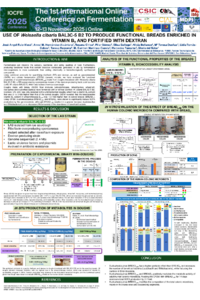
Use of Weissella cibaria BAL3C-5 B2 to produce functional breads enriched in vitamin B2 and fortified with dextran
'%3e%3cpath%20d='M12.6647%2010.9104C12.4176%2010.325%2012.0589%209.7933%2011.6088%209.34485C11.16%208.89511%2010.6283%208.53653%2010.0432%208.28891C10.038%208.28629%2010.0327%208.28498%2010.0275%208.28236C10.8437%207.69282%2011.3743%206.73252%2011.3743%205.64907C11.3743%203.85423%209.92005%202.40002%208.12522%202.40002C6.33038%202.40002%204.87618%203.85423%204.87618%205.64907C4.87618%206.73252%205.40677%207.69282%206.22296%208.28367C6.21772%208.28629%206.21248%208.2876%206.20724%208.29022C5.62031%208.53783%205.09365%208.89287%204.64167%209.34616C4.19192%209.79496%203.83334%2010.3266%203.58573%2010.9117C3.34247%2011.4846%203.21128%2012.0987%203.19925%2012.721C3.1989%2012.735%203.20135%2012.7489%203.20646%2012.7619C3.21157%2012.7749%203.21924%2012.7868%203.22901%2012.7968C3.23877%2012.8068%203.25045%2012.8148%203.26334%2012.8202C3.27623%2012.8256%203.29007%2012.8284%203.30406%2012.8284H4.09012C4.14776%2012.8284%204.19362%2012.7825%204.19493%2012.7262C4.22113%2011.7148%204.62726%2010.7676%205.34519%2010.0497C6.08802%209.30686%207.07452%208.89811%208.12522%208.89811C9.17592%208.89811%2010.1624%209.30686%2010.9052%2010.0497C11.6232%2010.7676%2012.0293%2011.7148%2012.0555%2012.7262C12.0568%2012.7839%2012.1027%2012.8284%2012.1603%2012.8284H12.9464C12.9604%2012.8284%2012.9742%2012.8256%2012.9871%2012.8202C13%2012.8148%2013.0117%2012.8068%2013.0214%2012.7968C13.0312%2012.7868%2013.0389%2012.7749%2013.044%2012.7619C13.0491%2012.7489%2013.0515%2012.735%2013.0512%2012.721C13.0381%2012.0947%2012.9084%2011.4856%2012.6647%2010.9104ZM8.12522%207.90243C7.52388%207.90243%206.95792%207.66793%206.53214%207.24215C6.10636%206.81636%205.87185%206.2504%205.87185%205.64907C5.87185%205.04773%206.10636%204.48177%206.53214%204.05599C6.95792%203.63021%207.52388%203.3957%208.12522%203.3957C8.72655%203.3957%209.29252%203.63021%209.7183%204.05599C10.1441%204.48177%2010.3786%205.04773%2010.3786%205.64907C10.3786%206.2504%2010.1441%206.81636%209.7183%207.24215C9.29252%207.66793%208.72655%207.90243%208.12522%207.90243Z'%20fill='%235D1EE1'/%3e%3c/g%3e%3c/svg%3e)
José Ángel Ruiz-Masó 1
Annel Magdalena Hernández-Alcántara 1

Rosana Chiva 2
Pilar Gómez 2
Elisa Gallego 3
Alicia Bellanco 4
Mª Teresa Dueñas 5
Lidia Tomás-Cobos 3
Teresa Requena 4
Mª Carmen Martínez-Cuesta 4

Mercedes Tamame 2
Gloria del Solar 1
1. Department of Biotechnology, Margarita Salas Center for Biological Research (CIB), CSIC, Madrid, 28040, Spain
2. Department of Biomedicine and Biotechnology, Institute of Functional Biology and Genomics (IBFG), CSIC-University of Salamanca, Salamanca, 37007, Spain
3. Biotechnology Department, AINIA, Paterna, 46980, Spain
4. Department of Food Biotechnology and Microbiology, Food Science Research Institute (CIAL), (CSIC-UAM), Madrid, 28049, Spain
5. Department of Applied Chemistry, Faculty of Chemistry, University of the Basque Country (EHU), San Sebastián, 20018, Spain
Abstract
Fermentation can improve the sensory, nutritional, and safety qualities of food. Furthermore, producing functional foods that contain bioactive compounds generated in situ by fermentative microorganisms is more sustainable than adding chemically or biotechnologically synthesized compounds.
Using optimized protocols for quantifying riboflavin (RF) and dextran, as well as gastrointestinal (GIDM) and colonic fermentation (CFDM) dynamic models, we have analyzed the functional properties of experimental breads (BLAB) made from doughs inoculated with Weissella cibaria BAL3C-5 B2, a RF-overproducing spontaneous mutant of the dextran-producing lactic acid bacteria (LAB) W. cibaria BAL3C-5, which was isolated from rye sourdough.
Doughs made with binary (50:50) flour mixtures (wheat/chickpea, wheat/quinoa, wheat/teff, rice/quinoa and buckwheat/quinoa) were fermented with or without (control) W. cibaria BAL3C-5 B2. Dextran (~2% w/w) was only detected in the LAB-fermented doughs, which had 2-3-fold higher vitamin B2 content. GIDM revealed that the bioaccessible vitamin B2 content in wheat/chickpea BLAB was ~3.7-fold higher than in control breads (BC). Using CFDM, buckwheat/quinoa BLAB and BC were shown to significantly induce SCFA production by the gut microbiota, although BLAB resulted in a greater increase (Lactobacillus and Bifidobacterium) or no decrease (Akkermansia) of the abundance of beneficial bacteria.
Keywords
Dextran
Functional foods
Lactic acid bacteria
Riboflavin
Poster
Ruiz-Masó et al. J. A. sciforum-143686.pdf
Lactic acid bacteria from Nigerian traditional fermented foods screened for the production of selected B-vitamins in beverages
Programmable Morphology Shifts in Lactic Acid Bacteria: A Low-Energy Harvesting Strategy for Functional Food Fermentation