Event submissions
Published

This submission belongs to the session S1. General Organic Synthesis of the event The 29th International Electronic Conference on Synthetic Organic Chemistry
Published date
11 Nov, 2025
Academic Editor
'%3e%3cpath%20d='M12.6657%2010.9104C12.4185%2010.325%2012.0599%209.79327%2011.6097%209.34482C11.1609%208.89508%2010.6293%208.5365%2010.0442%208.28888C10.0389%208.28626%2010.0337%208.28495%2010.0285%208.28233C10.8446%207.69279%2011.3752%206.73249%2011.3752%205.64904C11.3752%203.8542%209.92103%202.39999%208.1262%202.39999C6.33136%202.39999%204.87715%203.8542%204.87715%205.64904C4.87715%206.73249%205.40774%207.69279%206.22393%208.28364C6.21869%208.28626%206.21345%208.28757%206.20821%208.29019C5.62129%208.5378%205.09463%208.89284%204.64265%209.34613C4.1929%209.79493%203.83432%2010.3266%203.58671%2010.9117C3.34345%2011.4845%203.21226%2012.0987%203.20023%2012.7209C3.19988%2012.7349%203.20233%2012.7488%203.20744%2012.7619C3.21255%2012.7749%203.22022%2012.7867%203.22998%2012.7968C3.23975%2012.8068%203.25142%2012.8147%203.26431%2012.8202C3.2772%2012.8256%203.29105%2012.8284%203.30504%2012.8284H4.09109C4.14874%2012.8284%204.19459%2012.7825%204.1959%2012.7262C4.2221%2011.7148%204.62823%2010.7676%205.34617%2010.0497C6.08899%209.30683%207.0755%208.89808%208.1262%208.89808C9.17689%208.89808%2010.1634%209.30683%2010.9062%2010.0497C11.6242%2010.7676%2012.0303%2011.7148%2012.0565%2012.7262C12.0578%2012.7838%2012.1037%2012.8284%2012.1613%2012.8284H12.9474C12.9613%2012.8284%2012.9752%2012.8256%2012.9881%2012.8202C13.001%2012.8147%2013.0126%2012.8068%2013.0224%2012.7968C13.0322%2012.7867%2013.0398%2012.7749%2013.0449%2012.7619C13.0501%2012.7488%2013.0525%2012.7349%2013.0522%2012.7209C13.0391%2012.0947%2012.9094%2011.4855%2012.6657%2010.9104ZM8.1262%207.9024C7.52486%207.9024%206.9589%207.6679%206.53312%207.24211C6.10733%206.81633%205.87283%206.25037%205.87283%205.64904C5.87283%205.0477%206.10733%204.48174%206.53312%204.05596C6.9589%203.63018%207.52486%203.39567%208.1262%203.39567C8.72753%203.39567%209.29349%203.63018%209.71927%204.05596C10.1451%204.48174%2010.3796%205.0477%2010.3796%205.64904C10.3796%206.25037%2010.1451%206.81633%209.71927%207.24211C9.29349%207.6679%208.72753%207.9024%208.1262%207.9024Z'%20fill='%235D1EE1'/%3e%3c/g%3e%3c/svg%3e) Julio A. Seijas
Julio A. SeijasCitation
Diego Flosi Silva, Enzymatic Synthesis of Phenylethyl Fatty Esters from Fixed Oil Extracted from Syagrus coronata (Mart.) Becc., in Proceedings of The 29th International Electronic Conference on Synthetic Organic Chemistry, 14 November–28 November 2025, MDPI: Basel, Switzerland, doi: 10.3390/ecsoc-29-26666
Share
Email
Facebook
Twitter
LinkedIn
Enzymatic Synthesis of Phenylethyl Fatty Esters from Fixed Oil Extracted from Syagrus coronata (Mart.) Becc.

Diego Flosi Silva 1
1. Department of Fundamental Chemistry - Federal University of Pernambuco (UFPE) in Recife, Pernambuco 50670-420, Brazil
Abstract
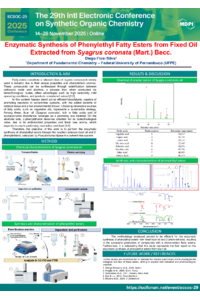
Fatty esters are highly relevant industrially due to their distinctive olfactory characteristics and wide range of applications, from fragrances and cosmetics to food and biolubricants. Among the synthesis routes, enzymatic esterification stands out as a sustainable alternative to conventional chemical catalysts, offering high selectivity, lower byproduct formation, and mild reaction conditions, in line with the principles of green chemistry. In this study, we investigated the synthesis of phenylethyl fatty esters via enzymatic catalysis using licuri oil (Syagrus coronata), 2-phenylethanol, and lipase from Pseudomonas. The oil composition was characterized by acid catalysis followed by chromatography, while the conversion of the esters formed was confirmed by gas chromatography with a flame ionization detector (GC-FID) and Fourier-transform infrared spectroscopy (FTIR). In the obtained products, the absence of the hydroxyl band at 3327 cm⁻¹ indicated the consumption of alcohol during the reaction. The shift of the carbonyl band from 1743 cm⁻¹ to 1736 cm⁻¹ suggested the formation of new esters. Additionally, the presence of bands at 1240–1150 cm⁻¹, attributed to C–O stretching, and at 1607 cm⁻¹, related to the aromatic ring of 2-phenylethanol, corroborated the formation of the desired product. GC-FID analysis also confirmed ester formation, reinforcing the consistency of the results. Thus, this study demonstrates the technical feasibility of the enzymatic approach for producing phenylethyl esters from licuri oil, highlighting their industrial potential.
Keywords
Enzymatic esterification
Syagrus coronata
2-phenylethanol.
Manuscript
chemproc-sciforum_144919_S1_original_MANUSCRIPT_Enzymatic_Synthesis_of_Phenylethyl_Fatty_Esters_from_Fixed-done.pdf
Poster
POSTER - Enzymatic Synthesis of Phenylethyl Fatty Esters from Fixed.pdf
Mechanosynthesis of solid-state benzoxazoles for use as OLED