Event submissions
Published

This submission belongs to the session S2. Chemistry of Bioorganics, Medicinal and Natural Products of the event The 29th International Electronic Conference on Synthetic Organic Chemistry
Published date
26 Nov, 2025
Academic Editor
'%3e%3cpath%20d='M12.6657%2010.9104C12.4185%2010.325%2012.0599%209.79327%2011.6097%209.34482C11.1609%208.89508%2010.6293%208.5365%2010.0442%208.28888C10.0389%208.28626%2010.0337%208.28495%2010.0285%208.28233C10.8446%207.69279%2011.3752%206.73249%2011.3752%205.64904C11.3752%203.8542%209.92103%202.39999%208.1262%202.39999C6.33136%202.39999%204.87715%203.8542%204.87715%205.64904C4.87715%206.73249%205.40774%207.69279%206.22393%208.28364C6.21869%208.28626%206.21345%208.28757%206.20821%208.29019C5.62129%208.5378%205.09463%208.89284%204.64265%209.34613C4.1929%209.79493%203.83432%2010.3266%203.58671%2010.9117C3.34345%2011.4845%203.21226%2012.0987%203.20023%2012.7209C3.19988%2012.7349%203.20233%2012.7488%203.20744%2012.7619C3.21255%2012.7749%203.22022%2012.7867%203.22998%2012.7968C3.23975%2012.8068%203.25142%2012.8147%203.26431%2012.8202C3.2772%2012.8256%203.29105%2012.8284%203.30504%2012.8284H4.09109C4.14874%2012.8284%204.19459%2012.7825%204.1959%2012.7262C4.2221%2011.7148%204.62823%2010.7676%205.34617%2010.0497C6.08899%209.30683%207.0755%208.89808%208.1262%208.89808C9.17689%208.89808%2010.1634%209.30683%2010.9062%2010.0497C11.6242%2010.7676%2012.0303%2011.7148%2012.0565%2012.7262C12.0578%2012.7838%2012.1037%2012.8284%2012.1613%2012.8284H12.9474C12.9613%2012.8284%2012.9752%2012.8256%2012.9881%2012.8202C13.001%2012.8147%2013.0126%2012.8068%2013.0224%2012.7968C13.0322%2012.7867%2013.0398%2012.7749%2013.0449%2012.7619C13.0501%2012.7488%2013.0525%2012.7349%2013.0522%2012.7209C13.0391%2012.0947%2012.9094%2011.4855%2012.6657%2010.9104ZM8.1262%207.9024C7.52486%207.9024%206.9589%207.6679%206.53312%207.24211C6.10733%206.81633%205.87283%206.25037%205.87283%205.64904C5.87283%205.0477%206.10733%204.48174%206.53312%204.05596C6.9589%203.63018%207.52486%203.39567%208.1262%203.39567C8.72753%203.39567%209.29349%203.63018%209.71927%204.05596C10.1451%204.48174%2010.3796%205.0477%2010.3796%205.64904C10.3796%206.25037%2010.1451%206.81633%209.71927%207.24211C9.29349%207.6679%208.72753%207.9024%208.1262%207.9024Z'%20fill='%235D1EE1'/%3e%3c/g%3e%3c/svg%3e) Julio A. Seijas
Julio A. SeijasCitation
Miglena Milusheva, Vera Gledacheva, Mihaela Stoyanova, Mina Todorova, Iliyana Stefanova, Stoyanka Atanasova Nikolova, Structure-Based Design and Synthesis of Novel Hybrid Molecules Derived from Anthranilic Acid as Drug Candidates, in Proceedings of The 29th International Electronic Conference on Synthetic Organic Chemistry, 14 November–28 November 2025, MDPI: Basel, Switzerland, doi: 10.3390/ecsoc-29-26686
Share
Email
Facebook
Twitter
LinkedIn
Structure-Based Design and Synthesis of Novel Hybrid Molecules Derived from Anthranilic Acid as Drug Candidates

Miglena Milusheva 1,2

Vera Gledacheva 3
'%3e%3cpath%20d='M12.6647%2010.9104C12.4176%2010.325%2012.0589%209.7933%2011.6088%209.34485C11.16%208.89511%2010.6283%208.53653%2010.0432%208.28891C10.038%208.28629%2010.0327%208.28498%2010.0275%208.28236C10.8437%207.69282%2011.3743%206.73252%2011.3743%205.64907C11.3743%203.85423%209.92005%202.40002%208.12522%202.40002C6.33038%202.40002%204.87618%203.85423%204.87618%205.64907C4.87618%206.73252%205.40677%207.69282%206.22296%208.28367C6.21772%208.28629%206.21248%208.2876%206.20724%208.29022C5.62031%208.53783%205.09365%208.89287%204.64167%209.34616C4.19192%209.79496%203.83334%2010.3266%203.58573%2010.9117C3.34247%2011.4846%203.21128%2012.0987%203.19925%2012.721C3.1989%2012.735%203.20135%2012.7489%203.20646%2012.7619C3.21157%2012.7749%203.21924%2012.7868%203.22901%2012.7968C3.23877%2012.8068%203.25045%2012.8148%203.26334%2012.8202C3.27623%2012.8256%203.29007%2012.8284%203.30406%2012.8284H4.09012C4.14776%2012.8284%204.19362%2012.7825%204.19493%2012.7262C4.22113%2011.7148%204.62726%2010.7676%205.34519%2010.0497C6.08802%209.30686%207.07452%208.89811%208.12522%208.89811C9.17592%208.89811%2010.1624%209.30686%2010.9052%2010.0497C11.6232%2010.7676%2012.0293%2011.7148%2012.0555%2012.7262C12.0568%2012.7839%2012.1027%2012.8284%2012.1603%2012.8284H12.9464C12.9604%2012.8284%2012.9742%2012.8256%2012.9871%2012.8202C13%2012.8148%2013.0117%2012.8068%2013.0214%2012.7968C13.0312%2012.7868%2013.0389%2012.7749%2013.044%2012.7619C13.0491%2012.7489%2013.0515%2012.735%2013.0512%2012.721C13.0381%2012.0947%2012.9084%2011.4856%2012.6647%2010.9104ZM8.12522%207.90243C7.52388%207.90243%206.95792%207.66793%206.53214%207.24215C6.10636%206.81636%205.87185%206.2504%205.87185%205.64907C5.87185%205.04773%206.10636%204.48177%206.53214%204.05599C6.95792%203.63021%207.52388%203.3957%208.12522%203.3957C8.72655%203.3957%209.29252%203.63021%209.7183%204.05599C10.1441%204.48177%2010.3786%205.04773%2010.3786%205.64907C10.3786%206.2504%2010.1441%206.81636%209.7183%207.24215C9.29252%207.66793%208.72655%207.90243%208.12522%207.90243Z'%20fill='%235D1EE1'/%3e%3c/g%3e%3c/svg%3e)
Mihaela Stoyanova 2
Mina Todorova 2

Iliyana Stefanova 3

Stoyanka Atanasova Nikolova 2
1. Department of Bioorganic Chemistry, Faculty of Pharmacy, Medical University of Plovdiv, 4002 Plovdiv, Bulgaria
2. Department of Organic Chemistry, Faculty of Chemistry, University of Plovdiv, 4000 Plovdiv, Bulgaria
3. Department of Medical Physics and Biophysics, Faculty of Pharmacy, Medical University of Plovdiv, 4002 Plovdiv, Bulgaria
Abstract
Introduction: Modern drug discovery increasingly relies on the concept of hybrid molecules—structures that combine two or more pharmacophoric elements into a single scaffold. This approach allows for the fine-tuning of pharmacological properties and may offer improved selectivity, efficacy, and safety. In this context, anthranilic acid stands out as a versatile building block, already known for its spectrum of biological activities.
Aim: This study aimed to design and synthesize novel anthranilic acid-based hybrid molecules with improved pharmacokinetic and pharmacodynamic properties.
Methods: A combination of cheminformatics tools (SwissADME, PASS, ProTox-II) was used to guide the design of a focused library of target compounds. The synthetic routes involved amide bond formation between anthranilic acid derivatives and substituted 2-phenylethylamines. All compounds were purified and characterized using standard spectroscopic techniques, including NMR, IR, and HRMS. Computational drug-likeness parameters, such as Lipinski compliance, topological polar surface area, and predicted toxicity classes, were evaluated to support candidate selection.
Results: The resulting hybrid structures integrate multiple pharmacophores and demonstrate favorable predicted ADME/tox properties. The synthetic procedures were efficient and reproducible, yielding structurally confirmed compounds ready for further biological exploration.
Conclusion: The generated hybrid structures show promising in silico drug-likeness and synthetic accessibility. This work provides a strong foundation for developing new small molecules aimed at treating disorders involving smooth muscle dysfunction and inflammation.
Acknowledgments: This study is supported by the Bulgarian Ministry of Education, National Program “Young Scientists and Postdoctoral Students–2”, Project № MUPD-HF-017.
Keywords
anthranilic acid derivatives
hybrid molecule synthesis
amide bond formation
structure-based design
2-phenylethylamines
Manuscript
chemproc-sciforum_140595_S2_original_Structure_Based_Design_and_Synthesis_of_Novel_Hybrid_Molecules_Derived_from_Anthranilic_Acid_as_Drug_Candidates_Proceedings_Paper-done.pdf
Poster
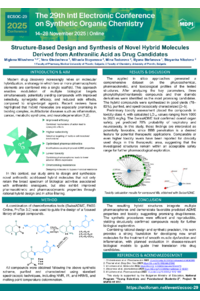
Structure-Based Design and Synthesis of Novel Hybrid Molecules Derived from Anthranilic Acid as Drug Candidates Poster.pdf
Functional Insights into the Active Site of Purified Seed Acid Phosphatase AP-I from Erythrina indica: Role of Key Amino Acid Residues
COMPUTATIONAL SCREENING AND SYNTHESIS OF SOME ISATIN-THIADIAZOLE HYBRIDS POTENTIALLY TARGATING DIABETES