Event submissions
Published

This submission belongs to the session S2. Chemistry of Bioorganics, Medicinal and Natural Products of the event The 29th International Electronic Conference on Synthetic Organic Chemistry
Published date
11 Nov, 2025
Academic Editor
'%3e%3cpath%20d='M12.6657%2010.9104C12.4185%2010.325%2012.0599%209.79327%2011.6097%209.34482C11.1609%208.89508%2010.6293%208.5365%2010.0442%208.28888C10.0389%208.28626%2010.0337%208.28495%2010.0285%208.28233C10.8446%207.69279%2011.3752%206.73249%2011.3752%205.64904C11.3752%203.8542%209.92103%202.39999%208.1262%202.39999C6.33136%202.39999%204.87715%203.8542%204.87715%205.64904C4.87715%206.73249%205.40774%207.69279%206.22393%208.28364C6.21869%208.28626%206.21345%208.28757%206.20821%208.29019C5.62129%208.5378%205.09463%208.89284%204.64265%209.34613C4.1929%209.79493%203.83432%2010.3266%203.58671%2010.9117C3.34345%2011.4845%203.21226%2012.0987%203.20023%2012.7209C3.19988%2012.7349%203.20233%2012.7488%203.20744%2012.7619C3.21255%2012.7749%203.22022%2012.7867%203.22998%2012.7968C3.23975%2012.8068%203.25142%2012.8147%203.26431%2012.8202C3.2772%2012.8256%203.29105%2012.8284%203.30504%2012.8284H4.09109C4.14874%2012.8284%204.19459%2012.7825%204.1959%2012.7262C4.2221%2011.7148%204.62823%2010.7676%205.34617%2010.0497C6.08899%209.30683%207.0755%208.89808%208.1262%208.89808C9.17689%208.89808%2010.1634%209.30683%2010.9062%2010.0497C11.6242%2010.7676%2012.0303%2011.7148%2012.0565%2012.7262C12.0578%2012.7838%2012.1037%2012.8284%2012.1613%2012.8284H12.9474C12.9613%2012.8284%2012.9752%2012.8256%2012.9881%2012.8202C13.001%2012.8147%2013.0126%2012.8068%2013.0224%2012.7968C13.0322%2012.7867%2013.0398%2012.7749%2013.0449%2012.7619C13.0501%2012.7488%2013.0525%2012.7349%2013.0522%2012.7209C13.0391%2012.0947%2012.9094%2011.4855%2012.6657%2010.9104ZM8.1262%207.9024C7.52486%207.9024%206.9589%207.6679%206.53312%207.24211C6.10733%206.81633%205.87283%206.25037%205.87283%205.64904C5.87283%205.0477%206.10733%204.48174%206.53312%204.05596C6.9589%203.63018%207.52486%203.39567%208.1262%203.39567C8.72753%203.39567%209.29349%203.63018%209.71927%204.05596C10.1451%204.48174%2010.3796%205.0477%2010.3796%205.64904C10.3796%206.25037%2010.1451%206.81633%209.71927%207.24211C9.29349%207.6679%208.72753%207.9024%208.1262%207.9024Z'%20fill='%235D1EE1'/%3e%3c/g%3e%3c/svg%3e) Julio A. Seijas
Julio A. SeijasCitation
nessrine KAZI TANI, Hocine ALLALI, anna puscion-jakubik, Nadia AISSAOUI, Katarzyna Socha, Toxicological Assessment of Algerian Honeys: Heavy Metal Contamination as an Indicator of Environmental and Public Health Risks, in Proceedings of The 29th International Electronic Conference on Synthetic Organic Chemistry, 14 November–28 November 2025, MDPI: Basel, Switzerland, doi: 10.3390/ecsoc-29-26688
Share
Email
Facebook
Twitter
LinkedIn
Toxicological Assessment of Algerian Honeys: Heavy Metal Contamination as an Indicator of Environmental and Public Health Risks
'%3e%3cpath%20d='M12.6647%2010.9104C12.4176%2010.325%2012.0589%209.7933%2011.6088%209.34485C11.16%208.89511%2010.6283%208.53653%2010.0432%208.28891C10.038%208.28629%2010.0327%208.28498%2010.0275%208.28236C10.8437%207.69282%2011.3743%206.73252%2011.3743%205.64907C11.3743%203.85423%209.92005%202.40002%208.12522%202.40002C6.33038%202.40002%204.87618%203.85423%204.87618%205.64907C4.87618%206.73252%205.40677%207.69282%206.22296%208.28367C6.21772%208.28629%206.21248%208.2876%206.20724%208.29022C5.62031%208.53783%205.09365%208.89287%204.64167%209.34616C4.19192%209.79496%203.83334%2010.3266%203.58573%2010.9117C3.34247%2011.4846%203.21128%2012.0987%203.19925%2012.721C3.1989%2012.735%203.20135%2012.7489%203.20646%2012.7619C3.21157%2012.7749%203.21924%2012.7868%203.22901%2012.7968C3.23877%2012.8068%203.25045%2012.8148%203.26334%2012.8202C3.27623%2012.8256%203.29007%2012.8284%203.30406%2012.8284H4.09012C4.14776%2012.8284%204.19362%2012.7825%204.19493%2012.7262C4.22113%2011.7148%204.62726%2010.7676%205.34519%2010.0497C6.08802%209.30686%207.07452%208.89811%208.12522%208.89811C9.17592%208.89811%2010.1624%209.30686%2010.9052%2010.0497C11.6232%2010.7676%2012.0293%2011.7148%2012.0555%2012.7262C12.0568%2012.7839%2012.1027%2012.8284%2012.1603%2012.8284H12.9464C12.9604%2012.8284%2012.9742%2012.8256%2012.9871%2012.8202C13%2012.8148%2013.0117%2012.8068%2013.0214%2012.7968C13.0312%2012.7868%2013.0389%2012.7749%2013.044%2012.7619C13.0491%2012.7489%2013.0515%2012.735%2013.0512%2012.721C13.0381%2012.0947%2012.9084%2011.4856%2012.6647%2010.9104ZM8.12522%207.90243C7.52388%207.90243%206.95792%207.66793%206.53214%207.24215C6.10636%206.81636%205.87185%206.2504%205.87185%205.64907C5.87185%205.04773%206.10636%204.48177%206.53214%204.05599C6.95792%203.63021%207.52388%203.3957%208.12522%203.3957C8.72655%203.3957%209.29252%203.63021%209.7183%204.05599C10.1441%204.48177%2010.3786%205.04773%2010.3786%205.64907C10.3786%206.2504%2010.1441%206.81636%209.7183%207.24215C9.29252%207.66793%208.72655%207.90243%208.12522%207.90243Z'%20fill='%235D1EE1'/%3e%3c/g%3e%3c/svg%3e)
nessrine KAZI TANI 1,2
Hocine ALLALI 1

anna puscion-jakubik 3
Nadia AISSAOUI 4

Katarzyna Socha 3
1. Department of Chemistry. Faculty of Sciences. Abou Bekr Belkaïd University, P.O. Box 119, Tlemcen 13000, Algeria
2. Laboratory of Application of Electrolytes and Organic Poly-electrolytes (LCPO), Abou Bekr Belkaïd University, P.O. Box 119, Tlemcen 13000, Algeria
3. Department of Bromatology, Faculty of Pharmacy with the Division of Laboratory Medicine, Medical University of Białystok, Mickiewicza 2D Street, 15-222 Białystok, Poland
4. Laboratory for the Sustainable Management of Natural Resources in Arid and Semi-arid Areas, University Center Salhi Ahmed Naâma, Bp: 66 Naâma 45000, Algeria
Abstract
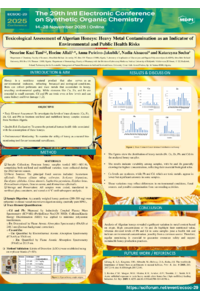
Honey is widely recognised not only for its nutritional and therapeutic properties but also as a natural bioindicator of environmental pollution due to its botanical and geographical origin. In this preliminary study, we assessed the presence of toxic elements in fourteen unifloral and multifloral honeys collected from different regions of northern Algeria, with the aim of evaluating potential public health risks and levels of environmental contamination. The concentrations of selected heavy metals—copper (Cu), iron (Fe), zinc (Zn), cadmium (Cd), and lead (Pb)—were determined using atomic absorption spectrometry (AAS) or inductively coupled plasma mass spectrometry (ICP-MS), depending on the element. Statistical analyses were conducted to explore regional variability and identify potential sources of contamination. The results revealed a wide range of concentrations, namely Cu (0.133–1.975 µg/kg), Fe (1.11–28.04 mg/kg), Zn (4.40–26.30 mg/kg), Cd (1.119–39.521 µg/kg), and Pb (11.515–77.216 µg/kg). Several samples exceeded internationally recommended safety limits for levels of heavy metals such as Cd and Pb, raising concerns regarding long-term dietary exposure. Significant geographical differences were observed, suggesting the influence of local environmental factors and anthropogenic activities. These findings highlight the importance of routine heavy metal monitoring in honey and support its application in environmental surveillance and food safety risk management.
Keywords
Honey
trace metal contamination
health risk assessment
environmental monitoring
food quality.
Manuscript
chemproc-sciforum_139829_S2_original_ALLALI_3_The_29th_Int_Elec_Conf_Syn_Org_Chem_14_28_Nov_2025-done.pdf
Poster
Poster mdpi 2025.pdf
COMPUTATIONAL SCREENING AND SYNTHESIS OF SOME ISATIN-THIADIAZOLE HYBRIDS POTENTIALLY TARGATING DIABETES
Optimization of Alternative Techniques for the Extraction of Natural Pigments from Beetroot Waste