Event submissions
Published

This submission belongs to the session S2. Chemistry of Bioorganics, Medicinal and Natural Products of the event The 29th International Electronic Conference on Synthetic Organic Chemistry
Published date
11 Nov, 2025
Academic Editor
'%3e%3cpath%20d='M12.6657%2010.9104C12.4185%2010.325%2012.0599%209.79327%2011.6097%209.34482C11.1609%208.89508%2010.6293%208.5365%2010.0442%208.28888C10.0389%208.28626%2010.0337%208.28495%2010.0285%208.28233C10.8446%207.69279%2011.3752%206.73249%2011.3752%205.64904C11.3752%203.8542%209.92103%202.39999%208.1262%202.39999C6.33136%202.39999%204.87715%203.8542%204.87715%205.64904C4.87715%206.73249%205.40774%207.69279%206.22393%208.28364C6.21869%208.28626%206.21345%208.28757%206.20821%208.29019C5.62129%208.5378%205.09463%208.89284%204.64265%209.34613C4.1929%209.79493%203.83432%2010.3266%203.58671%2010.9117C3.34345%2011.4845%203.21226%2012.0987%203.20023%2012.7209C3.19988%2012.7349%203.20233%2012.7488%203.20744%2012.7619C3.21255%2012.7749%203.22022%2012.7867%203.22998%2012.7968C3.23975%2012.8068%203.25142%2012.8147%203.26431%2012.8202C3.2772%2012.8256%203.29105%2012.8284%203.30504%2012.8284H4.09109C4.14874%2012.8284%204.19459%2012.7825%204.1959%2012.7262C4.2221%2011.7148%204.62823%2010.7676%205.34617%2010.0497C6.08899%209.30683%207.0755%208.89808%208.1262%208.89808C9.17689%208.89808%2010.1634%209.30683%2010.9062%2010.0497C11.6242%2010.7676%2012.0303%2011.7148%2012.0565%2012.7262C12.0578%2012.7838%2012.1037%2012.8284%2012.1613%2012.8284H12.9474C12.9613%2012.8284%2012.9752%2012.8256%2012.9881%2012.8202C13.001%2012.8147%2013.0126%2012.8068%2013.0224%2012.7968C13.0322%2012.7867%2013.0398%2012.7749%2013.0449%2012.7619C13.0501%2012.7488%2013.0525%2012.7349%2013.0522%2012.7209C13.0391%2012.0947%2012.9094%2011.4855%2012.6657%2010.9104ZM8.1262%207.9024C7.52486%207.9024%206.9589%207.6679%206.53312%207.24211C6.10733%206.81633%205.87283%206.25037%205.87283%205.64904C5.87283%205.0477%206.10733%204.48174%206.53312%204.05596C6.9589%203.63018%207.52486%203.39567%208.1262%203.39567C8.72753%203.39567%209.29349%203.63018%209.71927%204.05596C10.1451%204.48174%2010.3796%205.0477%2010.3796%205.64904C10.3796%206.25037%2010.1451%206.81633%209.71927%207.24211C9.29349%207.6679%208.72753%207.9024%208.1262%207.9024Z'%20fill='%235D1EE1'/%3e%3c/g%3e%3c/svg%3e) Julio A. Seijas
Julio A. SeijasCitation
Beatriz Elizabeth Utrera Hernández, Ever Blé Gonzalez, Manases Gonzalez Cortazar, Maria Dolores Pérez García, Alejandro Zamilpa, "Bioactive potential of the Ethyl Acetate Extract from Prosopis laevigata: Antimicrobial and Anti-inflammatory effects", in Proceedings of The 29th International Electronic Conference on Synthetic Organic Chemistry, 14 November–28 November 2025, MDPI: Basel, Switzerland, doi: 10.3390/ecsoc-29-26717
Share
Email
Facebook
Twitter
LinkedIn
"Bioactive potential of the Ethyl Acetate Extract from Prosopis laevigata: Antimicrobial and Anti-inflammatory effects"
'%3e%3cpath%20d='M12.6647%2010.9104C12.4176%2010.325%2012.0589%209.7933%2011.6088%209.34485C11.16%208.89511%2010.6283%208.53653%2010.0432%208.28891C10.038%208.28629%2010.0327%208.28498%2010.0275%208.28236C10.8437%207.69282%2011.3743%206.73252%2011.3743%205.64907C11.3743%203.85423%209.92005%202.40002%208.12522%202.40002C6.33038%202.40002%204.87618%203.85423%204.87618%205.64907C4.87618%206.73252%205.40677%207.69282%206.22296%208.28367C6.21772%208.28629%206.21248%208.2876%206.20724%208.29022C5.62031%208.53783%205.09365%208.89287%204.64167%209.34616C4.19192%209.79496%203.83334%2010.3266%203.58573%2010.9117C3.34247%2011.4846%203.21128%2012.0987%203.19925%2012.721C3.1989%2012.735%203.20135%2012.7489%203.20646%2012.7619C3.21157%2012.7749%203.21924%2012.7868%203.22901%2012.7968C3.23877%2012.8068%203.25045%2012.8148%203.26334%2012.8202C3.27623%2012.8256%203.29007%2012.8284%203.30406%2012.8284H4.09012C4.14776%2012.8284%204.19362%2012.7825%204.19493%2012.7262C4.22113%2011.7148%204.62726%2010.7676%205.34519%2010.0497C6.08802%209.30686%207.07452%208.89811%208.12522%208.89811C9.17592%208.89811%2010.1624%209.30686%2010.9052%2010.0497C11.6232%2010.7676%2012.0293%2011.7148%2012.0555%2012.7262C12.0568%2012.7839%2012.1027%2012.8284%2012.1603%2012.8284H12.9464C12.9604%2012.8284%2012.9742%2012.8256%2012.9871%2012.8202C13%2012.8148%2013.0117%2012.8068%2013.0214%2012.7968C13.0312%2012.7868%2013.0389%2012.7749%2013.044%2012.7619C13.0491%2012.7489%2013.0515%2012.735%2013.0512%2012.721C13.0381%2012.0947%2012.9084%2011.4856%2012.6647%2010.9104ZM8.12522%207.90243C7.52388%207.90243%206.95792%207.66793%206.53214%207.24215C6.10636%206.81636%205.87185%206.2504%205.87185%205.64907C5.87185%205.04773%206.10636%204.48177%206.53214%204.05599C6.95792%203.63021%207.52388%203.3957%208.12522%203.3957C8.72655%203.3957%209.29252%203.63021%209.7183%204.05599C10.1441%204.48177%2010.3786%205.04773%2010.3786%205.64907C10.3786%206.2504%2010.1441%206.81636%209.7183%207.24215C9.29252%207.66793%208.72655%207.90243%208.12522%207.90243Z'%20fill='%235D1EE1'/%3e%3c/g%3e%3c/svg%3e)
Beatriz Elizabeth Utrera Hernández 1
Ever Blé Gonzalez 1

Manases Gonzalez Cortazar 2

Maria Dolores Pérez García 2

Alejandro Zamilpa 2
1. División Académica de Ciencias Básicas, Universidad Juárez Autónoma de Tabasco, Carretera Cunducán-Jalpa Km. 0.5, Cunduacán 86690, Tabasco, Mexico
2. Centro de Investigación Biomédica del Sur, Instituto Mexicano del Seguro Social (IMSS), Argentina 1, 62790 Xochitepec, Morelos, México
Abstract
Introduction
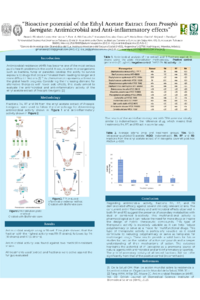
Antimicrobial resistance (AMR) occurs when treatment of infections caused by viruses, bacteria, fungi, or parasites becomes ineffective, allowing the microorganism to persist in the host, leading to the spread of disease, its progression, or even death. This phenomenon represents a threat to the global health progress. Considering the increasing demand for alternative therapies with fewer side effects, this study aimed to evaluate the antimicrobial and anti-inflammatory activity of the ethyl acetate extract of Prosopis laevigata.
Results and Discussion
The chromatographic analysis of the ethyl acetate extract from Prosopis laevigata was carried out by High-Performance Liquid Chromatography (HPLC) at a detection wavelength of 330nm. A significant retention time was observed at 13.917 min (λmax = 199.0, 253.3 and 349.4nm), suggesting this compound corresponds to luteolin. Fraction R9 showed antimicrobial activity against 11 strains, including Staphylococcus aureus, S. epidermidis, K. pneumoniae, P. aeruginosa, S. dublin and Candida albicans. In the TPA-induced inflammation model, R9 reduced edema to 2.675 mg, R4 to 2.850 mg, and R7 to 3.450 mg. The positive control (indomethacin) showed significant inhibition with 1.380 mg. These values correspond to inhibition rates of 75.74%, 74.15%, and 68.71%. Statistical analysis showed anti-inflammatory effects comparable to indomethacin. The results were analyzed using one-way ANOVA and Dunnett’s post hoc test (p ≤ 0.05).
Experimental Section
The antimicrobial activity was determined by minimal inhibitory concentration (MIC) against 14 strains. Anti-inflammatory activity was tested using a TPA-induced ear edema model in ICR mice. HPLC-PDA was used to analyze the extract’s chemical profile.
Keywords
Prosopis laevigata
antimicrobial
anti-inflammatory
ethyl acetate
antimicrobial resistance (AMR)
inflammation
Manuscript
chemproc-sciforum_135782_S2_original_17_OCTUBRE_Bioactive_potential_of_the_Ethyl_Acetate_Extract_from_Prosopis_laevigata_Antimicrobial_and_Anti_inflammatory_effects-done.pdf
Poster
17 octubre POSTER SCIFORUM.pdf
Tocopherol-Doxorubicin Conjugate as a Lipid-Prodrug: Synthesis methods, Self-assembly, Breast Cancer Cell Inhibition, and Theoretical Analysis
Halogenated Cinnamanilides and Their Activity against Selected Gram-negative Bacteria