Event submissions
Published

This submission belongs to the session S3. Polymers and Supramolecular Chemistry of the event The 29th International Electronic Conference on Synthetic Organic Chemistry
Published date
11 Nov, 2025
Academic Editor
'%3e%3cpath%20d='M12.6657%2010.9104C12.4185%2010.325%2012.0599%209.79327%2011.6097%209.34482C11.1609%208.89508%2010.6293%208.5365%2010.0442%208.28888C10.0389%208.28626%2010.0337%208.28495%2010.0285%208.28233C10.8446%207.69279%2011.3752%206.73249%2011.3752%205.64904C11.3752%203.8542%209.92103%202.39999%208.1262%202.39999C6.33136%202.39999%204.87715%203.8542%204.87715%205.64904C4.87715%206.73249%205.40774%207.69279%206.22393%208.28364C6.21869%208.28626%206.21345%208.28757%206.20821%208.29019C5.62129%208.5378%205.09463%208.89284%204.64265%209.34613C4.1929%209.79493%203.83432%2010.3266%203.58671%2010.9117C3.34345%2011.4845%203.21226%2012.0987%203.20023%2012.7209C3.19988%2012.7349%203.20233%2012.7488%203.20744%2012.7619C3.21255%2012.7749%203.22022%2012.7867%203.22998%2012.7968C3.23975%2012.8068%203.25142%2012.8147%203.26431%2012.8202C3.2772%2012.8256%203.29105%2012.8284%203.30504%2012.8284H4.09109C4.14874%2012.8284%204.19459%2012.7825%204.1959%2012.7262C4.2221%2011.7148%204.62823%2010.7676%205.34617%2010.0497C6.08899%209.30683%207.0755%208.89808%208.1262%208.89808C9.17689%208.89808%2010.1634%209.30683%2010.9062%2010.0497C11.6242%2010.7676%2012.0303%2011.7148%2012.0565%2012.7262C12.0578%2012.7838%2012.1037%2012.8284%2012.1613%2012.8284H12.9474C12.9613%2012.8284%2012.9752%2012.8256%2012.9881%2012.8202C13.001%2012.8147%2013.0126%2012.8068%2013.0224%2012.7968C13.0322%2012.7867%2013.0398%2012.7749%2013.0449%2012.7619C13.0501%2012.7488%2013.0525%2012.7349%2013.0522%2012.7209C13.0391%2012.0947%2012.9094%2011.4855%2012.6657%2010.9104ZM8.1262%207.9024C7.52486%207.9024%206.9589%207.6679%206.53312%207.24211C6.10733%206.81633%205.87283%206.25037%205.87283%205.64904C5.87283%205.0477%206.10733%204.48174%206.53312%204.05596C6.9589%203.63018%207.52486%203.39567%208.1262%203.39567C8.72753%203.39567%209.29349%203.63018%209.71927%204.05596C10.1451%204.48174%2010.3796%205.0477%2010.3796%205.64904C10.3796%206.25037%2010.1451%206.81633%209.71927%207.24211C9.29349%207.6679%208.72753%207.9024%208.1262%207.9024Z'%20fill='%235D1EE1'/%3e%3c/g%3e%3c/svg%3e) Julio A. Seijas
Julio A. SeijasCitation
Adriana Popa, Aurelia Visa, Laura Cocheci, Lavinia Lupa, Milica Țară-Lungă Mihali, Ecaterina Stela Dragan, STYRENE-DIVINYLBENZENE COPOLYMERS FUNCTIONALIZED WITH AMINOACID GROUPS: SYNTHESIS, PHYSICOCHEMICAL CHARACTERIZATION, in Proceedings of The 29th International Electronic Conference on Synthetic Organic Chemistry, 14 November–28 November 2025, MDPI: Basel, Switzerland, doi: 10.3390/ecsoc-29-26721
Share
Email
Facebook
Twitter
LinkedIn
STYRENE-DIVINYLBENZENE COPOLYMERS FUNCTIONALIZED WITH AMINOACID GROUPS: SYNTHESIS, PHYSICOCHEMICAL CHARACTERIZATION
'%3e%3cpath%20d='M12.6647%2010.9104C12.4176%2010.325%2012.0589%209.7933%2011.6088%209.34485C11.16%208.89511%2010.6283%208.53653%2010.0432%208.28891C10.038%208.28629%2010.0327%208.28498%2010.0275%208.28236C10.8437%207.69282%2011.3743%206.73252%2011.3743%205.64907C11.3743%203.85423%209.92005%202.40002%208.12522%202.40002C6.33038%202.40002%204.87618%203.85423%204.87618%205.64907C4.87618%206.73252%205.40677%207.69282%206.22296%208.28367C6.21772%208.28629%206.21248%208.2876%206.20724%208.29022C5.62031%208.53783%205.09365%208.89287%204.64167%209.34616C4.19192%209.79496%203.83334%2010.3266%203.58573%2010.9117C3.34247%2011.4846%203.21128%2012.0987%203.19925%2012.721C3.1989%2012.735%203.20135%2012.7489%203.20646%2012.7619C3.21157%2012.7749%203.21924%2012.7868%203.22901%2012.7968C3.23877%2012.8068%203.25045%2012.8148%203.26334%2012.8202C3.27623%2012.8256%203.29007%2012.8284%203.30406%2012.8284H4.09012C4.14776%2012.8284%204.19362%2012.7825%204.19493%2012.7262C4.22113%2011.7148%204.62726%2010.7676%205.34519%2010.0497C6.08802%209.30686%207.07452%208.89811%208.12522%208.89811C9.17592%208.89811%2010.1624%209.30686%2010.9052%2010.0497C11.6232%2010.7676%2012.0293%2011.7148%2012.0555%2012.7262C12.0568%2012.7839%2012.1027%2012.8284%2012.1603%2012.8284H12.9464C12.9604%2012.8284%2012.9742%2012.8256%2012.9871%2012.8202C13%2012.8148%2013.0117%2012.8068%2013.0214%2012.7968C13.0312%2012.7868%2013.0389%2012.7749%2013.044%2012.7619C13.0491%2012.7489%2013.0515%2012.735%2013.0512%2012.721C13.0381%2012.0947%2012.9084%2011.4856%2012.6647%2010.9104ZM8.12522%207.90243C7.52388%207.90243%206.95792%207.66793%206.53214%207.24215C6.10636%206.81636%205.87185%206.2504%205.87185%205.64907C5.87185%205.04773%206.10636%204.48177%206.53214%204.05599C6.95792%203.63021%207.52388%203.3957%208.12522%203.3957C8.72655%203.3957%209.29252%203.63021%209.7183%204.05599C10.1441%204.48177%2010.3786%205.04773%2010.3786%205.64907C10.3786%206.2504%2010.1441%206.81636%209.7183%207.24215C9.29252%207.66793%208.72655%207.90243%208.12522%207.90243Z'%20fill='%235D1EE1'/%3e%3c/g%3e%3c/svg%3e)
Adriana Popa 1

Aurelia Visa 1

Laura Cocheci 2

Lavinia Lupa 2
Milica Țară-Lungă Mihali 1
Ecaterina Stela Dragan 3
1. “Coriolan Drăgulescu” Institute of Chemistry, 24 Mihai Viteazul Blv., 300223 Timisoara, Romania
2. Faculty of Chemical Engineering, Biotechnology and Environmental Protection, Politehnica University Timișoara, 6 Vasile Parvan Blvd., 300223 Timisoara, Romania
3. ”Petru Poni” Institute of Macromolecular Chemistry, 41A Aleea Grigore Ghica Vodă, 700487 Iași, Romania
Abstract
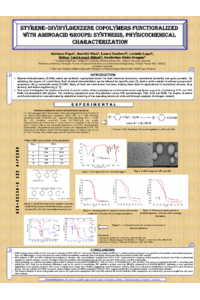
Styrene-divinylbenzene resins are synthetic copolymers known for their chemical resistance, mechanical durability, and good porosity . Amino acids contain functional groups such as amines (-NH₂), carboxylic acids (-COOH). Many of them are natural and non-toxic, making them ideal for applications in biomedical devices, drug delivery, and tissue engineering. This work investigates the physicochemical characterization of two copolymer supports, (containing 6.7% and 15% DVB), functionalized with aminoacid. The syntheses to obtain AP1 and AP2 were performed as presented in a previous paper. FTIR analysis shows shifts in C=O, C–N, and C–H bands at 1510–1365 cm⁻¹ and broad OH/NH absorption at 3510 cm⁻¹, confirming the copolymer's functionalization. EDX analysis of AP1 and AP2 confirmed the presence of nitrogen, with concentrations ranging from 0.4% to 0.5%. TGA was further employed to investigate the impact of grafted aminoacid groups on the thermal stability and decomposition behavior of the copolymers. Thermal stability, as indicated by residual mass at 900 °C, follows the trend:S-6.7%DVBCH₂Cl > AP2 (21.72%) > S-15%DVBCH₂Cl > AP1 (15.52%). AP1 exhibits a greater mass loss (84.48%) compared to S-15%DVB (80.82%), indicating a more significant degradation of its polymer structure. AP2 shows a slightly lower weight loss (78.28%), suggesting improved thermal stability, likely due to structural modifications involving aminoacid functional groups. The differences in functionalization and degree of crosslinking between AP1 and AP2 contribute to AP2’s more thermal stability.
Keywords
aminoacid groups
styrene-divinylbenzene
functionalized copolymer
Manuscript
chemproc-sciforum_132736_S3_original_Chemistry_Proceedings_Adriana_Popa_R1-done.pdf
Poster
Adriana Popa-Poster.pdf
UV-Visible spectrophotometric determination of Vonoprazan Fumarate in Pharmaceutical Formulation through Complex Formation with Cu(II) and Fe(II) ions
Integration of CO/PES support modules for enhancement of modified-chitosan filtration membranes