Event submissions
Published

This submission belongs to the session S2. Chemistry of Bioorganics, Medicinal and Natural Products of the event The 29th International Electronic Conference on Synthetic Organic Chemistry
Published date
11 Nov, 2025
Academic Editor
'%3e%3cpath%20d='M12.6657%2010.9104C12.4185%2010.325%2012.0599%209.79327%2011.6097%209.34482C11.1609%208.89508%2010.6293%208.5365%2010.0442%208.28888C10.0389%208.28626%2010.0337%208.28495%2010.0285%208.28233C10.8446%207.69279%2011.3752%206.73249%2011.3752%205.64904C11.3752%203.8542%209.92103%202.39999%208.1262%202.39999C6.33136%202.39999%204.87715%203.8542%204.87715%205.64904C4.87715%206.73249%205.40774%207.69279%206.22393%208.28364C6.21869%208.28626%206.21345%208.28757%206.20821%208.29019C5.62129%208.5378%205.09463%208.89284%204.64265%209.34613C4.1929%209.79493%203.83432%2010.3266%203.58671%2010.9117C3.34345%2011.4845%203.21226%2012.0987%203.20023%2012.7209C3.19988%2012.7349%203.20233%2012.7488%203.20744%2012.7619C3.21255%2012.7749%203.22022%2012.7867%203.22998%2012.7968C3.23975%2012.8068%203.25142%2012.8147%203.26431%2012.8202C3.2772%2012.8256%203.29105%2012.8284%203.30504%2012.8284H4.09109C4.14874%2012.8284%204.19459%2012.7825%204.1959%2012.7262C4.2221%2011.7148%204.62823%2010.7676%205.34617%2010.0497C6.08899%209.30683%207.0755%208.89808%208.1262%208.89808C9.17689%208.89808%2010.1634%209.30683%2010.9062%2010.0497C11.6242%2010.7676%2012.0303%2011.7148%2012.0565%2012.7262C12.0578%2012.7838%2012.1037%2012.8284%2012.1613%2012.8284H12.9474C12.9613%2012.8284%2012.9752%2012.8256%2012.9881%2012.8202C13.001%2012.8147%2013.0126%2012.8068%2013.0224%2012.7968C13.0322%2012.7867%2013.0398%2012.7749%2013.0449%2012.7619C13.0501%2012.7488%2013.0525%2012.7349%2013.0522%2012.7209C13.0391%2012.0947%2012.9094%2011.4855%2012.6657%2010.9104ZM8.1262%207.9024C7.52486%207.9024%206.9589%207.6679%206.53312%207.24211C6.10733%206.81633%205.87283%206.25037%205.87283%205.64904C5.87283%205.0477%206.10733%204.48174%206.53312%204.05596C6.9589%203.63018%207.52486%203.39567%208.1262%203.39567C8.72753%203.39567%209.29349%203.63018%209.71927%204.05596C10.1451%204.48174%2010.3796%205.0477%2010.3796%205.64904C10.3796%206.25037%2010.1451%206.81633%209.71927%207.24211C9.29349%207.6679%208.72753%207.9024%208.1262%207.9024Z'%20fill='%235D1EE1'/%3e%3c/g%3e%3c/svg%3e) Julio A. Seijas
Julio A. SeijasCitation
Egor Vyacheslavovich Morozov, Denis Andreevich Kolesnik, Igor Pavlovich Yakovlev, Marina Vasilevna Sopova, Oleg Aleksandrovich Kolesnik, Synthesis of a new bis(1,2,4-triazole) derivative with antimicrobial activity, in Proceedings of The 29th International Electronic Conference on Synthetic Organic Chemistry, 14 November–28 November 2025, MDPI: Basel, Switzerland, doi: 10.3390/ecsoc-29-26734
Share
Email
Facebook
Twitter
LinkedIn
Synthesis of a new bis(1,2,4-triazole) derivative with antimicrobial activity
'%3e%3cpath%20d='M12.6647%2010.9104C12.4176%2010.325%2012.0589%209.7933%2011.6088%209.34485C11.16%208.89511%2010.6283%208.53653%2010.0432%208.28891C10.038%208.28629%2010.0327%208.28498%2010.0275%208.28236C10.8437%207.69282%2011.3743%206.73252%2011.3743%205.64907C11.3743%203.85423%209.92005%202.40002%208.12522%202.40002C6.33038%202.40002%204.87618%203.85423%204.87618%205.64907C4.87618%206.73252%205.40677%207.69282%206.22296%208.28367C6.21772%208.28629%206.21248%208.2876%206.20724%208.29022C5.62031%208.53783%205.09365%208.89287%204.64167%209.34616C4.19192%209.79496%203.83334%2010.3266%203.58573%2010.9117C3.34247%2011.4846%203.21128%2012.0987%203.19925%2012.721C3.1989%2012.735%203.20135%2012.7489%203.20646%2012.7619C3.21157%2012.7749%203.21924%2012.7868%203.22901%2012.7968C3.23877%2012.8068%203.25045%2012.8148%203.26334%2012.8202C3.27623%2012.8256%203.29007%2012.8284%203.30406%2012.8284H4.09012C4.14776%2012.8284%204.19362%2012.7825%204.19493%2012.7262C4.22113%2011.7148%204.62726%2010.7676%205.34519%2010.0497C6.08802%209.30686%207.07452%208.89811%208.12522%208.89811C9.17592%208.89811%2010.1624%209.30686%2010.9052%2010.0497C11.6232%2010.7676%2012.0293%2011.7148%2012.0555%2012.7262C12.0568%2012.7839%2012.1027%2012.8284%2012.1603%2012.8284H12.9464C12.9604%2012.8284%2012.9742%2012.8256%2012.9871%2012.8202C13%2012.8148%2013.0117%2012.8068%2013.0214%2012.7968C13.0312%2012.7868%2013.0389%2012.7749%2013.044%2012.7619C13.0491%2012.7489%2013.0515%2012.735%2013.0512%2012.721C13.0381%2012.0947%2012.9084%2011.4856%2012.6647%2010.9104ZM8.12522%207.90243C7.52388%207.90243%206.95792%207.66793%206.53214%207.24215C6.10636%206.81636%205.87185%206.2504%205.87185%205.64907C5.87185%205.04773%206.10636%204.48177%206.53214%204.05599C6.95792%203.63021%207.52388%203.3957%208.12522%203.3957C8.72655%203.3957%209.29252%203.63021%209.7183%204.05599C10.1441%204.48177%2010.3786%205.04773%2010.3786%205.64907C10.3786%206.2504%2010.1441%206.81636%209.7183%207.24215C9.29252%207.66793%208.72655%207.90243%208.12522%207.90243Z'%20fill='%235D1EE1'/%3e%3c/g%3e%3c/svg%3e)
Egor Vyacheslavovich Morozov 1
Denis Andreevich Kolesnik 1
Igor Pavlovich Yakovlev 1
Marina Vasilevna Sopova 1
Oleg Aleksandrovich Kolesnik 1
1. Department of Organic Chemistry, State Federal-Funded Educational Institution of Higher Education «Saint Petersburg State Chemical and Pharmaceutical University of the Ministry of Healthcare of the Russian Federa-tion», 197022 St. Petersburg, Russia
Abstract
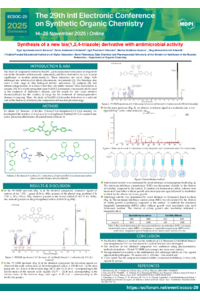
The importance of 1,2,4-triazole derivatives in modern pharmaceuticals is very high. They find their application in drug therapy as antifungal, antifungal agents (fluconazole, intraconazole). It is worth noting that some 1,2,4-triazole compounds are used in therapy for the treatment of Alzheimer's disease, and new, more effective pharmacophores are being sought to create drugs for neurodegenerative diseases. We have proposed a modernized method for obtaining a new bis(1,2,4-triazole) derivative using the recyclization reaction of 4-hydroxy-2,5-disubstituted-1,3-6H-oxazin-6-ones with a bisnucleophilic reagent, which was m-phenylenedihydrazine. The method of preparation described in the literature did not lead to the expected products, so it was necessary to select new reaction conditions. 1,1′-(benzene-1,3-diyl)bis[5-benzyl-3-(4-nitrophenyl)-1H-1,2,4-triazole] was obtained by recyclization of 4-hydroxy-2-(4-nitrophenyl)-5-phenyl-6H-1,3-oxazin-6-one with m-phenylenedihydrazine dihydrochloride in absolute methanol in the presence of sodium methoxide for 48 hours. The structure of the compound was confirmed by 1H, 13C NMR spectroscopy and mass spectrometry. Antifungal and antibacterial activities were determined by serial dilutions using meat-peptone broth and Sabouraud medium. The yield based on 4-hydroxy-2-(4-nitrophenyl)-5-phenyl-6H-1,3-oxazin-6-one was 76%. The obtained compound exhibits antimicrobial activity against Staphylococcus aureus with a minimum inhibitory concentration of 62.5 μg/ml and 125 μg/ml against Candida albicans.
Keywords
bis(1,2,4-triazoles)
recycling
m-phenylenedihydrazine dihydrochloride
antimicrobial activity
Staphylococcus aureus
minimum inhibitory concentration.
Manuscript
chemproc-sciforum_137156_S2_original_Morozov_Egor_ECSOC_29-done.pdf
Poster
Morozov Egor ECSOC-29.pdf
A Computational Study to Determine Thermodynamic Properties for Hydrogen Production From Sodium Borohydride Reaction
TOWARDS TRANSFORMATIVE HEALTHCARE APPLICATIONS: BIOMIMETIC HYDROXYAPATITE SYSTEMS FOR CONTROLLED DRUG DELIVERY