Event submissions
Published

This submission belongs to the session S2. Chemistry of Bioorganics, Medicinal and Natural Products of the event The 29th International Electronic Conference on Synthetic Organic Chemistry
Published date
11 Nov, 2025
Academic Editor
'%3e%3cpath%20d='M12.6657%2010.9104C12.4185%2010.325%2012.0599%209.79327%2011.6097%209.34482C11.1609%208.89508%2010.6293%208.5365%2010.0442%208.28888C10.0389%208.28626%2010.0337%208.28495%2010.0285%208.28233C10.8446%207.69279%2011.3752%206.73249%2011.3752%205.64904C11.3752%203.8542%209.92103%202.39999%208.1262%202.39999C6.33136%202.39999%204.87715%203.8542%204.87715%205.64904C4.87715%206.73249%205.40774%207.69279%206.22393%208.28364C6.21869%208.28626%206.21345%208.28757%206.20821%208.29019C5.62129%208.5378%205.09463%208.89284%204.64265%209.34613C4.1929%209.79493%203.83432%2010.3266%203.58671%2010.9117C3.34345%2011.4845%203.21226%2012.0987%203.20023%2012.7209C3.19988%2012.7349%203.20233%2012.7488%203.20744%2012.7619C3.21255%2012.7749%203.22022%2012.7867%203.22998%2012.7968C3.23975%2012.8068%203.25142%2012.8147%203.26431%2012.8202C3.2772%2012.8256%203.29105%2012.8284%203.30504%2012.8284H4.09109C4.14874%2012.8284%204.19459%2012.7825%204.1959%2012.7262C4.2221%2011.7148%204.62823%2010.7676%205.34617%2010.0497C6.08899%209.30683%207.0755%208.89808%208.1262%208.89808C9.17689%208.89808%2010.1634%209.30683%2010.9062%2010.0497C11.6242%2010.7676%2012.0303%2011.7148%2012.0565%2012.7262C12.0578%2012.7838%2012.1037%2012.8284%2012.1613%2012.8284H12.9474C12.9613%2012.8284%2012.9752%2012.8256%2012.9881%2012.8202C13.001%2012.8147%2013.0126%2012.8068%2013.0224%2012.7968C13.0322%2012.7867%2013.0398%2012.7749%2013.0449%2012.7619C13.0501%2012.7488%2013.0525%2012.7349%2013.0522%2012.7209C13.0391%2012.0947%2012.9094%2011.4855%2012.6657%2010.9104ZM8.1262%207.9024C7.52486%207.9024%206.9589%207.6679%206.53312%207.24211C6.10733%206.81633%205.87283%206.25037%205.87283%205.64904C5.87283%205.0477%206.10733%204.48174%206.53312%204.05596C6.9589%203.63018%207.52486%203.39567%208.1262%203.39567C8.72753%203.39567%209.29349%203.63018%209.71927%204.05596C10.1451%204.48174%2010.3796%205.0477%2010.3796%205.64904C10.3796%206.25037%2010.1451%206.81633%209.71927%207.24211C9.29349%207.6679%208.72753%207.9024%208.1262%207.9024Z'%20fill='%235D1EE1'/%3e%3c/g%3e%3c/svg%3e) Julio A. Seijas
Julio A. SeijasCitation
Olumakinde Charles Omiyale, TOWARDS TRANSFORMATIVE HEALTHCARE APPLICATIONS: BIOMIMETIC HYDROXYAPATITE SYSTEMS FOR CONTROLLED DRUG DELIVERY, in Proceedings of The 29th International Electronic Conference on Synthetic Organic Chemistry, 14 November–28 November 2025, MDPI: Basel, Switzerland, doi: 10.3390/ecsoc-29-26735
Share
Email
Facebook
Twitter
LinkedIn
TOWARDS TRANSFORMATIVE HEALTHCARE APPLICATIONS: BIOMIMETIC HYDROXYAPATITE SYSTEMS FOR CONTROLLED DRUG DELIVERY
'%3e%3cpath%20d='M12.6647%2010.9104C12.4176%2010.325%2012.0589%209.7933%2011.6088%209.34485C11.16%208.89511%2010.6283%208.53653%2010.0432%208.28891C10.038%208.28629%2010.0327%208.28498%2010.0275%208.28236C10.8437%207.69282%2011.3743%206.73252%2011.3743%205.64907C11.3743%203.85423%209.92005%202.40002%208.12522%202.40002C6.33038%202.40002%204.87618%203.85423%204.87618%205.64907C4.87618%206.73252%205.40677%207.69282%206.22296%208.28367C6.21772%208.28629%206.21248%208.2876%206.20724%208.29022C5.62031%208.53783%205.09365%208.89287%204.64167%209.34616C4.19192%209.79496%203.83334%2010.3266%203.58573%2010.9117C3.34247%2011.4846%203.21128%2012.0987%203.19925%2012.721C3.1989%2012.735%203.20135%2012.7489%203.20646%2012.7619C3.21157%2012.7749%203.21924%2012.7868%203.22901%2012.7968C3.23877%2012.8068%203.25045%2012.8148%203.26334%2012.8202C3.27623%2012.8256%203.29007%2012.8284%203.30406%2012.8284H4.09012C4.14776%2012.8284%204.19362%2012.7825%204.19493%2012.7262C4.22113%2011.7148%204.62726%2010.7676%205.34519%2010.0497C6.08802%209.30686%207.07452%208.89811%208.12522%208.89811C9.17592%208.89811%2010.1624%209.30686%2010.9052%2010.0497C11.6232%2010.7676%2012.0293%2011.7148%2012.0555%2012.7262C12.0568%2012.7839%2012.1027%2012.8284%2012.1603%2012.8284H12.9464C12.9604%2012.8284%2012.9742%2012.8256%2012.9871%2012.8202C13%2012.8148%2013.0117%2012.8068%2013.0214%2012.7968C13.0312%2012.7868%2013.0389%2012.7749%2013.044%2012.7619C13.0491%2012.7489%2013.0515%2012.735%2013.0512%2012.721C13.0381%2012.0947%2012.9084%2011.4856%2012.6647%2010.9104ZM8.12522%207.90243C7.52388%207.90243%206.95792%207.66793%206.53214%207.24215C6.10636%206.81636%205.87185%206.2504%205.87185%205.64907C5.87185%205.04773%206.10636%204.48177%206.53214%204.05599C6.95792%203.63021%207.52388%203.3957%208.12522%203.3957C8.72655%203.3957%209.29252%203.63021%209.7183%204.05599C10.1441%204.48177%2010.3786%205.04773%2010.3786%205.64907C10.3786%206.2504%2010.1441%206.81636%209.7183%207.24215C9.29252%207.66793%208.72655%207.90243%208.12522%207.90243Z'%20fill='%235D1EE1'/%3e%3c/g%3e%3c/svg%3e)
Olumakinde Charles Omiyale 1
1. Infochemistry Scientific Centre. ITMO University. Saint Petersburg. 197101. Russia
Abstract
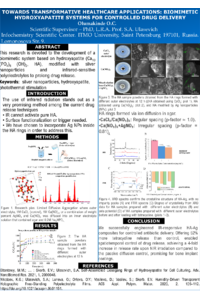
Recently, there has been a growing interest in multifunctional materials, therefore we developed a system that combines biocompatibility, gradient changing and antibacterial properties. We aim to combine these properties in the development of a biomimetic system based on hydroxyapatite (Ca10 (PO4)6 (OH)2, HA) by incorporating silver nanoparticles (Ag NPs) into HA matrices, leveraging their antimicrobial effects, while also exploring their role as drug release triggers (absorb infrared (IR) light of 808-960 nm, convert to heat energy to induce localized heating and cause a structure leak for drug release) to unmodified HA which cannot be activated by IR in significant amounts. Limited diffusion aggregation is used to form HA (enhanced with glycine or produced with different outer electrolytes) by diffusing calcium phosphates through Na2HPO4-agar. The composite was then packed with tetracycline and deposition of polyelectrolytes (PE). The combination of polydiallyldimethylammonium chloride (PDADMAC) and heparin forms a robust PE. Infrared light (808 nm, 1.4 mW/cm²) was utilized as energy source for non-invasive and on-demand drug release. Physical and chemical characterization of HA was carried out. Glycine did not affect the p-factor of the resulting rings, which is equal to ca. 1.00. NIR increased release rates 2.1-fold (k = 39.21 compared to 18.22). High glycine concentrations reduces HA crystallinity (94 to 30%), a 12.5% increased drug loading capacity, increases solubility (5× control). NIR reduced the Korsmeyer-Peppas release exponent (n) from 0.42 (Fickian) to 0.11 (PE-coated HA-Ag), confirming photothermal disruption of diffusion barriers due to the presence of silver nanoparticle peaks in the composition.
Keywords
hydroxyapatite patterns
infrared-triggered release
tetracycline
PDADMAC-heparin layer.
Manuscript
chemproc-sciforum_123709_S2_original_omiyale_MDPI_FULL_FILE_ABSTRACT-done.pdf
Poster
MDPI POSTER TOWARDS TRANSFORMATIVE HEALTHCARE APPLICA-TIONS BIOMIMETIC HYDROXYAPATITE SYSTEMS FOR CONTROLLED DRUG DELIVERY .pdf
Synthesis of a new bis(1,2,4-triazole) derivative with antimicrobial activity
Study and development on the hydroxamation of natural resinic acids: synthesis and computational studies