Event submissions
Published

This submission belongs to the session S2. Chemistry of Bioorganics, Medicinal and Natural Products of the event The 29th International Electronic Conference on Synthetic Organic Chemistry
Published date
12 Nov, 2025
Academic Editor
'%3e%3cpath%20d='M12.6657%2010.9104C12.4185%2010.325%2012.0599%209.79327%2011.6097%209.34482C11.1609%208.89508%2010.6293%208.5365%2010.0442%208.28888C10.0389%208.28626%2010.0337%208.28495%2010.0285%208.28233C10.8446%207.69279%2011.3752%206.73249%2011.3752%205.64904C11.3752%203.8542%209.92103%202.39999%208.1262%202.39999C6.33136%202.39999%204.87715%203.8542%204.87715%205.64904C4.87715%206.73249%205.40774%207.69279%206.22393%208.28364C6.21869%208.28626%206.21345%208.28757%206.20821%208.29019C5.62129%208.5378%205.09463%208.89284%204.64265%209.34613C4.1929%209.79493%203.83432%2010.3266%203.58671%2010.9117C3.34345%2011.4845%203.21226%2012.0987%203.20023%2012.7209C3.19988%2012.7349%203.20233%2012.7488%203.20744%2012.7619C3.21255%2012.7749%203.22022%2012.7867%203.22998%2012.7968C3.23975%2012.8068%203.25142%2012.8147%203.26431%2012.8202C3.2772%2012.8256%203.29105%2012.8284%203.30504%2012.8284H4.09109C4.14874%2012.8284%204.19459%2012.7825%204.1959%2012.7262C4.2221%2011.7148%204.62823%2010.7676%205.34617%2010.0497C6.08899%209.30683%207.0755%208.89808%208.1262%208.89808C9.17689%208.89808%2010.1634%209.30683%2010.9062%2010.0497C11.6242%2010.7676%2012.0303%2011.7148%2012.0565%2012.7262C12.0578%2012.7838%2012.1037%2012.8284%2012.1613%2012.8284H12.9474C12.9613%2012.8284%2012.9752%2012.8256%2012.9881%2012.8202C13.001%2012.8147%2013.0126%2012.8068%2013.0224%2012.7968C13.0322%2012.7867%2013.0398%2012.7749%2013.0449%2012.7619C13.0501%2012.7488%2013.0525%2012.7349%2013.0522%2012.7209C13.0391%2012.0947%2012.9094%2011.4855%2012.6657%2010.9104ZM8.1262%207.9024C7.52486%207.9024%206.9589%207.6679%206.53312%207.24211C6.10733%206.81633%205.87283%206.25037%205.87283%205.64904C5.87283%205.0477%206.10733%204.48174%206.53312%204.05596C6.9589%203.63018%207.52486%203.39567%208.1262%203.39567C8.72753%203.39567%209.29349%203.63018%209.71927%204.05596C10.1451%204.48174%2010.3796%205.0477%2010.3796%205.64904C10.3796%206.25037%2010.1451%206.81633%209.71927%207.24211C9.29349%207.6679%208.72753%207.9024%208.1262%207.9024Z'%20fill='%235D1EE1'/%3e%3c/g%3e%3c/svg%3e) Julio A. Seijas
Julio A. SeijasCitation
Rodrigo Barrón Velázquez, Mariana Macías Alonso, Edgar I. Juárez-Robles, JOAQUIN GONZÁLEZ MARRERO, Study on Diels–Alder reaction of Spilanthol, in Proceedings of The 29th International Electronic Conference on Synthetic Organic Chemistry, 14 November–28 November 2025, MDPI: Basel, Switzerland, doi: 10.3390/ecsoc-29-26737
Share
Email
Facebook
Twitter
LinkedIn
Study on Diels–Alder reaction of Spilanthol
'%3e%3cpath%20d='M12.6647%2010.9104C12.4176%2010.325%2012.0589%209.7933%2011.6088%209.34485C11.16%208.89511%2010.6283%208.53653%2010.0432%208.28891C10.038%208.28629%2010.0327%208.28498%2010.0275%208.28236C10.8437%207.69282%2011.3743%206.73252%2011.3743%205.64907C11.3743%203.85423%209.92005%202.40002%208.12522%202.40002C6.33038%202.40002%204.87618%203.85423%204.87618%205.64907C4.87618%206.73252%205.40677%207.69282%206.22296%208.28367C6.21772%208.28629%206.21248%208.2876%206.20724%208.29022C5.62031%208.53783%205.09365%208.89287%204.64167%209.34616C4.19192%209.79496%203.83334%2010.3266%203.58573%2010.9117C3.34247%2011.4846%203.21128%2012.0987%203.19925%2012.721C3.1989%2012.735%203.20135%2012.7489%203.20646%2012.7619C3.21157%2012.7749%203.21924%2012.7868%203.22901%2012.7968C3.23877%2012.8068%203.25045%2012.8148%203.26334%2012.8202C3.27623%2012.8256%203.29007%2012.8284%203.30406%2012.8284H4.09012C4.14776%2012.8284%204.19362%2012.7825%204.19493%2012.7262C4.22113%2011.7148%204.62726%2010.7676%205.34519%2010.0497C6.08802%209.30686%207.07452%208.89811%208.12522%208.89811C9.17592%208.89811%2010.1624%209.30686%2010.9052%2010.0497C11.6232%2010.7676%2012.0293%2011.7148%2012.0555%2012.7262C12.0568%2012.7839%2012.1027%2012.8284%2012.1603%2012.8284H12.9464C12.9604%2012.8284%2012.9742%2012.8256%2012.9871%2012.8202C13%2012.8148%2013.0117%2012.8068%2013.0214%2012.7968C13.0312%2012.7868%2013.0389%2012.7749%2013.044%2012.7619C13.0491%2012.7489%2013.0515%2012.735%2013.0512%2012.721C13.0381%2012.0947%2012.9084%2011.4856%2012.6647%2010.9104ZM8.12522%207.90243C7.52388%207.90243%206.95792%207.66793%206.53214%207.24215C6.10636%206.81636%205.87185%206.2504%205.87185%205.64907C5.87185%205.04773%206.10636%204.48177%206.53214%204.05599C6.95792%203.63021%207.52388%203.3957%208.12522%203.3957C8.72655%203.3957%209.29252%203.63021%209.7183%204.05599C10.1441%204.48177%2010.3786%205.04773%2010.3786%205.64907C10.3786%206.2504%2010.1441%206.81636%209.7183%207.24215C9.29252%207.66793%208.72655%207.90243%208.12522%207.90243Z'%20fill='%235D1EE1'/%3e%3c/g%3e%3c/svg%3e)
Rodrigo Barrón Velázquez 1
Mariana Macías Alonso 1
Edgar I. Juárez-Robles 1
JOAQUIN GONZÁLEZ MARRERO 1
1. Instituto Politécnico Nacional – UPIIG, Av. Mineral de Valencia No. 200, Col. Fracc. Industrial Puerto Interior, Silao de la Victoria, Guanajuato 36275, México.
Abstract
Introduction
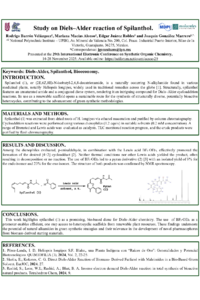
Spilanthol (1), or (2E,6Z,8E)-N-isobutyl-2,6,8-decatrienamide, is a naturally occurring N-alkylamide found in various medicinal plants, notably Heliopsis longipes, widely used in traditional remedies across the globe. Structurally, spilanthol features an unsaturated amide and a conjugated diene system, rendering it an intriguing compound for Diels–Alder cycloaddition reactions. Its use as a renewable scaffold opens a sustainable route for the synthesis of structurally diverse, potentially bioactive heterocycles, contributing to the advancement of green synthetic methodologies.
Methods
Spilanthol (1) was extracted from dried roots of H. longipes via ethanol maceration and purified by column chromatography. Cycloaddition reactions were performed using various dienophiles (1.2 equiv) in suitable solvents (0.2 mM concentration). A range of Brønsted and Lewis acids was evaluated as catalysts. TLC monitored reaction progress, and the crude products were purified by flash chromatography.
Results
A variety of dienophiles, including aldehydes and succinimides, were tested. Among the catalysts screened, only BF₃·OEt₂ effectively promoted the formation of the desired [4+2] cycloadduct. Neither thermal conditions nor other Lewis acids yielded the product, often resulting in decomposition or no reaction. The use of BF₃·OEt₂ yielded a pyran derivative in moderate isolated yield. NMR confirmed the product's structure.
Conclusions
This work highlights spilanthol (1) as a promising, bio-based diene for Diels–Alder chemistry. The use of BF₃·OEt₂ as a promoter enables efficient, one-step access to heterocyclic scaffolds from renewable plant resources. These findings underscore the potential of natural alkamides in green synthetic strategies and their relevance in the development of novel pharmacophores from biomass-derived starting materials.
Keywords
Spilanthol
Diels–Alder cycloaddition
Natural products
Green chemistry
Manuscript
chemproc-sciforum_137998_S2_original_sciforum_137998_Study_on_Diels_Alder_reaction_of_Spilanthol_1-done.pdf
Poster
sciforum-137998._POSTER_Study_on_Diels–Alder_reaction_of_Spilantho.pdf
Study and development on the hydroxamation of natural resinic acids: synthesis and computational studies
STANDARDISATION & STABILITY STUDIES OF AN AYURVEDIC FORMULATION- HINGVASTIKA CHURNA AS PER ICH GUIDELINES