Event submissions
Published
This submission belongs to the session S5. General Surgery of the event The 3rd International Online Conference on Clinical Medicine
Published date
12 Nov, 2025
Academic Editor
'%3e%3cpath%20d='M12.6657%2010.9104C12.4185%2010.325%2012.0599%209.79327%2011.6097%209.34482C11.1609%208.89508%2010.6293%208.5365%2010.0442%208.28888C10.0389%208.28626%2010.0337%208.28495%2010.0285%208.28233C10.8446%207.69279%2011.3752%206.73249%2011.3752%205.64904C11.3752%203.8542%209.92103%202.39999%208.1262%202.39999C6.33136%202.39999%204.87715%203.8542%204.87715%205.64904C4.87715%206.73249%205.40774%207.69279%206.22393%208.28364C6.21869%208.28626%206.21345%208.28757%206.20821%208.29019C5.62129%208.5378%205.09463%208.89284%204.64265%209.34613C4.1929%209.79493%203.83432%2010.3266%203.58671%2010.9117C3.34345%2011.4845%203.21226%2012.0987%203.20023%2012.7209C3.19988%2012.7349%203.20233%2012.7488%203.20744%2012.7619C3.21255%2012.7749%203.22022%2012.7867%203.22998%2012.7968C3.23975%2012.8068%203.25142%2012.8147%203.26431%2012.8202C3.2772%2012.8256%203.29105%2012.8284%203.30504%2012.8284H4.09109C4.14874%2012.8284%204.19459%2012.7825%204.1959%2012.7262C4.2221%2011.7148%204.62823%2010.7676%205.34617%2010.0497C6.08899%209.30683%207.0755%208.89808%208.1262%208.89808C9.17689%208.89808%2010.1634%209.30683%2010.9062%2010.0497C11.6242%2010.7676%2012.0303%2011.7148%2012.0565%2012.7262C12.0578%2012.7838%2012.1037%2012.8284%2012.1613%2012.8284H12.9474C12.9613%2012.8284%2012.9752%2012.8256%2012.9881%2012.8202C13.001%2012.8147%2013.0126%2012.8068%2013.0224%2012.7968C13.0322%2012.7867%2013.0398%2012.7749%2013.0449%2012.7619C13.0501%2012.7488%2013.0525%2012.7349%2013.0522%2012.7209C13.0391%2012.0947%2012.9094%2011.4855%2012.6657%2010.9104ZM8.1262%207.9024C7.52486%207.9024%206.9589%207.6679%206.53312%207.24211C6.10733%206.81633%205.87283%206.25037%205.87283%205.64904C5.87283%205.0477%206.10733%204.48174%206.53312%204.05596C6.9589%203.63018%207.52486%203.39567%208.1262%203.39567C8.72753%203.39567%209.29349%203.63018%209.71927%204.05596C10.1451%204.48174%2010.3796%205.0477%2010.3796%205.64904C10.3796%206.25037%2010.1451%206.81633%209.71927%207.24211C9.29349%207.6679%208.72753%207.9024%208.1262%207.9024Z'%20fill='%235D1EE1'/%3e%3c/g%3e%3c/svg%3e) Orestis Ioannidis
Orestis IoannidisCitation
Naukhaiz Taqi Sheikh, SVR achievement in triple-therapy-treated hepatitis C-induced cirrhosis: A dual center retrospective cohort study, in Proceedings of The 3rd International Online Conference on Clinical Medicine, 17 November–19 November 2025, MDPI: Basel, Switzerland
Share
Email
Facebook
Twitter
LinkedIn
SVR achievement in triple-therapy-treated hepatitis C-induced cirrhosis: A dual center retrospective cohort study
'%3e%3cpath%20d='M12.6647%2010.9104C12.4176%2010.325%2012.0589%209.7933%2011.6088%209.34485C11.16%208.89511%2010.6283%208.53653%2010.0432%208.28891C10.038%208.28629%2010.0327%208.28498%2010.0275%208.28236C10.8437%207.69282%2011.3743%206.73252%2011.3743%205.64907C11.3743%203.85423%209.92005%202.40002%208.12522%202.40002C6.33038%202.40002%204.87618%203.85423%204.87618%205.64907C4.87618%206.73252%205.40677%207.69282%206.22296%208.28367C6.21772%208.28629%206.21248%208.2876%206.20724%208.29022C5.62031%208.53783%205.09365%208.89287%204.64167%209.34616C4.19192%209.79496%203.83334%2010.3266%203.58573%2010.9117C3.34247%2011.4846%203.21128%2012.0987%203.19925%2012.721C3.1989%2012.735%203.20135%2012.7489%203.20646%2012.7619C3.21157%2012.7749%203.21924%2012.7868%203.22901%2012.7968C3.23877%2012.8068%203.25045%2012.8148%203.26334%2012.8202C3.27623%2012.8256%203.29007%2012.8284%203.30406%2012.8284H4.09012C4.14776%2012.8284%204.19362%2012.7825%204.19493%2012.7262C4.22113%2011.7148%204.62726%2010.7676%205.34519%2010.0497C6.08802%209.30686%207.07452%208.89811%208.12522%208.89811C9.17592%208.89811%2010.1624%209.30686%2010.9052%2010.0497C11.6232%2010.7676%2012.0293%2011.7148%2012.0555%2012.7262C12.0568%2012.7839%2012.1027%2012.8284%2012.1603%2012.8284H12.9464C12.9604%2012.8284%2012.9742%2012.8256%2012.9871%2012.8202C13%2012.8148%2013.0117%2012.8068%2013.0214%2012.7968C13.0312%2012.7868%2013.0389%2012.7749%2013.044%2012.7619C13.0491%2012.7489%2013.0515%2012.735%2013.0512%2012.721C13.0381%2012.0947%2012.9084%2011.4856%2012.6647%2010.9104ZM8.12522%207.90243C7.52388%207.90243%206.95792%207.66793%206.53214%207.24215C6.10636%206.81636%205.87185%206.2504%205.87185%205.64907C5.87185%205.04773%206.10636%204.48177%206.53214%204.05599C6.95792%203.63021%207.52388%203.3957%208.12522%203.3957C8.72655%203.3957%209.29252%203.63021%209.7183%204.05599C10.1441%204.48177%2010.3786%205.04773%2010.3786%205.64907C10.3786%206.2504%2010.1441%206.81636%209.7183%207.24215C9.29252%207.66793%208.72655%207.90243%208.12522%207.90243Z'%20fill='%235D1EE1'/%3e%3c/g%3e%3c/svg%3e)
Naukhaiz Taqi Sheikh 1,2
1. Department of General Medicine, Southampton General Hospital, University Hospital Southampton, United Kingdoom, Southampton SO16 6YD, United Kingdom
2. Department of General Medicine, Lahore General Hospital, University of Health Sciences, Ameer-ud-Din Medical College, Lahore, 54000, Pakistan
Abstract
Background and Objective:
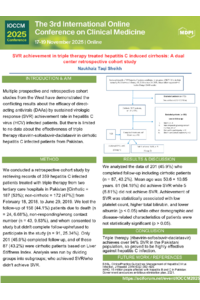
Multiple prospective and retrospective cohort studies from Western countries have reported conflicting results regarding the efficacy of direct-acting antivirals (DAAs) in achieving sustained virologic response (SVR) among patients with hepatitis C virus (HCV) infection. However, there is limited evidence from South Asia, and almost no data evaluating the effectiveness of triple therapy with ribavirin, sofosbuvir, and daclatasvir in cirrhotic HCV-infected patients from Pakistan. Understanding the real-world effectiveness of this regimen is crucial for improving patient outcomes in resource-limited settings. This study aimed to assess treatment outcomes and identify factors associated with SVR in this population.
Methods:
We conducted a retrospective cohort study of 359 HCV-infected patients treated with triple therapy at two tertiary care hospitals in Pakistan between February 2018 and June 2019. Of these, 187 (53%) were cirrhotic and 172 (47%) non-cirrhotic. Follow-up was incomplete for 158 (44.1%) patients due to death (n = 24, 6.68%), non-response to contact (n = 43, 9.63%), or withdrawal/refusal (n = 91, 25.34%). The final analysis included 201 (55.9%) patients, of whom 87 (43.2%) were cirrhotic, classified using the Liver Stiffness Index. Patients were stratified into SVR and non-SVR groups for comparison.
Results:
Among 201 patients completing follow-up, mean age was 50.6 ± 10.65 years. SVR was achieved in 81 cirrhotic patients (94.2%), while 5 (5.8%) failed therapy. SVR achievement was significantly associated with lower platelet count, elevated total bilirubin, and reduced albumin (p < 0.05). Other demographic and disease-related factors were not statistically significant.
Conclusion:
Triple therapy with ribavirin, sofosbuvir, and daclatasvir demonstrated a high SVR rate (>94%) in Pakistani cirrhotic patients, highlighting its effectiveness in this population. These findings support its continued use as a valuable therapeutic option and provide real-world evidence to guide clinical decision-making and policy development in similar resource-limited settings.
Keywords
Antivirals
Hepatitis C
Hepatocellular carcinoma
Sustained viral response (SVR)
Treatment
Poster
Hep_NTS_Research.pptx.pdf.pdf
A Rare Cause of Chronic Iron Deficiency Anaemia: 13 cm Jejunal Venous Haemangioma
Comparative outcomes of percutaneous transhepatic biliary drainage versus endoscopic ultrasound-guided transluminal procedures after failed endoscopic retrograde cholangiopancreatography in malignant biliary obstruction