Event submissions
Published
This submission belongs to the session S6. Clinical Rehabilitation of the event The 3rd International Online Conference on Clinical Medicine
Published date
12 Nov, 2025
Academic Editor
'%3e%3cpath%20d='M12.6657%2010.9104C12.4185%2010.325%2012.0599%209.79327%2011.6097%209.34482C11.1609%208.89508%2010.6293%208.5365%2010.0442%208.28888C10.0389%208.28626%2010.0337%208.28495%2010.0285%208.28233C10.8446%207.69279%2011.3752%206.73249%2011.3752%205.64904C11.3752%203.8542%209.92103%202.39999%208.1262%202.39999C6.33136%202.39999%204.87715%203.8542%204.87715%205.64904C4.87715%206.73249%205.40774%207.69279%206.22393%208.28364C6.21869%208.28626%206.21345%208.28757%206.20821%208.29019C5.62129%208.5378%205.09463%208.89284%204.64265%209.34613C4.1929%209.79493%203.83432%2010.3266%203.58671%2010.9117C3.34345%2011.4845%203.21226%2012.0987%203.20023%2012.7209C3.19988%2012.7349%203.20233%2012.7488%203.20744%2012.7619C3.21255%2012.7749%203.22022%2012.7867%203.22998%2012.7968C3.23975%2012.8068%203.25142%2012.8147%203.26431%2012.8202C3.2772%2012.8256%203.29105%2012.8284%203.30504%2012.8284H4.09109C4.14874%2012.8284%204.19459%2012.7825%204.1959%2012.7262C4.2221%2011.7148%204.62823%2010.7676%205.34617%2010.0497C6.08899%209.30683%207.0755%208.89808%208.1262%208.89808C9.17689%208.89808%2010.1634%209.30683%2010.9062%2010.0497C11.6242%2010.7676%2012.0303%2011.7148%2012.0565%2012.7262C12.0578%2012.7838%2012.1037%2012.8284%2012.1613%2012.8284H12.9474C12.9613%2012.8284%2012.9752%2012.8256%2012.9881%2012.8202C13.001%2012.8147%2013.0126%2012.8068%2013.0224%2012.7968C13.0322%2012.7867%2013.0398%2012.7749%2013.0449%2012.7619C13.0501%2012.7488%2013.0525%2012.7349%2013.0522%2012.7209C13.0391%2012.0947%2012.9094%2011.4855%2012.6657%2010.9104ZM8.1262%207.9024C7.52486%207.9024%206.9589%207.6679%206.53312%207.24211C6.10733%206.81633%205.87283%206.25037%205.87283%205.64904C5.87283%205.0477%206.10733%204.48174%206.53312%204.05596C6.9589%203.63018%207.52486%203.39567%208.1262%203.39567C8.72753%203.39567%209.29349%203.63018%209.71927%204.05596C10.1451%204.48174%2010.3796%205.0477%2010.3796%205.64904C10.3796%206.25037%2010.1451%206.81633%209.71927%207.24211C9.29349%207.6679%208.72753%207.9024%208.1262%207.9024Z'%20fill='%235D1EE1'/%3e%3c/g%3e%3c/svg%3e) Francisco Guillen-Grima
Francisco Guillen-GrimaCitation
Monika Bal-Bocheńska, Renata Borys, Agnieszka Guzik, The effectiveness of prehabilitation, i.e. comprehensive preparation of a preparation for use analysis based on the measurement of respiratory adequacy, in Proceedings of The 3rd International Online Conference on Clinical Medicine, 17 November–19 November 2025, MDPI: Basel, Switzerland
Share
Email
Facebook
Twitter
LinkedIn
The effectiveness of prehabilitation, i.e. comprehensive preparation of a preparation for use analysis based on the measurement of respiratory adequacy
'%3e%3cpath%20d='M12.6647%2010.9104C12.4176%2010.325%2012.0589%209.7933%2011.6088%209.34485C11.16%208.89511%2010.6283%208.53653%2010.0432%208.28891C10.038%208.28629%2010.0327%208.28498%2010.0275%208.28236C10.8437%207.69282%2011.3743%206.73252%2011.3743%205.64907C11.3743%203.85423%209.92005%202.40002%208.12522%202.40002C6.33038%202.40002%204.87618%203.85423%204.87618%205.64907C4.87618%206.73252%205.40677%207.69282%206.22296%208.28367C6.21772%208.28629%206.21248%208.2876%206.20724%208.29022C5.62031%208.53783%205.09365%208.89287%204.64167%209.34616C4.19192%209.79496%203.83334%2010.3266%203.58573%2010.9117C3.34247%2011.4846%203.21128%2012.0987%203.19925%2012.721C3.1989%2012.735%203.20135%2012.7489%203.20646%2012.7619C3.21157%2012.7749%203.21924%2012.7868%203.22901%2012.7968C3.23877%2012.8068%203.25045%2012.8148%203.26334%2012.8202C3.27623%2012.8256%203.29007%2012.8284%203.30406%2012.8284H4.09012C4.14776%2012.8284%204.19362%2012.7825%204.19493%2012.7262C4.22113%2011.7148%204.62726%2010.7676%205.34519%2010.0497C6.08802%209.30686%207.07452%208.89811%208.12522%208.89811C9.17592%208.89811%2010.1624%209.30686%2010.9052%2010.0497C11.6232%2010.7676%2012.0293%2011.7148%2012.0555%2012.7262C12.0568%2012.7839%2012.1027%2012.8284%2012.1603%2012.8284H12.9464C12.9604%2012.8284%2012.9742%2012.8256%2012.9871%2012.8202C13%2012.8148%2013.0117%2012.8068%2013.0214%2012.7968C13.0312%2012.7868%2013.0389%2012.7749%2013.044%2012.7619C13.0491%2012.7489%2013.0515%2012.735%2013.0512%2012.721C13.0381%2012.0947%2012.9084%2011.4856%2012.6647%2010.9104ZM8.12522%207.90243C7.52388%207.90243%206.95792%207.66793%206.53214%207.24215C6.10636%206.81636%205.87185%206.2504%205.87185%205.64907C5.87185%205.04773%206.10636%204.48177%206.53214%204.05599C6.95792%203.63021%207.52388%203.3957%208.12522%203.3957C8.72655%203.3957%209.29252%203.63021%209.7183%204.05599C10.1441%204.48177%2010.3786%205.04773%2010.3786%205.64907C10.3786%206.2504%2010.1441%206.81636%209.7183%207.24215C9.29252%207.66793%208.72655%207.90243%208.12522%207.90243Z'%20fill='%235D1EE1'/%3e%3c/g%3e%3c/svg%3e)
Monika Bal-Bocheńska 1
Renata Borys 1
Agnieszka Guzik 1
1. Faculty of Health Sciences and Psychology, Collegium Medicum, University of Rzeszow, Rzeszow, Poland
Abstract
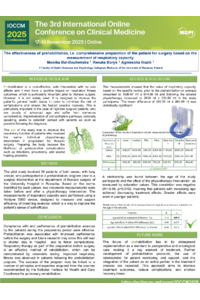
Prehabilitation is a cost-effective, safe, and side-effect-free intervention that can positively impact respiratory function, which is particularly important before thoracic surgery. However, it is not widely used. Its goal is to improve the patient's overall health, minimize the risk of complications, and ensure the fastest possible recovery. This is particularly important for high-risk surgical patients, who are typically elderly and suffer from multiple comorbidities. Implementing prehabilitation programs, rationally speaking, aims to establish contact with patients as soon as possible after diagnosis.
The pilot study involved 30 patients of both sexes with lung cancer who participated in a prehabilitation program prior to surgery at the Thoracic Surgery Department of the University Hospital in Rzeszów. Based on established standards for each patient, two volume measurements were performed before and after the physiotherapy procedure. Inspiratory capacity measurements were performed using the Voldyne 5000 device, designed to measure and support the effectiveness of breathing exercises, which is a way to improve patients' self-efficacy.
The measurements showed that inspiratory capacity, calculated according to specific standards, averaged 1686.67 ml ± 644.06 ml before the start of prehabilitation, and after individually tailored physiotherapy, it increased to 2030 ml ± 631.86 ml in the study participants. The mean difference of 343.33 ml ± 264.49 ml was statistically significant.
Patients' adherence to recommendations and performance of prehabilitation exercises during the preparatory period was effective. Prehabilitation was associated with improved performance before surgery, and future studies may demonstrate that this will lead to a shorter hospital stay and fewer complications. Respiratory therapy as part of preoperative preparation is an effective rehabilitation method, as confirmed by volumetric studies. Patients who completed the prehabilitation program experienced improved respiratory function. The program's success may be attributed to a number of principles and expertise acquired from sources recommended by the National Institute for Health and Care Excellence in Pulmonary Rehabilitation
Keywords
prehabilitation
lung cancer
respiratory capacity
Poster
M. Bal-Bocheńska _ 143922 MDPI.pdf
A population study of MRONJ-afflicted patients
Enhancing Post-Stroke Motor Recovery Through a Structured Home-Based Rehabilitation Program: A Pilot Study