Event submissions
Published
This submission belongs to the session S8. Anesthesiology of the event The 3rd International Online Conference on Clinical Medicine
Published date
12 Nov, 2025
Academic Editor
'%3e%3cpath%20d='M12.6657%2010.9104C12.4185%2010.325%2012.0599%209.79327%2011.6097%209.34482C11.1609%208.89508%2010.6293%208.5365%2010.0442%208.28888C10.0389%208.28626%2010.0337%208.28495%2010.0285%208.28233C10.8446%207.69279%2011.3752%206.73249%2011.3752%205.64904C11.3752%203.8542%209.92103%202.39999%208.1262%202.39999C6.33136%202.39999%204.87715%203.8542%204.87715%205.64904C4.87715%206.73249%205.40774%207.69279%206.22393%208.28364C6.21869%208.28626%206.21345%208.28757%206.20821%208.29019C5.62129%208.5378%205.09463%208.89284%204.64265%209.34613C4.1929%209.79493%203.83432%2010.3266%203.58671%2010.9117C3.34345%2011.4845%203.21226%2012.0987%203.20023%2012.7209C3.19988%2012.7349%203.20233%2012.7488%203.20744%2012.7619C3.21255%2012.7749%203.22022%2012.7867%203.22998%2012.7968C3.23975%2012.8068%203.25142%2012.8147%203.26431%2012.8202C3.2772%2012.8256%203.29105%2012.8284%203.30504%2012.8284H4.09109C4.14874%2012.8284%204.19459%2012.7825%204.1959%2012.7262C4.2221%2011.7148%204.62823%2010.7676%205.34617%2010.0497C6.08899%209.30683%207.0755%208.89808%208.1262%208.89808C9.17689%208.89808%2010.1634%209.30683%2010.9062%2010.0497C11.6242%2010.7676%2012.0303%2011.7148%2012.0565%2012.7262C12.0578%2012.7838%2012.1037%2012.8284%2012.1613%2012.8284H12.9474C12.9613%2012.8284%2012.9752%2012.8256%2012.9881%2012.8202C13.001%2012.8147%2013.0126%2012.8068%2013.0224%2012.7968C13.0322%2012.7867%2013.0398%2012.7749%2013.0449%2012.7619C13.0501%2012.7488%2013.0525%2012.7349%2013.0522%2012.7209C13.0391%2012.0947%2012.9094%2011.4855%2012.6657%2010.9104ZM8.1262%207.9024C7.52486%207.9024%206.9589%207.6679%206.53312%207.24211C6.10733%206.81633%205.87283%206.25037%205.87283%205.64904C5.87283%205.0477%206.10733%204.48174%206.53312%204.05596C6.9589%203.63018%207.52486%203.39567%208.1262%203.39567C8.72753%203.39567%209.29349%203.63018%209.71927%204.05596C10.1451%204.48174%2010.3796%205.0477%2010.3796%205.64904C10.3796%206.25037%2010.1451%206.81633%209.71927%207.24211C9.29349%207.6679%208.72753%207.9024%208.1262%207.9024Z'%20fill='%235D1EE1'/%3e%3c/g%3e%3c/svg%3e) Emmanuel Andrès
Emmanuel AndrèsCitation
Ankita Maheshwari, Ishita Dhyani, Rohit Verma, Bhavuk Garg, Puneet Khanna, Association of Biochemical Markers with Postoperative Delirium and Cognitive Dysfunction in Elderly Orthopedic Patients, in Proceedings of The 3rd International Online Conference on Clinical Medicine, 17 November–19 November 2025, MDPI: Basel, Switzerland
Share
Email
Facebook
Twitter
LinkedIn
Association of Biochemical Markers with Postoperative Delirium and Cognitive Dysfunction in Elderly Orthopedic Patients
'%3e%3cpath%20d='M12.6647%2010.9104C12.4176%2010.325%2012.0589%209.7933%2011.6088%209.34485C11.16%208.89511%2010.6283%208.53653%2010.0432%208.28891C10.038%208.28629%2010.0327%208.28498%2010.0275%208.28236C10.8437%207.69282%2011.3743%206.73252%2011.3743%205.64907C11.3743%203.85423%209.92005%202.40002%208.12522%202.40002C6.33038%202.40002%204.87618%203.85423%204.87618%205.64907C4.87618%206.73252%205.40677%207.69282%206.22296%208.28367C6.21772%208.28629%206.21248%208.2876%206.20724%208.29022C5.62031%208.53783%205.09365%208.89287%204.64167%209.34616C4.19192%209.79496%203.83334%2010.3266%203.58573%2010.9117C3.34247%2011.4846%203.21128%2012.0987%203.19925%2012.721C3.1989%2012.735%203.20135%2012.7489%203.20646%2012.7619C3.21157%2012.7749%203.21924%2012.7868%203.22901%2012.7968C3.23877%2012.8068%203.25045%2012.8148%203.26334%2012.8202C3.27623%2012.8256%203.29007%2012.8284%203.30406%2012.8284H4.09012C4.14776%2012.8284%204.19362%2012.7825%204.19493%2012.7262C4.22113%2011.7148%204.62726%2010.7676%205.34519%2010.0497C6.08802%209.30686%207.07452%208.89811%208.12522%208.89811C9.17592%208.89811%2010.1624%209.30686%2010.9052%2010.0497C11.6232%2010.7676%2012.0293%2011.7148%2012.0555%2012.7262C12.0568%2012.7839%2012.1027%2012.8284%2012.1603%2012.8284H12.9464C12.9604%2012.8284%2012.9742%2012.8256%2012.9871%2012.8202C13%2012.8148%2013.0117%2012.8068%2013.0214%2012.7968C13.0312%2012.7868%2013.0389%2012.7749%2013.044%2012.7619C13.0491%2012.7489%2013.0515%2012.735%2013.0512%2012.721C13.0381%2012.0947%2012.9084%2011.4856%2012.6647%2010.9104ZM8.12522%207.90243C7.52388%207.90243%206.95792%207.66793%206.53214%207.24215C6.10636%206.81636%205.87185%206.2504%205.87185%205.64907C5.87185%205.04773%206.10636%204.48177%206.53214%204.05599C6.95792%203.63021%207.52388%203.3957%208.12522%203.3957C8.72655%203.3957%209.29252%203.63021%209.7183%204.05599C10.1441%204.48177%2010.3786%205.04773%2010.3786%205.64907C10.3786%206.2504%2010.1441%206.81636%209.7183%207.24215C9.29252%207.66793%208.72655%207.90243%208.12522%207.90243Z'%20fill='%235D1EE1'/%3e%3c/g%3e%3c/svg%3e)
Ankita Maheshwari 1
Ishita Dhyani 2
Rohit Verma 2
Bhavuk Garg 3
Puneet Khanna 1
1. Department of Anaesthesiology, Pain Medicine and Critical Care, All India Institute of Medical Sciences, New Delhi, India
2. Department of Psychiatry, All India Institute of Medical Sciences, New Delhi, India
3. Department of Orthopaedics, All India Institute of Medical Sciences, New Delhi, India
Abstract
Background
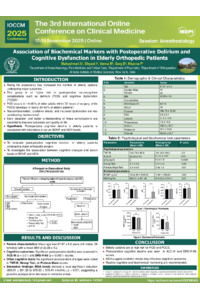
The growing elderly population has increased susceptibility to postoperative neurocognitive disorders, particularly delirium (POD) and cognitive dysfunction (POCD). POD occurs in 14–60% and POCD in 30–50% of older surgical patients. Emerging evidence implicates neuroinflammation, oxidative stress, and neuronal dysfunction. We hypothesize that Brain-Derived Neurotrophic Factor (BDNF) and Malondialdehyde (MDA) biomarkers may predict POD and POCD risk.
Methods
This prospective observational cohort study (IEC approval: 283/07.05.2021; CTRI/2024/12/077549) enrolled 80 patients >60 years undergoing major orthopaedic surgery. After informed consent, baseline demographics, comorbidities, and laboratory parameters were recorded. Cognitive and neuropsychiatric assessments were conducted pre and postoperatively using standardized psychological scales. Serum levels of biochemical markers, BDNF and MDA were measured using ELISA at both time points.
Results
The cohort had a mean age of 67.67 ± 6.2 years (44 males, 36 females) and mean BMI of 23.08 ± 4.2. Comorbidities were diabetes (17), hypertension (11), thyroid disorders (8), and hypercholesterolemia (11), where most cases were ASA Grade I (62) with 18 cases of PONV. Cognitive assessments revealed a significant postoperative decline in ACE-III (p = 0.01) and DRS-R-98 (p = 0.0001) scores with no significant changes in TMT-B, Stroop Test, or Porteus Maze scores. MDA levels demonstrated a near-significant reduction (885.01 ± 891.26 to 670.35 ± 570.41 nmol/mL; p = 0.07), indicating a possible decrease in oxidative stress post-surgery.
Conclusion
This study reveals a high risk of POD and POCD among elderly patients undergoing major orthopedic surgery. Significant cognitive decline by ACE-III and DRS-R-98 scores was observed postoperatively. MDA levels suggest a potential role of oxidative stress in cognitive outcomes. These findings highlight the importance of routine cognitive assessment and biochemical monitoring in the perioperative period. Further research is needed to confirm these associations and to develop preventive strategies.
Keywords
Postoperative delirium
Postoperative cognitive dysfunction
Elderly
Orthopedic surgery
Brain-Derived Neurotrophic Factor
Malondialdehyde
Biomarkers
Oxidative stress
Poster
Sciform_Poster.pdf
The effectiveness of perioperative gabapentin and ketamine in managing postoperative pain in adolescent idiopathic scoliosis patients undergoing spinal fusion surgery: A systematic review and meta-analysis
BISPECTRAL INDEX AND EEG-BASED MONITORING DURING GENERAL ANESTHESIA: CLINICAL UTILITY AND SAFETY