Event submissions
Published
This submission belongs to the session S8. Anesthesiology of the event The 3rd International Online Conference on Clinical Medicine
Published date
12 Nov, 2025
Academic Editor
'%3e%3cpath%20d='M12.6657%2010.9104C12.4185%2010.325%2012.0599%209.79327%2011.6097%209.34482C11.1609%208.89508%2010.6293%208.5365%2010.0442%208.28888C10.0389%208.28626%2010.0337%208.28495%2010.0285%208.28233C10.8446%207.69279%2011.3752%206.73249%2011.3752%205.64904C11.3752%203.8542%209.92103%202.39999%208.1262%202.39999C6.33136%202.39999%204.87715%203.8542%204.87715%205.64904C4.87715%206.73249%205.40774%207.69279%206.22393%208.28364C6.21869%208.28626%206.21345%208.28757%206.20821%208.29019C5.62129%208.5378%205.09463%208.89284%204.64265%209.34613C4.1929%209.79493%203.83432%2010.3266%203.58671%2010.9117C3.34345%2011.4845%203.21226%2012.0987%203.20023%2012.7209C3.19988%2012.7349%203.20233%2012.7488%203.20744%2012.7619C3.21255%2012.7749%203.22022%2012.7867%203.22998%2012.7968C3.23975%2012.8068%203.25142%2012.8147%203.26431%2012.8202C3.2772%2012.8256%203.29105%2012.8284%203.30504%2012.8284H4.09109C4.14874%2012.8284%204.19459%2012.7825%204.1959%2012.7262C4.2221%2011.7148%204.62823%2010.7676%205.34617%2010.0497C6.08899%209.30683%207.0755%208.89808%208.1262%208.89808C9.17689%208.89808%2010.1634%209.30683%2010.9062%2010.0497C11.6242%2010.7676%2012.0303%2011.7148%2012.0565%2012.7262C12.0578%2012.7838%2012.1037%2012.8284%2012.1613%2012.8284H12.9474C12.9613%2012.8284%2012.9752%2012.8256%2012.9881%2012.8202C13.001%2012.8147%2013.0126%2012.8068%2013.0224%2012.7968C13.0322%2012.7867%2013.0398%2012.7749%2013.0449%2012.7619C13.0501%2012.7488%2013.0525%2012.7349%2013.0522%2012.7209C13.0391%2012.0947%2012.9094%2011.4855%2012.6657%2010.9104ZM8.1262%207.9024C7.52486%207.9024%206.9589%207.6679%206.53312%207.24211C6.10733%206.81633%205.87283%206.25037%205.87283%205.64904C5.87283%205.0477%206.10733%204.48174%206.53312%204.05596C6.9589%203.63018%207.52486%203.39567%208.1262%203.39567C8.72753%203.39567%209.29349%203.63018%209.71927%204.05596C10.1451%204.48174%2010.3796%205.0477%2010.3796%205.64904C10.3796%206.25037%2010.1451%206.81633%209.71927%207.24211C9.29349%207.6679%208.72753%207.9024%208.1262%207.9024Z'%20fill='%235D1EE1'/%3e%3c/g%3e%3c/svg%3e) Kent Doi
Kent DoiCitation
Carolina Khouri Panzarin, BISPECTRAL INDEX AND EEG-BASED MONITORING DURING GENERAL ANESTHESIA: CLINICAL UTILITY AND SAFETY, in Proceedings of The 3rd International Online Conference on Clinical Medicine, 17 November–19 November 2025, MDPI: Basel, Switzerland
Share
Email
Facebook
Twitter
LinkedIn
BISPECTRAL INDEX AND EEG-BASED MONITORING DURING GENERAL ANESTHESIA: CLINICAL UTILITY AND SAFETY
'%3e%3cpath%20d='M12.6647%2010.9104C12.4176%2010.325%2012.0589%209.7933%2011.6088%209.34485C11.16%208.89511%2010.6283%208.53653%2010.0432%208.28891C10.038%208.28629%2010.0327%208.28498%2010.0275%208.28236C10.8437%207.69282%2011.3743%206.73252%2011.3743%205.64907C11.3743%203.85423%209.92005%202.40002%208.12522%202.40002C6.33038%202.40002%204.87618%203.85423%204.87618%205.64907C4.87618%206.73252%205.40677%207.69282%206.22296%208.28367C6.21772%208.28629%206.21248%208.2876%206.20724%208.29022C5.62031%208.53783%205.09365%208.89287%204.64167%209.34616C4.19192%209.79496%203.83334%2010.3266%203.58573%2010.9117C3.34247%2011.4846%203.21128%2012.0987%203.19925%2012.721C3.1989%2012.735%203.20135%2012.7489%203.20646%2012.7619C3.21157%2012.7749%203.21924%2012.7868%203.22901%2012.7968C3.23877%2012.8068%203.25045%2012.8148%203.26334%2012.8202C3.27623%2012.8256%203.29007%2012.8284%203.30406%2012.8284H4.09012C4.14776%2012.8284%204.19362%2012.7825%204.19493%2012.7262C4.22113%2011.7148%204.62726%2010.7676%205.34519%2010.0497C6.08802%209.30686%207.07452%208.89811%208.12522%208.89811C9.17592%208.89811%2010.1624%209.30686%2010.9052%2010.0497C11.6232%2010.7676%2012.0293%2011.7148%2012.0555%2012.7262C12.0568%2012.7839%2012.1027%2012.8284%2012.1603%2012.8284H12.9464C12.9604%2012.8284%2012.9742%2012.8256%2012.9871%2012.8202C13%2012.8148%2013.0117%2012.8068%2013.0214%2012.7968C13.0312%2012.7868%2013.0389%2012.7749%2013.044%2012.7619C13.0491%2012.7489%2013.0515%2012.735%2013.0512%2012.721C13.0381%2012.0947%2012.9084%2011.4856%2012.6647%2010.9104ZM8.12522%207.90243C7.52388%207.90243%206.95792%207.66793%206.53214%207.24215C6.10636%206.81636%205.87185%206.2504%205.87185%205.64907C5.87185%205.04773%206.10636%204.48177%206.53214%204.05599C6.95792%203.63021%207.52388%203.3957%208.12522%203.3957C8.72655%203.3957%209.29252%203.63021%209.7183%204.05599C10.1441%204.48177%2010.3786%205.04773%2010.3786%205.64907C10.3786%206.2504%2010.1441%206.81636%209.7183%207.24215C9.29252%207.66793%208.72655%207.90243%208.12522%207.90243Z'%20fill='%235D1EE1'/%3e%3c/g%3e%3c/svg%3e)
Carolina Khouri Panzarin 1
1. School of Medicine, Faculdade Israelita de Ciências da Saúde Albert Einstein (FICSAE), São Paulo, 05653-120, Brazil
Abstract
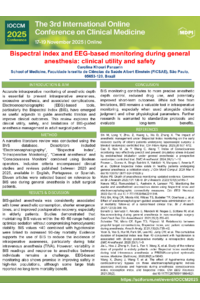
Introduction: Accurate intraoperative monitoring of anesthetic depth is essential to prevent intraoperative awareness, excessive anesthesia, and associated complications. Electroencephalographic (EEG)-based tools, particularly the Bispectral Index (BIS), have emerged as useful adjuncts to guide anesthetic titration and improve clinical outcomes. This review explores the clinical utility, safety, and limitations of BIS-guided anesthesia management in adult surgical patients. Methods: A narrative literature review was conducted using the BVS database. Descriptors included “Electroencephalography”, “Bispectral Index”, “Intraoperative Monitoring”, “General anesthesia” and “Consciousness Monitors” combined using Boolean operators. Inclusion criteria encompassed clinical studies and reviews published between 2020 and 2025, available in English, Portuguese, or Spanish. Eleven articles were selected based on relevance to BIS use during general anesthesia in adult surgical patients. Results: BIS-guided anesthesia was consistently associated with lower anesthetic consumption, shorter emergence times, and improved postoperative recovery, especially in elderly patients. Studies demonstrated that maintaining BIS values within the 40–60 range helped optimize sedation without compromising hemodynamic stability. BIS values <40 combined with hypotension were linked to increased 90-day mortality. Evidence supports the use of BIS to reduce the incidence of intraoperative awareness, particularly during total intravenous anesthesia (TIVA). However, variability in BIS readings and response to anesthetics between individuals remains a challenge. EEG-based monitoring also shows promise in improving safety in high-risk populations, although some large trials reported no long-term mortality benefit. Conclusion: BIS monitoring contributes to more precise anesthetic depth control, reduced drug use, and potentially improved short-term outcomes. While not free from limitations, BIS remains a valuable tool in intraoperative monitoring, especially when used alongside clinical judgment and other physiological parameters. Further research is warranted to standardize protocols and evaluate long-term benefits.
Keywords
Anesthesia Monitoring
Bispectral Index
Electroencephalography
General Anesthesia
Intraoperative Monitoring
Patient Safety.
Poster
poster bispectral index.pdf
Association of Biochemical Markers with Postoperative Delirium and Cognitive Dysfunction in Elderly Orthopedic Patients
Self-Reported Cardiovascular Symptoms Following COVID-19 Vaccination: A Cross-Sectional Study in Algeria