Event submissions
Published
This submission belongs to the session S1. Cardiology & Cardiovascular Medicine of the event The 3rd International Online Conference on Clinical Medicine
Published date
12 Nov, 2025
Academic Editor
'%3e%3cpath%20d='M12.6657%2010.9104C12.4185%2010.325%2012.0599%209.79327%2011.6097%209.34482C11.1609%208.89508%2010.6293%208.5365%2010.0442%208.28888C10.0389%208.28626%2010.0337%208.28495%2010.0285%208.28233C10.8446%207.69279%2011.3752%206.73249%2011.3752%205.64904C11.3752%203.8542%209.92103%202.39999%208.1262%202.39999C6.33136%202.39999%204.87715%203.8542%204.87715%205.64904C4.87715%206.73249%205.40774%207.69279%206.22393%208.28364C6.21869%208.28626%206.21345%208.28757%206.20821%208.29019C5.62129%208.5378%205.09463%208.89284%204.64265%209.34613C4.1929%209.79493%203.83432%2010.3266%203.58671%2010.9117C3.34345%2011.4845%203.21226%2012.0987%203.20023%2012.7209C3.19988%2012.7349%203.20233%2012.7488%203.20744%2012.7619C3.21255%2012.7749%203.22022%2012.7867%203.22998%2012.7968C3.23975%2012.8068%203.25142%2012.8147%203.26431%2012.8202C3.2772%2012.8256%203.29105%2012.8284%203.30504%2012.8284H4.09109C4.14874%2012.8284%204.19459%2012.7825%204.1959%2012.7262C4.2221%2011.7148%204.62823%2010.7676%205.34617%2010.0497C6.08899%209.30683%207.0755%208.89808%208.1262%208.89808C9.17689%208.89808%2010.1634%209.30683%2010.9062%2010.0497C11.6242%2010.7676%2012.0303%2011.7148%2012.0565%2012.7262C12.0578%2012.7838%2012.1037%2012.8284%2012.1613%2012.8284H12.9474C12.9613%2012.8284%2012.9752%2012.8256%2012.9881%2012.8202C13.001%2012.8147%2013.0126%2012.8068%2013.0224%2012.7968C13.0322%2012.7867%2013.0398%2012.7749%2013.0449%2012.7619C13.0501%2012.7488%2013.0525%2012.7349%2013.0522%2012.7209C13.0391%2012.0947%2012.9094%2011.4855%2012.6657%2010.9104ZM8.1262%207.9024C7.52486%207.9024%206.9589%207.6679%206.53312%207.24211C6.10733%206.81633%205.87283%206.25037%205.87283%205.64904C5.87283%205.0477%206.10733%204.48174%206.53312%204.05596C6.9589%203.63018%207.52486%203.39567%208.1262%203.39567C8.72753%203.39567%209.29349%203.63018%209.71927%204.05596C10.1451%204.48174%2010.3796%205.0477%2010.3796%205.64904C10.3796%206.25037%2010.1451%206.81633%209.71927%207.24211C9.29349%207.6679%208.72753%207.9024%208.1262%207.9024Z'%20fill='%235D1EE1'/%3e%3c/g%3e%3c/svg%3e) Carlos Escobar
Carlos EscobarCitation
Nnaemeka Emmanuel Mgbedo, Malkhaz Mizandari, Valerian Lobzhanidze, Endoluminal Radiofrequency Ablation and Stenting Following Percutaneous Transhepatic Biliary Drainage in Inoperable Common Bile Duct Cholangiocarcinoma: A Case Report, in Proceedings of The 3rd International Online Conference on Clinical Medicine, 17 November–19 November 2025, MDPI: Basel, Switzerland
Share
Email
Facebook
Twitter
LinkedIn
Endoluminal Radiofrequency Ablation and Stenting Following Percutaneous Transhepatic Biliary Drainage in Inoperable Common Bile Duct Cholangiocarcinoma: A Case Report
'%3e%3cpath%20d='M12.6647%2010.9104C12.4176%2010.325%2012.0589%209.7933%2011.6088%209.34485C11.16%208.89511%2010.6283%208.53653%2010.0432%208.28891C10.038%208.28629%2010.0327%208.28498%2010.0275%208.28236C10.8437%207.69282%2011.3743%206.73252%2011.3743%205.64907C11.3743%203.85423%209.92005%202.40002%208.12522%202.40002C6.33038%202.40002%204.87618%203.85423%204.87618%205.64907C4.87618%206.73252%205.40677%207.69282%206.22296%208.28367C6.21772%208.28629%206.21248%208.2876%206.20724%208.29022C5.62031%208.53783%205.09365%208.89287%204.64167%209.34616C4.19192%209.79496%203.83334%2010.3266%203.58573%2010.9117C3.34247%2011.4846%203.21128%2012.0987%203.19925%2012.721C3.1989%2012.735%203.20135%2012.7489%203.20646%2012.7619C3.21157%2012.7749%203.21924%2012.7868%203.22901%2012.7968C3.23877%2012.8068%203.25045%2012.8148%203.26334%2012.8202C3.27623%2012.8256%203.29007%2012.8284%203.30406%2012.8284H4.09012C4.14776%2012.8284%204.19362%2012.7825%204.19493%2012.7262C4.22113%2011.7148%204.62726%2010.7676%205.34519%2010.0497C6.08802%209.30686%207.07452%208.89811%208.12522%208.89811C9.17592%208.89811%2010.1624%209.30686%2010.9052%2010.0497C11.6232%2010.7676%2012.0293%2011.7148%2012.0555%2012.7262C12.0568%2012.7839%2012.1027%2012.8284%2012.1603%2012.8284H12.9464C12.9604%2012.8284%2012.9742%2012.8256%2012.9871%2012.8202C13%2012.8148%2013.0117%2012.8068%2013.0214%2012.7968C13.0312%2012.7868%2013.0389%2012.7749%2013.044%2012.7619C13.0491%2012.7489%2013.0515%2012.735%2013.0512%2012.721C13.0381%2012.0947%2012.9084%2011.4856%2012.6647%2010.9104ZM8.12522%207.90243C7.52388%207.90243%206.95792%207.66793%206.53214%207.24215C6.10636%206.81636%205.87185%206.2504%205.87185%205.64907C5.87185%205.04773%206.10636%204.48177%206.53214%204.05599C6.95792%203.63021%207.52388%203.3957%208.12522%203.3957C8.72655%203.3957%209.29252%203.63021%209.7183%204.05599C10.1441%204.48177%2010.3786%205.04773%2010.3786%205.64907C10.3786%206.2504%2010.1441%206.81636%209.7183%207.24215C9.29252%207.66793%208.72655%207.90243%208.12522%207.90243Z'%20fill='%235D1EE1'/%3e%3c/g%3e%3c/svg%3e)
Nnaemeka Emmanuel Mgbedo 1
Malkhaz Mizandari 2
Valerian Lobzhanidze 3
1. Department of Medicine, School of Health Sciences, Faculty of Medicine, University of Georgia, Tbilisi, 0131 Georgia
2. Department of Radiology, New Hospitals, 12 Krtsanisi Street, Tbilisi 0114, Georgia
3. Department of Internal Medicine, New Hospitals, 12 Krtsanisi Street, Tbilisi 0114, Georgia
Abstract
Background
Percutaneous transhepatic biliary drainage (PTBD) is a minimally invasive procedure used in malignant biliary obstruction, including cholangiocarcinoma, pancreatic cancer, and tumors of the liver hilum, duodenum, and major papilla. In selected patients, endoluminal radiofrequency ablation (RFA) followed by stent placement may improve ductal patency. Prior reports, including our own experience, have suggested possible benefits in prolonging stent patency, and in some cases contributing to survival advantage, although evidence remains limited and heterogeneous.
Methods
A 78-year-old male presented with obstructive jaundice due to a tumor obstructing the middle third of the common bile duct. Imaging and laboratory findings confirmed elevated direct bilirubin. After ultrasound and fluoroscopy-guided right-sided PTBD, the patient underwent percutaneous recanalization of the malignant stricture two weeks later, via the mature drainage fistula under intravenous analgesia. A 0.035-inch guidewire was advanced into the duodenum, an 8 French bipolar endobiliary RFA catheter was positioned at the obstruction, and energy was applied (15 watts for 2 minutes). A 10 mm self-expanding metal stent was subsequently deployed to restore bile duct patency. The procedure was conducted as part of compassionate use without institutional review board (IRB) approval, given the palliative setting.
Results
The patient’s bilirubin levels normalized, and there were no immediate complications. He was discharged in stable condition and referred to oncology for systemic therapy and palliative care. Known potential risks of RFA and stenting include cholangitis, biliary perforation, bleeding, and stent occlusion, but none were encountered in this case.
Conclusions
This case supports the feasibility and short-term safety of combining PTBD with endoluminal RFA and stenting in inoperable cholangiocarcinoma. While prior reports have suggested potential benefits for stent patency and symptom-free survival, the present case does not provide evidence of a direct effect on tumor progression. The procedure remains primarily palliative, and further controlled studies are required to clarify its role in modifying survival or long-term outcomes.
Keywords
Percutaneous transhepatic biliary drainage
obstructive jaundice
Endoluminal RFA
Poster
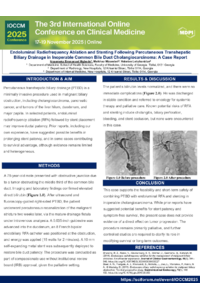
Endoluminal Radiofrequency Ablation and Stenting Following Percutaneous Transhepatic Biliary Drainage in Inoperable Common Bile Duct Cholangiocarcinoma A Case Report.pdf
Emerging Nontraditional Therapies in Diabetic Kidney Disease: Evidence from 12 Clinical Trials
Effect of Pulmonary Hypertension on Pulmonary Hemorrhage in Patients Undergoing CT-Guided Lung Biopsy