Event submissions
Published
This submission belongs to the session S1. Cardiology & Cardiovascular Medicine of the event The 3rd International Online Conference on Clinical Medicine
Published date
12 Nov, 2025
Academic Editor
'%3e%3cpath%20d='M12.6657%2010.9104C12.4185%2010.325%2012.0599%209.79327%2011.6097%209.34482C11.1609%208.89508%2010.6293%208.5365%2010.0442%208.28888C10.0389%208.28626%2010.0337%208.28495%2010.0285%208.28233C10.8446%207.69279%2011.3752%206.73249%2011.3752%205.64904C11.3752%203.8542%209.92103%202.39999%208.1262%202.39999C6.33136%202.39999%204.87715%203.8542%204.87715%205.64904C4.87715%206.73249%205.40774%207.69279%206.22393%208.28364C6.21869%208.28626%206.21345%208.28757%206.20821%208.29019C5.62129%208.5378%205.09463%208.89284%204.64265%209.34613C4.1929%209.79493%203.83432%2010.3266%203.58671%2010.9117C3.34345%2011.4845%203.21226%2012.0987%203.20023%2012.7209C3.19988%2012.7349%203.20233%2012.7488%203.20744%2012.7619C3.21255%2012.7749%203.22022%2012.7867%203.22998%2012.7968C3.23975%2012.8068%203.25142%2012.8147%203.26431%2012.8202C3.2772%2012.8256%203.29105%2012.8284%203.30504%2012.8284H4.09109C4.14874%2012.8284%204.19459%2012.7825%204.1959%2012.7262C4.2221%2011.7148%204.62823%2010.7676%205.34617%2010.0497C6.08899%209.30683%207.0755%208.89808%208.1262%208.89808C9.17689%208.89808%2010.1634%209.30683%2010.9062%2010.0497C11.6242%2010.7676%2012.0303%2011.7148%2012.0565%2012.7262C12.0578%2012.7838%2012.1037%2012.8284%2012.1613%2012.8284H12.9474C12.9613%2012.8284%2012.9752%2012.8256%2012.9881%2012.8202C13.001%2012.8147%2013.0126%2012.8068%2013.0224%2012.7968C13.0322%2012.7867%2013.0398%2012.7749%2013.0449%2012.7619C13.0501%2012.7488%2013.0525%2012.7349%2013.0522%2012.7209C13.0391%2012.0947%2012.9094%2011.4855%2012.6657%2010.9104ZM8.1262%207.9024C7.52486%207.9024%206.9589%207.6679%206.53312%207.24211C6.10733%206.81633%205.87283%206.25037%205.87283%205.64904C5.87283%205.0477%206.10733%204.48174%206.53312%204.05596C6.9589%203.63018%207.52486%203.39567%208.1262%203.39567C8.72753%203.39567%209.29349%203.63018%209.71927%204.05596C10.1451%204.48174%2010.3796%205.0477%2010.3796%205.64904C10.3796%206.25037%2010.1451%206.81633%209.71927%207.24211C9.29349%207.6679%208.72753%207.9024%208.1262%207.9024Z'%20fill='%235D1EE1'/%3e%3c/g%3e%3c/svg%3e) Carlos Escobar
Carlos EscobarCitation
Shadab Ahamad, Anagha Tulsi, Amita Sharma, Prachi Kukshal, Maternal-Child Blood Group Discordance and Congenital Heart Disease Severity: An Immunological Risk Perspective from a Tertiary Hospital-Based Study, in Proceedings of The 3rd International Online Conference on Clinical Medicine, 17 November–19 November 2025, MDPI: Basel, Switzerland
Share
Email
Facebook
Twitter
LinkedIn
Maternal-Child Blood Group Discordance and Congenital Heart Disease Severity: An Immunological Risk Perspective from a Tertiary Hospital-Based Study
'%3e%3cpath%20d='M12.6647%2010.9104C12.4176%2010.325%2012.0589%209.7933%2011.6088%209.34485C11.16%208.89511%2010.6283%208.53653%2010.0432%208.28891C10.038%208.28629%2010.0327%208.28498%2010.0275%208.28236C10.8437%207.69282%2011.3743%206.73252%2011.3743%205.64907C11.3743%203.85423%209.92005%202.40002%208.12522%202.40002C6.33038%202.40002%204.87618%203.85423%204.87618%205.64907C4.87618%206.73252%205.40677%207.69282%206.22296%208.28367C6.21772%208.28629%206.21248%208.2876%206.20724%208.29022C5.62031%208.53783%205.09365%208.89287%204.64167%209.34616C4.19192%209.79496%203.83334%2010.3266%203.58573%2010.9117C3.34247%2011.4846%203.21128%2012.0987%203.19925%2012.721C3.1989%2012.735%203.20135%2012.7489%203.20646%2012.7619C3.21157%2012.7749%203.21924%2012.7868%203.22901%2012.7968C3.23877%2012.8068%203.25045%2012.8148%203.26334%2012.8202C3.27623%2012.8256%203.29007%2012.8284%203.30406%2012.8284H4.09012C4.14776%2012.8284%204.19362%2012.7825%204.19493%2012.7262C4.22113%2011.7148%204.62726%2010.7676%205.34519%2010.0497C6.08802%209.30686%207.07452%208.89811%208.12522%208.89811C9.17592%208.89811%2010.1624%209.30686%2010.9052%2010.0497C11.6232%2010.7676%2012.0293%2011.7148%2012.0555%2012.7262C12.0568%2012.7839%2012.1027%2012.8284%2012.1603%2012.8284H12.9464C12.9604%2012.8284%2012.9742%2012.8256%2012.9871%2012.8202C13%2012.8148%2013.0117%2012.8068%2013.0214%2012.7968C13.0312%2012.7868%2013.0389%2012.7749%2013.044%2012.7619C13.0491%2012.7489%2013.0515%2012.735%2013.0512%2012.721C13.0381%2012.0947%2012.9084%2011.4856%2012.6647%2010.9104ZM8.12522%207.90243C7.52388%207.90243%206.95792%207.66793%206.53214%207.24215C6.10636%206.81636%205.87185%206.2504%205.87185%205.64907C5.87185%205.04773%206.10636%204.48177%206.53214%204.05599C6.95792%203.63021%207.52388%203.3957%208.12522%203.3957C8.72655%203.3957%209.29252%203.63021%209.7183%204.05599C10.1441%204.48177%2010.3786%205.04773%2010.3786%205.64907C10.3786%206.2504%2010.1441%206.81636%209.7183%207.24215C9.29252%207.66793%208.72655%207.90243%208.12522%207.90243Z'%20fill='%235D1EE1'/%3e%3c/g%3e%3c/svg%3e)
Shadab Ahamad 1,2
Anagha Tulsi 3
Amita Sharma 3
Prachi Kukshal 4
1. Sri Sathya Sai Sanjeevani Research Centre, Palwal, Haryana, India
2. Sri Sathya Sai University for Human Excellence, Kalaburagi, Karnataka, India
3. Sri Sathya Sai Sanjeevani International Centre for Child Heart Care & Research, Palwal, Haryana, India
4. Sri Sathya Sai Sanjeevani Research Foundation, Palwal, Haryana, India
Abstract
Background
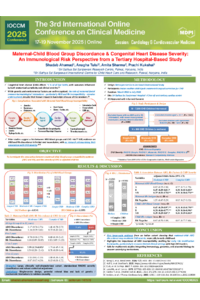
Congenital heart disease (CHD) is the most prevalent congenital anomaly, with outcomes strongly influenced by disease complexity. Beyond genetic and environmental determinants, maternal-fetal immuno-haematological interactions may contribute to CHD risk and severity. ABO and Rh incompatibilities can trigger immune responses in utero, yet their role in CHD severity remains unclear. This study assessed associations between maternal-child blood groups, compatibility patterns, and CHD severity using the Risk Adjustment for Congenital Heart Surgery (RACHS) scoring system and cyanosis status.
Methods
A retrospective cohort of 900 non-syndromic singleton children with CHD (0-12 years) undergoing surgical correction and their mothers was analysed at a tertiary referral center. Maternal and child ABO/Rh blood groups and compatibility status were documented. CHD was categorised as simple (RACHS 1), moderate (RACHS 2), or complex (RACHS ≥3), and as cyanotic vs. acyanotic. Associations were tested using comparative statistics and ordinal regression with subgroup validation by age.
Results
Of 900 cases, 562 (62.4%) were acyanotic; RACHS distribution was 64 simple, 432 moderate, and 404 complex. Blood group B predominated in mothers (n=319, 35.4%) and children (n=316, 35.1%). ABO and Rh incompatibilities occurred in 257 (28.6%) and n=44 (4.9%) dyads, respectively. Maternal-child ABO discordance was significantly associated with moderate CHD (OR=3.31, 95% CI: 1.19-9.18; p=0.022), while Rh incompatibility showed a notable trend with cyanotic CHD (p=0.076) in children aged 1-5 years. Maternal blood groups B and AB were protective against CHD severity compared to O (OR=0.26-0.41, p <0.05). Child blood groups A, B, and AB also conferred protection against moderate and complex CHDs (OR=0.29-0.39, p <0.05). No significant association was observed for combined ABOxRh discordance.
Conclusion
This study provides the first evidence that maternal–child blood group relationships, particularly ABO incompatibility, may influence CHD severity. These findings warrant multicentric validation and exploration of underlying immunogenetic mechanisms.
Keywords
Blood-group
Compatibility
Congenital heart disease
India
Severity
Poster
Sciforum-147578 (Shadab Ahamad).pdf
Oral Health and Quality of Life in Head and Neck Cancer Patients Undergoing Radiotherapy: A Cross-Sectional Study
Impact of Periconceptional Maternal Diet and Supplementation on Malnutrition in Infants with Congenital Heart Disease: A Cross-Sectional Study