Event submissions
Published
This submission belongs to the session S1. Cardiology & Cardiovascular Medicine of the event The 3rd International Online Conference on Clinical Medicine
Published date
12 Nov, 2025
Academic Editor
'%3e%3cpath%20d='M12.6657%2010.9104C12.4185%2010.325%2012.0599%209.79327%2011.6097%209.34482C11.1609%208.89508%2010.6293%208.5365%2010.0442%208.28888C10.0389%208.28626%2010.0337%208.28495%2010.0285%208.28233C10.8446%207.69279%2011.3752%206.73249%2011.3752%205.64904C11.3752%203.8542%209.92103%202.39999%208.1262%202.39999C6.33136%202.39999%204.87715%203.8542%204.87715%205.64904C4.87715%206.73249%205.40774%207.69279%206.22393%208.28364C6.21869%208.28626%206.21345%208.28757%206.20821%208.29019C5.62129%208.5378%205.09463%208.89284%204.64265%209.34613C4.1929%209.79493%203.83432%2010.3266%203.58671%2010.9117C3.34345%2011.4845%203.21226%2012.0987%203.20023%2012.7209C3.19988%2012.7349%203.20233%2012.7488%203.20744%2012.7619C3.21255%2012.7749%203.22022%2012.7867%203.22998%2012.7968C3.23975%2012.8068%203.25142%2012.8147%203.26431%2012.8202C3.2772%2012.8256%203.29105%2012.8284%203.30504%2012.8284H4.09109C4.14874%2012.8284%204.19459%2012.7825%204.1959%2012.7262C4.2221%2011.7148%204.62823%2010.7676%205.34617%2010.0497C6.08899%209.30683%207.0755%208.89808%208.1262%208.89808C9.17689%208.89808%2010.1634%209.30683%2010.9062%2010.0497C11.6242%2010.7676%2012.0303%2011.7148%2012.0565%2012.7262C12.0578%2012.7838%2012.1037%2012.8284%2012.1613%2012.8284H12.9474C12.9613%2012.8284%2012.9752%2012.8256%2012.9881%2012.8202C13.001%2012.8147%2013.0126%2012.8068%2013.0224%2012.7968C13.0322%2012.7867%2013.0398%2012.7749%2013.0449%2012.7619C13.0501%2012.7488%2013.0525%2012.7349%2013.0522%2012.7209C13.0391%2012.0947%2012.9094%2011.4855%2012.6657%2010.9104ZM8.1262%207.9024C7.52486%207.9024%206.9589%207.6679%206.53312%207.24211C6.10733%206.81633%205.87283%206.25037%205.87283%205.64904C5.87283%205.0477%206.10733%204.48174%206.53312%204.05596C6.9589%203.63018%207.52486%203.39567%208.1262%203.39567C8.72753%203.39567%209.29349%203.63018%209.71927%204.05596C10.1451%204.48174%2010.3796%205.0477%2010.3796%205.64904C10.3796%206.25037%2010.1451%206.81633%209.71927%207.24211C9.29349%207.6679%208.72753%207.9024%208.1262%207.9024Z'%20fill='%235D1EE1'/%3e%3c/g%3e%3c/svg%3e) Francisco Epelde
Francisco EpeldeCitation
Nivy Patel, Preet Baxi, Sagar Kabde, Indian Experience of Bifurcation PCI: Provisional or Two-Stent—Does Strategy Matter?, in Proceedings of The 3rd International Online Conference on Clinical Medicine, 17 November–19 November 2025, MDPI: Basel, Switzerland
Share
Email
Facebook
Twitter
LinkedIn
Indian Experience of Bifurcation PCI: Provisional or Two-Stent—Does Strategy Matter?
'%3e%3cpath%20d='M12.6647%2010.9104C12.4176%2010.325%2012.0589%209.7933%2011.6088%209.34485C11.16%208.89511%2010.6283%208.53653%2010.0432%208.28891C10.038%208.28629%2010.0327%208.28498%2010.0275%208.28236C10.8437%207.69282%2011.3743%206.73252%2011.3743%205.64907C11.3743%203.85423%209.92005%202.40002%208.12522%202.40002C6.33038%202.40002%204.87618%203.85423%204.87618%205.64907C4.87618%206.73252%205.40677%207.69282%206.22296%208.28367C6.21772%208.28629%206.21248%208.2876%206.20724%208.29022C5.62031%208.53783%205.09365%208.89287%204.64167%209.34616C4.19192%209.79496%203.83334%2010.3266%203.58573%2010.9117C3.34247%2011.4846%203.21128%2012.0987%203.19925%2012.721C3.1989%2012.735%203.20135%2012.7489%203.20646%2012.7619C3.21157%2012.7749%203.21924%2012.7868%203.22901%2012.7968C3.23877%2012.8068%203.25045%2012.8148%203.26334%2012.8202C3.27623%2012.8256%203.29007%2012.8284%203.30406%2012.8284H4.09012C4.14776%2012.8284%204.19362%2012.7825%204.19493%2012.7262C4.22113%2011.7148%204.62726%2010.7676%205.34519%2010.0497C6.08802%209.30686%207.07452%208.89811%208.12522%208.89811C9.17592%208.89811%2010.1624%209.30686%2010.9052%2010.0497C11.6232%2010.7676%2012.0293%2011.7148%2012.0555%2012.7262C12.0568%2012.7839%2012.1027%2012.8284%2012.1603%2012.8284H12.9464C12.9604%2012.8284%2012.9742%2012.8256%2012.9871%2012.8202C13%2012.8148%2013.0117%2012.8068%2013.0214%2012.7968C13.0312%2012.7868%2013.0389%2012.7749%2013.044%2012.7619C13.0491%2012.7489%2013.0515%2012.735%2013.0512%2012.721C13.0381%2012.0947%2012.9084%2011.4856%2012.6647%2010.9104ZM8.12522%207.90243C7.52388%207.90243%206.95792%207.66793%206.53214%207.24215C6.10636%206.81636%205.87185%206.2504%205.87185%205.64907C5.87185%205.04773%206.10636%204.48177%206.53214%204.05599C6.95792%203.63021%207.52388%203.3957%208.12522%203.3957C8.72655%203.3957%209.29252%203.63021%209.7183%204.05599C10.1441%204.48177%2010.3786%205.04773%2010.3786%205.64907C10.3786%206.2504%2010.1441%206.81636%209.7183%207.24215C9.29252%207.66793%208.72655%207.90243%208.12522%207.90243Z'%20fill='%235D1EE1'/%3e%3c/g%3e%3c/svg%3e)
Nivy Patel 1
Preet Baxi 1
Sagar Kabde 1
1. Department of Cardiology, Bankers Heart Institute, Surat 395006, India
Abstract
Introduction:
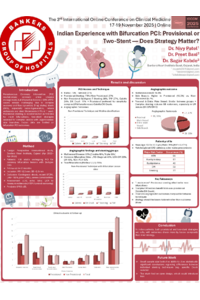
Coronary bifurcation lesions, encountered in roughly one-fifth of PCI cases, remain among the most technically demanding scenarios in interventional cardiology. While provisional stenting has become the global default, complex anatomy or large diseased side branches often demand a planned two-stent approach. Most evidence guiding these decisions comes from Western populations, with limited data available on Indian cohorts reflecting our unique patient profiles and disease patterns. This study evaluates the clinical profile, angiographic patterns, and mid-term outcomes of bifurcation PCI using second-generation drug-eluting stents (DESs) in an Indian tertiary care setting, and to compare provisional and two-stent strategies in real-world practice.
Methods:
In this prospective observational study (April 2022–April 2023), 100 consecutive patients with major epicardial bifurcation lesions (main vessel >2.5 mm, side branch >2.3 mm) underwent PCI at a high-volume centre in Western India. Procedural details, risk factors, and lesion morphology (Medina classification) were documented. Follow-up at 8–12 months included clinical review and quantitative coronary angiography (QCA). The primary endpoint was major adverse cardiac events (MACE: death, MI, TVR, TLR, stent thrombosis); the secondary endpoint was binary in-stent restenosis (ISR).
Results:
The mean age was 60.5 ± 12.1 years; 76% were male. True bifurcation lesions (Medina 1,1,1) dominated (58%), followed by 0,1,1 (21%). Hypertension (66%) and family history (57%) were common, with significant clustering in complex patterns (1,1,1 and 1,0,1; p<0.02). Provisional stenting was used in 73%, two-stent techniques in 27% (T-stenting most frequent). ISR occurred in 16.9% overall, with no difference between strategies. The MACE rate was 16%, again comparable across groups.
Conclusion:
In this detailed Indian dataset, provisional and two-stent bifurcation PCI with second-generation DESs achieved similar mid-term safety and efficacy. Our findings reinforce an anatomy-driven approach—provisional for simpler lesions, dedicated two-stent techniques for complex bifurcations—while underscoring the need for larger multicentre Indian registries.
Keywords
Coronary bifurcation PCI
Medina classification
Second-generation DES
Provisional stenting
MACE
Restenosis.
Poster
sciforum-144599.pdf
Impact of Periconceptional Maternal Diet and Supplementation on Malnutrition in Infants with Congenital Heart Disease: A Cross-Sectional Study
Surgical treatment for female stress urinary incontinence across various anatomical regions