Event submissions
Published
This submission belongs to the session S1. Cardiology & Cardiovascular Medicine of the event The 3rd International Online Conference on Clinical Medicine
Published date
12 Nov, 2025
Academic Editor
'%3e%3cpath%20d='M12.6657%2010.9104C12.4185%2010.325%2012.0599%209.79327%2011.6097%209.34482C11.1609%208.89508%2010.6293%208.5365%2010.0442%208.28888C10.0389%208.28626%2010.0337%208.28495%2010.0285%208.28233C10.8446%207.69279%2011.3752%206.73249%2011.3752%205.64904C11.3752%203.8542%209.92103%202.39999%208.1262%202.39999C6.33136%202.39999%204.87715%203.8542%204.87715%205.64904C4.87715%206.73249%205.40774%207.69279%206.22393%208.28364C6.21869%208.28626%206.21345%208.28757%206.20821%208.29019C5.62129%208.5378%205.09463%208.89284%204.64265%209.34613C4.1929%209.79493%203.83432%2010.3266%203.58671%2010.9117C3.34345%2011.4845%203.21226%2012.0987%203.20023%2012.7209C3.19988%2012.7349%203.20233%2012.7488%203.20744%2012.7619C3.21255%2012.7749%203.22022%2012.7867%203.22998%2012.7968C3.23975%2012.8068%203.25142%2012.8147%203.26431%2012.8202C3.2772%2012.8256%203.29105%2012.8284%203.30504%2012.8284H4.09109C4.14874%2012.8284%204.19459%2012.7825%204.1959%2012.7262C4.2221%2011.7148%204.62823%2010.7676%205.34617%2010.0497C6.08899%209.30683%207.0755%208.89808%208.1262%208.89808C9.17689%208.89808%2010.1634%209.30683%2010.9062%2010.0497C11.6242%2010.7676%2012.0303%2011.7148%2012.0565%2012.7262C12.0578%2012.7838%2012.1037%2012.8284%2012.1613%2012.8284H12.9474C12.9613%2012.8284%2012.9752%2012.8256%2012.9881%2012.8202C13.001%2012.8147%2013.0126%2012.8068%2013.0224%2012.7968C13.0322%2012.7867%2013.0398%2012.7749%2013.0449%2012.7619C13.0501%2012.7488%2013.0525%2012.7349%2013.0522%2012.7209C13.0391%2012.0947%2012.9094%2011.4855%2012.6657%2010.9104ZM8.1262%207.9024C7.52486%207.9024%206.9589%207.6679%206.53312%207.24211C6.10733%206.81633%205.87283%206.25037%205.87283%205.64904C5.87283%205.0477%206.10733%204.48174%206.53312%204.05596C6.9589%203.63018%207.52486%203.39567%208.1262%203.39567C8.72753%203.39567%209.29349%203.63018%209.71927%204.05596C10.1451%204.48174%2010.3796%205.0477%2010.3796%205.64904C10.3796%206.25037%2010.1451%206.81633%209.71927%207.24211C9.29349%207.6679%208.72753%207.9024%208.1262%207.9024Z'%20fill='%235D1EE1'/%3e%3c/g%3e%3c/svg%3e) Emmanuel Andrès
Emmanuel AndrèsCitation
Hussein Alhawari, Abdallah Hamdan, Anas Naser Abdel Hafiz Suleiman, Anas Mohammad AbdalRahman Ananzeh, Maram Alzoubi, Abdallah Khamaiseh, Ahmad Alhaj, Association of Neutrophil-to-Lymphocyte Ratio with Hypertension in Jordanian Inpatients: A Cross-Sectional Study, in Proceedings of The 3rd International Online Conference on Clinical Medicine, 17 November–19 November 2025, MDPI: Basel, Switzerland
Share
Email
Facebook
Twitter
LinkedIn
Association of Neutrophil-to-Lymphocyte Ratio with Hypertension in Jordanian Inpatients: A Cross-Sectional Study
'%3e%3cpath%20d='M12.6647%2010.9104C12.4176%2010.325%2012.0589%209.7933%2011.6088%209.34485C11.16%208.89511%2010.6283%208.53653%2010.0432%208.28891C10.038%208.28629%2010.0327%208.28498%2010.0275%208.28236C10.8437%207.69282%2011.3743%206.73252%2011.3743%205.64907C11.3743%203.85423%209.92005%202.40002%208.12522%202.40002C6.33038%202.40002%204.87618%203.85423%204.87618%205.64907C4.87618%206.73252%205.40677%207.69282%206.22296%208.28367C6.21772%208.28629%206.21248%208.2876%206.20724%208.29022C5.62031%208.53783%205.09365%208.89287%204.64167%209.34616C4.19192%209.79496%203.83334%2010.3266%203.58573%2010.9117C3.34247%2011.4846%203.21128%2012.0987%203.19925%2012.721C3.1989%2012.735%203.20135%2012.7489%203.20646%2012.7619C3.21157%2012.7749%203.21924%2012.7868%203.22901%2012.7968C3.23877%2012.8068%203.25045%2012.8148%203.26334%2012.8202C3.27623%2012.8256%203.29007%2012.8284%203.30406%2012.8284H4.09012C4.14776%2012.8284%204.19362%2012.7825%204.19493%2012.7262C4.22113%2011.7148%204.62726%2010.7676%205.34519%2010.0497C6.08802%209.30686%207.07452%208.89811%208.12522%208.89811C9.17592%208.89811%2010.1624%209.30686%2010.9052%2010.0497C11.6232%2010.7676%2012.0293%2011.7148%2012.0555%2012.7262C12.0568%2012.7839%2012.1027%2012.8284%2012.1603%2012.8284H12.9464C12.9604%2012.8284%2012.9742%2012.8256%2012.9871%2012.8202C13%2012.8148%2013.0117%2012.8068%2013.0214%2012.7968C13.0312%2012.7868%2013.0389%2012.7749%2013.044%2012.7619C13.0491%2012.7489%2013.0515%2012.735%2013.0512%2012.721C13.0381%2012.0947%2012.9084%2011.4856%2012.6647%2010.9104ZM8.12522%207.90243C7.52388%207.90243%206.95792%207.66793%206.53214%207.24215C6.10636%206.81636%205.87185%206.2504%205.87185%205.64907C5.87185%205.04773%206.10636%204.48177%206.53214%204.05599C6.95792%203.63021%207.52388%203.3957%208.12522%203.3957C8.72655%203.3957%209.29252%203.63021%209.7183%204.05599C10.1441%204.48177%2010.3786%205.04773%2010.3786%205.64907C10.3786%206.2504%2010.1441%206.81636%209.7183%207.24215C9.29252%207.66793%208.72655%207.90243%208.12522%207.90243Z'%20fill='%235D1EE1'/%3e%3c/g%3e%3c/svg%3e)
Hussein Alhawari 1
Abdallah Hamdan 2
Anas Naser Abdel Hafiz Suleiman 2
Anas Mohammad AbdalRahman Ananzeh 2
Maram Alzoubi 2
Abdallah Khamaiseh 2
Ahmad Alhaj 2
1. Division of Nephrology, Department of Internal Medicine, School of Medicine, The University of Jordan, Queen Rania Street, Amman 11942, Jordan
2. School of Medicine, The University of Jordan, Queen Rania Street, Amman 11942, Jordan
Abstract
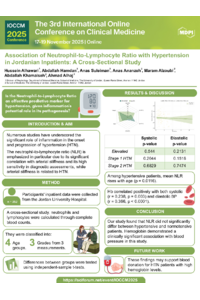
Inflammation is increasingly recognized in the pathogenesis of hypertension (HTN), and the neutrophil-to-lymphocyte ratio (NLR) has emerged as a simple, low-cost inflammatory marker. Yet published data on the NLR and HTN relationship are conflicting and virtually absent for Jordan. Clarifying this association could refine risk stratification and guide future anti-inflammatory interventions. Guided by the immuno-inflammatory model of HTN, we performed a cross-sectional analysis of 352 adult inpatients at the University of Jordan Hospital (February–July 2024). A minimum of three blood pressure readings were taken on different days. The HTN stage was assigned per ACC guidelines. Neutrophils and lymphocytes were measured using complete blood counts to calculate the NLR. Group differences were tested with independent-sample t-tests; Spearman correlation assessed relations between NLR, hemoglobin (Hb), and systolic/diastolic BP across age strata (young 18–35, middle-aged 36–55, older 56–75, elderly 76–90 yrs). NLR did not differ significantly between hypertensive and normotensive participants (p = 0.131) and showed only weak inverse correlations with systolic (r = –0.166, p = 0.039) and diastolic (r = –0.128, p = 0.113) pressures. Among hypertensive patients, mean NLR increased with age (p = 0.0116). Hb correlated positively with both systolic (r = 0.238, p = 0.003) and diastolic BP (r = 0.366, p < 0.0001). No significant associations were found between NLR and HTN stage. Hemoglobin demonstrated a clinically significant association with blood pressure in this Jordanian inpatient population, although NLR was not a significant predictor of the incidence or severity of HTN. These results raise uncertainty on NLR's ability to be used alone for HTN monitoring in comparable clinical contexts and suggest Hb as a potential marker. More extensive, multicenter research in a range of demographics is necessary to identify age-specific inflammatory profiles and investigate whether combining Hb with conventional risk factors will improve the treatment of hypertension.
Keywords
Hypertension
Blood Pressure
Biomarkers
Neutrophil-to-Lymphocyte Ratio
Hypertension Stages
Jordan
Poster
Poster Abstract.pdf
Combined Plasma Syndecan-1 and Renal Resistive Index as Early Predictiors of Sepsis-Associated Acute Kidney Injury: a prospective observational study
Real-world effectiveness of SGLT2 inhibitors on renal and metabolic parameters in patients with chronic kidney disease