Event submissions
Published
This submission belongs to the session S2. Nephrology & Urology of the event The 3rd International Online Conference on Clinical Medicine
Published date
12 Nov, 2025
Academic Editor
'%3e%3cpath%20d='M12.6657%2010.9104C12.4185%2010.325%2012.0599%209.79327%2011.6097%209.34482C11.1609%208.89508%2010.6293%208.5365%2010.0442%208.28888C10.0389%208.28626%2010.0337%208.28495%2010.0285%208.28233C10.8446%207.69279%2011.3752%206.73249%2011.3752%205.64904C11.3752%203.8542%209.92103%202.39999%208.1262%202.39999C6.33136%202.39999%204.87715%203.8542%204.87715%205.64904C4.87715%206.73249%205.40774%207.69279%206.22393%208.28364C6.21869%208.28626%206.21345%208.28757%206.20821%208.29019C5.62129%208.5378%205.09463%208.89284%204.64265%209.34613C4.1929%209.79493%203.83432%2010.3266%203.58671%2010.9117C3.34345%2011.4845%203.21226%2012.0987%203.20023%2012.7209C3.19988%2012.7349%203.20233%2012.7488%203.20744%2012.7619C3.21255%2012.7749%203.22022%2012.7867%203.22998%2012.7968C3.23975%2012.8068%203.25142%2012.8147%203.26431%2012.8202C3.2772%2012.8256%203.29105%2012.8284%203.30504%2012.8284H4.09109C4.14874%2012.8284%204.19459%2012.7825%204.1959%2012.7262C4.2221%2011.7148%204.62823%2010.7676%205.34617%2010.0497C6.08899%209.30683%207.0755%208.89808%208.1262%208.89808C9.17689%208.89808%2010.1634%209.30683%2010.9062%2010.0497C11.6242%2010.7676%2012.0303%2011.7148%2012.0565%2012.7262C12.0578%2012.7838%2012.1037%2012.8284%2012.1613%2012.8284H12.9474C12.9613%2012.8284%2012.9752%2012.8256%2012.9881%2012.8202C13.001%2012.8147%2013.0126%2012.8068%2013.0224%2012.7968C13.0322%2012.7867%2013.0398%2012.7749%2013.0449%2012.7619C13.0501%2012.7488%2013.0525%2012.7349%2013.0522%2012.7209C13.0391%2012.0947%2012.9094%2011.4855%2012.6657%2010.9104ZM8.1262%207.9024C7.52486%207.9024%206.9589%207.6679%206.53312%207.24211C6.10733%206.81633%205.87283%206.25037%205.87283%205.64904C5.87283%205.0477%206.10733%204.48174%206.53312%204.05596C6.9589%203.63018%207.52486%203.39567%208.1262%203.39567C8.72753%203.39567%209.29349%203.63018%209.71927%204.05596C10.1451%204.48174%2010.3796%205.0477%2010.3796%205.64904C10.3796%206.25037%2010.1451%206.81633%209.71927%207.24211C9.29349%207.6679%208.72753%207.9024%208.1262%207.9024Z'%20fill='%235D1EE1'/%3e%3c/g%3e%3c/svg%3e) Emmanuel Andrès
Emmanuel AndrèsCitation
Vanessa Talavera Cobo, José Enrique Robles Garcia, Francisco Guillen Grima, Mario Daniel Tapia Tapia, Carlos Andrés Yánez Ruiz, Andrés Calva López, Carmina Alejandra Muñoz Bastidas, Daniel Sánchez Zalabardo, Bernardino Miñana López, Intracavernosal OnabotulinumtoxinA (BoNT-A) for the Treatment of Erectile Dysfunction: A Systematic Review., in Proceedings of The 3rd International Online Conference on Clinical Medicine, 17 November–19 November 2025, MDPI: Basel, Switzerland
Share
Email
Facebook
Twitter
LinkedIn
Intracavernosal OnabotulinumtoxinA (BoNT-A) for the Treatment of Erectile Dysfunction: A Systematic Review.
'%3e%3cpath%20d='M12.6647%2010.9104C12.4176%2010.325%2012.0589%209.7933%2011.6088%209.34485C11.16%208.89511%2010.6283%208.53653%2010.0432%208.28891C10.038%208.28629%2010.0327%208.28498%2010.0275%208.28236C10.8437%207.69282%2011.3743%206.73252%2011.3743%205.64907C11.3743%203.85423%209.92005%202.40002%208.12522%202.40002C6.33038%202.40002%204.87618%203.85423%204.87618%205.64907C4.87618%206.73252%205.40677%207.69282%206.22296%208.28367C6.21772%208.28629%206.21248%208.2876%206.20724%208.29022C5.62031%208.53783%205.09365%208.89287%204.64167%209.34616C4.19192%209.79496%203.83334%2010.3266%203.58573%2010.9117C3.34247%2011.4846%203.21128%2012.0987%203.19925%2012.721C3.1989%2012.735%203.20135%2012.7489%203.20646%2012.7619C3.21157%2012.7749%203.21924%2012.7868%203.22901%2012.7968C3.23877%2012.8068%203.25045%2012.8148%203.26334%2012.8202C3.27623%2012.8256%203.29007%2012.8284%203.30406%2012.8284H4.09012C4.14776%2012.8284%204.19362%2012.7825%204.19493%2012.7262C4.22113%2011.7148%204.62726%2010.7676%205.34519%2010.0497C6.08802%209.30686%207.07452%208.89811%208.12522%208.89811C9.17592%208.89811%2010.1624%209.30686%2010.9052%2010.0497C11.6232%2010.7676%2012.0293%2011.7148%2012.0555%2012.7262C12.0568%2012.7839%2012.1027%2012.8284%2012.1603%2012.8284H12.9464C12.9604%2012.8284%2012.9742%2012.8256%2012.9871%2012.8202C13%2012.8148%2013.0117%2012.8068%2013.0214%2012.7968C13.0312%2012.7868%2013.0389%2012.7749%2013.044%2012.7619C13.0491%2012.7489%2013.0515%2012.735%2013.0512%2012.721C13.0381%2012.0947%2012.9084%2011.4856%2012.6647%2010.9104ZM8.12522%207.90243C7.52388%207.90243%206.95792%207.66793%206.53214%207.24215C6.10636%206.81636%205.87185%206.2504%205.87185%205.64907C5.87185%205.04773%206.10636%204.48177%206.53214%204.05599C6.95792%203.63021%207.52388%203.3957%208.12522%203.3957C8.72655%203.3957%209.29252%203.63021%209.7183%204.05599C10.1441%204.48177%2010.3786%205.04773%2010.3786%205.64907C10.3786%206.2504%2010.1441%206.81636%209.7183%207.24215C9.29252%207.66793%208.72655%207.90243%208.12522%207.90243Z'%20fill='%235D1EE1'/%3e%3c/g%3e%3c/svg%3e)
Vanessa Talavera Cobo 1
José Enrique Robles Garcia 1

Francisco Guillen Grima 1
Mario Daniel Tapia Tapia 1
Carlos Andrés Yánez Ruiz 1
Andrés Calva López 1
Carmina Alejandra Muñoz Bastidas 1
Daniel Sánchez Zalabardo 1
Bernardino Miñana López 1
1. Clínica Universidad de Navarra, Pamplona 31008, Spain
Abstract
Introduction
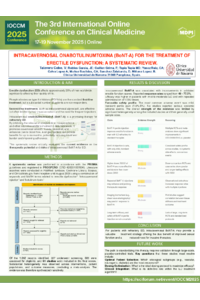
Erectile dysfunction (ED) affects up to 20% of men globally, with a significant subset unresponsive to first-line phosphodiesterase type 5 inhibitors (PDE5-Is). Alternatives like intracavernosal alprostadil are often declined due to administration difficulties. Intracavernosal onabotulinumtoxin type A (BoNT-A) has emerged as a potential treatment by relaxing cavernosal smooth muscle and enhancing penile blood flow, with effects lasting approximately six months.
Methods
A systematic search was conducted in accordance with PRISMA guidelines. Databases (PubMed, Embase, Cochrane Library) were searched from inception to 2025 for clinical studies (randomized controlled trials and prospective cohorts) investigating BoNT-A penile injections for ED. Data on patient demographics, BTX dosage, changes in International Index of Erectile Function (IIEF) scores, Erection Hardness Score (EHS), adverse events, and study quality were extracted using the Cochrane Risk of Bias or NIH Quality Assessment tools and narratively synthesized due to study heterogeneity.
Results:
Included studies (n=50) reported that BoNT-A injections were associated with improvements in erectile function scores (IIEF, SHIM, EHS), with response rates between 40% and 77.5%. Higher response rates were observed in patients with less severe ED and those receiving repeated doses, mainly at 100U. The treatment showed a favorable safety profile; adverse events were mostly mild and transient penile pain (1.5–6%), with no systemic complications reported. The quality of evidence was limited by study heterogeneity and small sample sizes
Conclusions
Intracavernosal BoNT-A is a promising and safe option for men with ED refractory to standard therapies. It may be moderately effective in select patients and could improve sexual function and reduce the need for invasive procedures. It may improve sexual function and reduce the need for invasive procedures. These findings warrant validation by large-scale, randomized, placebo-controlled trials to definitively establish its clinical role and optimal administration parameters.
Keywords
erectile dysfunction
intracavernosal injections
Onabotulinumtoxin-A
Poster
146966.pdf
Relationship of dietary intake of eicosapentaenoic acid and docosahexaenoic acid with subclinical atherosclerosis in subjects with and without diabetes mellitus
From Atlas to Algorithm: A Systematic Review of CNN-Based Bone Age Assessment