Event submissions
Published
This submission belongs to the session S4. Nuclear Medicine & Radiology of the event The 3rd International Online Conference on Clinical Medicine
Published date
12 Nov, 2025
Academic Editor
'%3e%3cpath%20d='M12.6657%2010.9104C12.4185%2010.325%2012.0599%209.79327%2011.6097%209.34482C11.1609%208.89508%2010.6293%208.5365%2010.0442%208.28888C10.0389%208.28626%2010.0337%208.28495%2010.0285%208.28233C10.8446%207.69279%2011.3752%206.73249%2011.3752%205.64904C11.3752%203.8542%209.92103%202.39999%208.1262%202.39999C6.33136%202.39999%204.87715%203.8542%204.87715%205.64904C4.87715%206.73249%205.40774%207.69279%206.22393%208.28364C6.21869%208.28626%206.21345%208.28757%206.20821%208.29019C5.62129%208.5378%205.09463%208.89284%204.64265%209.34613C4.1929%209.79493%203.83432%2010.3266%203.58671%2010.9117C3.34345%2011.4845%203.21226%2012.0987%203.20023%2012.7209C3.19988%2012.7349%203.20233%2012.7488%203.20744%2012.7619C3.21255%2012.7749%203.22022%2012.7867%203.22998%2012.7968C3.23975%2012.8068%203.25142%2012.8147%203.26431%2012.8202C3.2772%2012.8256%203.29105%2012.8284%203.30504%2012.8284H4.09109C4.14874%2012.8284%204.19459%2012.7825%204.1959%2012.7262C4.2221%2011.7148%204.62823%2010.7676%205.34617%2010.0497C6.08899%209.30683%207.0755%208.89808%208.1262%208.89808C9.17689%208.89808%2010.1634%209.30683%2010.9062%2010.0497C11.6242%2010.7676%2012.0303%2011.7148%2012.0565%2012.7262C12.0578%2012.7838%2012.1037%2012.8284%2012.1613%2012.8284H12.9474C12.9613%2012.8284%2012.9752%2012.8256%2012.9881%2012.8202C13.001%2012.8147%2013.0126%2012.8068%2013.0224%2012.7968C13.0322%2012.7867%2013.0398%2012.7749%2013.0449%2012.7619C13.0501%2012.7488%2013.0525%2012.7349%2013.0522%2012.7209C13.0391%2012.0947%2012.9094%2011.4855%2012.6657%2010.9104ZM8.1262%207.9024C7.52486%207.9024%206.9589%207.6679%206.53312%207.24211C6.10733%206.81633%205.87283%206.25037%205.87283%205.64904C5.87283%205.0477%206.10733%204.48174%206.53312%204.05596C6.9589%203.63018%207.52486%203.39567%208.1262%203.39567C8.72753%203.39567%209.29349%203.63018%209.71927%204.05596C10.1451%204.48174%2010.3796%205.0477%2010.3796%205.64904C10.3796%206.25037%2010.1451%206.81633%209.71927%207.24211C9.29349%207.6679%208.72753%207.9024%208.1262%207.9024Z'%20fill='%235D1EE1'/%3e%3c/g%3e%3c/svg%3e) Emmanuel Andrès
Emmanuel AndrèsCitation
JAVIER DIAZ-SANTOS, SILVIA MONTORO-GARCIA, LAURA MEDINA-RODRIGUEZ, ALBA RODRIGUEZ-VALLE, LOURDES RUIZ-CHECA, OLIVIA URQUIZAR-RODRIGUEZ, FERNANDO VIDAL-VANACLOCHA, Qoppa as a new synthetic analytical marker to detect the oncological population at high risk of metastasis during follow-up and optimize the imaging test schedule, in Proceedings of The 3rd International Online Conference on Clinical Medicine, 17 November–19 November 2025, MDPI: Basel, Switzerland
Share
Email
Facebook
Twitter
LinkedIn
Qoppa as a new synthetic analytical marker to detect the oncological population at high risk of metastasis during follow-up and optimize the imaging test schedule
'%3e%3cpath%20d='M12.6647%2010.9104C12.4176%2010.325%2012.0589%209.7933%2011.6088%209.34485C11.16%208.89511%2010.6283%208.53653%2010.0432%208.28891C10.038%208.28629%2010.0327%208.28498%2010.0275%208.28236C10.8437%207.69282%2011.3743%206.73252%2011.3743%205.64907C11.3743%203.85423%209.92005%202.40002%208.12522%202.40002C6.33038%202.40002%204.87618%203.85423%204.87618%205.64907C4.87618%206.73252%205.40677%207.69282%206.22296%208.28367C6.21772%208.28629%206.21248%208.2876%206.20724%208.29022C5.62031%208.53783%205.09365%208.89287%204.64167%209.34616C4.19192%209.79496%203.83334%2010.3266%203.58573%2010.9117C3.34247%2011.4846%203.21128%2012.0987%203.19925%2012.721C3.1989%2012.735%203.20135%2012.7489%203.20646%2012.7619C3.21157%2012.7749%203.21924%2012.7868%203.22901%2012.7968C3.23877%2012.8068%203.25045%2012.8148%203.26334%2012.8202C3.27623%2012.8256%203.29007%2012.8284%203.30406%2012.8284H4.09012C4.14776%2012.8284%204.19362%2012.7825%204.19493%2012.7262C4.22113%2011.7148%204.62726%2010.7676%205.34519%2010.0497C6.08802%209.30686%207.07452%208.89811%208.12522%208.89811C9.17592%208.89811%2010.1624%209.30686%2010.9052%2010.0497C11.6232%2010.7676%2012.0293%2011.7148%2012.0555%2012.7262C12.0568%2012.7839%2012.1027%2012.8284%2012.1603%2012.8284H12.9464C12.9604%2012.8284%2012.9742%2012.8256%2012.9871%2012.8202C13%2012.8148%2013.0117%2012.8068%2013.0214%2012.7968C13.0312%2012.7868%2013.0389%2012.7749%2013.044%2012.7619C13.0491%2012.7489%2013.0515%2012.735%2013.0512%2012.721C13.0381%2012.0947%2012.9084%2011.4856%2012.6647%2010.9104ZM8.12522%207.90243C7.52388%207.90243%206.95792%207.66793%206.53214%207.24215C6.10636%206.81636%205.87185%206.2504%205.87185%205.64907C5.87185%205.04773%206.10636%204.48177%206.53214%204.05599C6.95792%203.63021%207.52388%203.3957%208.12522%203.3957C8.72655%203.3957%209.29252%203.63021%209.7183%204.05599C10.1441%204.48177%2010.3786%205.04773%2010.3786%205.64907C10.3786%206.2504%2010.1441%206.81636%209.7183%207.24215C9.29252%207.66793%208.72655%207.90243%208.12522%207.90243Z'%20fill='%235D1EE1'/%3e%3c/g%3e%3c/svg%3e)
JAVIER DIAZ-SANTOS 1,2,3,4
SILVIA MONTORO-GARCIA 4
LAURA MEDINA-RODRIGUEZ 1,2
ALBA RODRIGUEZ-VALLE 1,2
LOURDES RUIZ-CHECA 1,2
OLIVIA URQUIZAR-RODRIGUEZ 1,2
FERNANDO VIDAL-VANACLOCHA 4,5
1. HM CIOCC MALAGA (Centro Integral Oncológico Clara Campal); Hospital Internacional HM Santa Elena, Málaga, Spain
2. Instituto de Investigación Sanitaria HM Hospitales, Madrid, Spain
3. Servicio de Urgencias, Hospital Regional Universitario de Málaga, Málaga, Spain
4. Escuela Internacional de Doctorado de la Universidad Católica San Antonio Mártir de Murcia (EIDUCAM), Guadalupe, Spain
5. The George Washington University, Washington DC, United States
Abstract
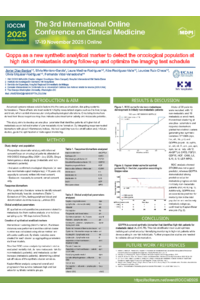
Introduction: Advanced cancers produce numerous soluble factors that affect the microcirculation of organs with high capillary density. This produces a response in these organs, whose pathophysiological biomarkers can indirectly alert us to the existence of premetastatic niches. We propose a new synthetic analytical marker called Qoppa to identify the population at highest risk of metastasis to more effectively schedule the follow-up imaging tests.
Methods: In this RESOLT prospective observational study, plasma samples were obtained from cancer patients to detect 11 biomarkers of response to soluble tumor factors using multiplex immunoassay with Luminex and to calculate 20 global analytical parameters related to prognosis. A clustering study was performed using Eucledean metrics and Ward method, followed by the creation of synthetic covariates for each cluster. Their potential as classifiers for the risk of death and the development of de novo metastasis was analyzed using ROC operator curves. Finally, their classifying role was related to the clinical impact using Kapplan–Meier and Cox analyses.
Results: Thirty patients were enrolled. The clustering study resulted in two clusters: the first with only 12 global parameters and the second with the 11 response biomarkers and the remaining 9 global parameters. The synthetic covariate Stigma was built from the first cluster, and the synthetic covariate Qoppa from the second cluster. While Stigma showed a poor performance as a classifier for death or the development of de novo metastasis, Qoppa was an acceptable classifier with an AUC of 0.78 for both events (cutoff: 4.775). Likewise, the Cox and Kapplan–Meier risk analysis showed that a high Qoppa population has a statistically significantly higher risk of death and metastasis.
Conclusion: Qoppa could help detect the cancer population at higher risk of metastasis or death during the follow-up. This could allow for optimal and early scheduling of imaging tests for detection of metastasis formation.
Keywords
EARLY DIAGNOSIS
METASTASIS
IMAGING SCHEDULE
FOLLOW-UP
CANCER
Poster
DIAZSANTOS_POSTER_3IOCCM.pdf
From Atlas to Algorithm: A Systematic Review of CNN-Based Bone Age Assessment
Renal Involvement in West Nile Virus Infection: A Systematic Review and Meta-Analysis