Event submissions
Published
 10.3390/ecsoc-29-26830 (registering DOI)
 This submission belongs to the session S1. General Organic Synthesis of the event The 29th International Electronic Conference on Synthetic Organic Chemistry
Published date
12 Nov, 2025
Academic Editor
'%3e%3cpath%20d='M12.6657%2010.9104C12.4185%2010.325%2012.0599%209.79327%2011.6097%209.34482C11.1609%208.89508%2010.6293%208.5365%2010.0442%208.28888C10.0389%208.28626%2010.0337%208.28495%2010.0285%208.28233C10.8446%207.69279%2011.3752%206.73249%2011.3752%205.64904C11.3752%203.8542%209.92103%202.39999%208.1262%202.39999C6.33136%202.39999%204.87715%203.8542%204.87715%205.64904C4.87715%206.73249%205.40774%207.69279%206.22393%208.28364C6.21869%208.28626%206.21345%208.28757%206.20821%208.29019C5.62129%208.5378%205.09463%208.89284%204.64265%209.34613C4.1929%209.79493%203.83432%2010.3266%203.58671%2010.9117C3.34345%2011.4845%203.21226%2012.0987%203.20023%2012.7209C3.19988%2012.7349%203.20233%2012.7488%203.20744%2012.7619C3.21255%2012.7749%203.22022%2012.7867%203.22998%2012.7968C3.23975%2012.8068%203.25142%2012.8147%203.26431%2012.8202C3.2772%2012.8256%203.29105%2012.8284%203.30504%2012.8284H4.09109C4.14874%2012.8284%204.19459%2012.7825%204.1959%2012.7262C4.2221%2011.7148%204.62823%2010.7676%205.34617%2010.0497C6.08899%209.30683%207.0755%208.89808%208.1262%208.89808C9.17689%208.89808%2010.1634%209.30683%2010.9062%2010.0497C11.6242%2010.7676%2012.0303%2011.7148%2012.0565%2012.7262C12.0578%2012.7838%2012.1037%2012.8284%2012.1613%2012.8284H12.9474C12.9613%2012.8284%2012.9752%2012.8256%2012.9881%2012.8202C13.001%2012.8147%2013.0126%2012.8068%2013.0224%2012.7968C13.0322%2012.7867%2013.0398%2012.7749%2013.0449%2012.7619C13.0501%2012.7488%2013.0525%2012.7349%2013.0522%2012.7209C13.0391%2012.0947%2012.9094%2011.4855%2012.6657%2010.9104ZM8.1262%207.9024C7.52486%207.9024%206.9589%207.6679%206.53312%207.24211C6.10733%206.81633%205.87283%206.25037%205.87283%205.64904C5.87283%205.0477%206.10733%204.48174%206.53312%204.05596C6.9589%203.63018%207.52486%203.39567%208.1262%203.39567C8.72753%203.39567%209.29349%203.63018%209.71927%204.05596C10.1451%204.48174%2010.3796%205.0477%2010.3796%205.64904C10.3796%206.25037%2010.1451%206.81633%209.71927%207.24211C9.29349%207.6679%208.72753%207.9024%208.1262%207.9024Z'%20fill='%235D1EE1'/%3e%3c/g%3e%3c/svg%3e) Julio A. Seijas
Julio A. SeijasCitation
Malena Luana Boffadossi, Sofía Carla Santamarina, Milena Belén Boarini, Edgardo Nestor Durantini, María Elisa Milanesio, Covalent functionalization of fullerene C₆₀ with polyethyleneimine, in Proceedings of The 29th International Electronic Conference on Synthetic Organic Chemistry, 14 November–28 November 2025, MDPI: Basel, Switzerland, doi: 10.3390/ecsoc-29-26830
Share
Email
Facebook
Twitter
LinkedIn
Covalent functionalization of fullerene C60 with polyethyleneimine
'%3e%3cpath%20d='M12.6647%2010.9104C12.4176%2010.325%2012.0589%209.7933%2011.6088%209.34485C11.16%208.89511%2010.6283%208.53653%2010.0432%208.28891C10.038%208.28629%2010.0327%208.28498%2010.0275%208.28236C10.8437%207.69282%2011.3743%206.73252%2011.3743%205.64907C11.3743%203.85423%209.92005%202.40002%208.12522%202.40002C6.33038%202.40002%204.87618%203.85423%204.87618%205.64907C4.87618%206.73252%205.40677%207.69282%206.22296%208.28367C6.21772%208.28629%206.21248%208.2876%206.20724%208.29022C5.62031%208.53783%205.09365%208.89287%204.64167%209.34616C4.19192%209.79496%203.83334%2010.3266%203.58573%2010.9117C3.34247%2011.4846%203.21128%2012.0987%203.19925%2012.721C3.1989%2012.735%203.20135%2012.7489%203.20646%2012.7619C3.21157%2012.7749%203.21924%2012.7868%203.22901%2012.7968C3.23877%2012.8068%203.25045%2012.8148%203.26334%2012.8202C3.27623%2012.8256%203.29007%2012.8284%203.30406%2012.8284H4.09012C4.14776%2012.8284%204.19362%2012.7825%204.19493%2012.7262C4.22113%2011.7148%204.62726%2010.7676%205.34519%2010.0497C6.08802%209.30686%207.07452%208.89811%208.12522%208.89811C9.17592%208.89811%2010.1624%209.30686%2010.9052%2010.0497C11.6232%2010.7676%2012.0293%2011.7148%2012.0555%2012.7262C12.0568%2012.7839%2012.1027%2012.8284%2012.1603%2012.8284H12.9464C12.9604%2012.8284%2012.9742%2012.8256%2012.9871%2012.8202C13%2012.8148%2013.0117%2012.8068%2013.0214%2012.7968C13.0312%2012.7868%2013.0389%2012.7749%2013.044%2012.7619C13.0491%2012.7489%2013.0515%2012.735%2013.0512%2012.721C13.0381%2012.0947%2012.9084%2011.4856%2012.6647%2010.9104ZM8.12522%207.90243C7.52388%207.90243%206.95792%207.66793%206.53214%207.24215C6.10636%206.81636%205.87185%206.2504%205.87185%205.64907C5.87185%205.04773%206.10636%204.48177%206.53214%204.05599C6.95792%203.63021%207.52388%203.3957%208.12522%203.3957C8.72655%203.3957%209.29252%203.63021%209.7183%204.05599C10.1441%204.48177%2010.3786%205.04773%2010.3786%205.64907C10.3786%206.2504%2010.1441%206.81636%209.7183%207.24215C9.29252%207.66793%208.72655%207.90243%208.12522%207.90243Z'%20fill='%235D1EE1'/%3e%3c/g%3e%3c/svg%3e)
Malena Luana Boffadossi 1
Sofía Carla Santamarina 1
Milena Belén Boarini 1
Edgardo Nestor Durantini 1
María Elisa Milanesio 1
1. Instituto para el Desarrollo Agroindustrial y de la Salud (IDAS-CONICET)-Departamento de Química, Facultad de Ciencias Exactas, Físico-Químicas y Naturales, Universidad Nacional de Río Cuarto. Ruta Nacional 36 Km 601, Río Cuarto, Córdoba, Argentina
Abstract
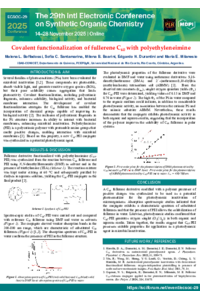
Fullerene C60 derivatives have been evaluated as potential photosensitizers (PSs) for the inactivation of microorganisms. Fullerenes exhibit several attractive features, including high photostability, absorption in the visible region of the spectrum, and the ability to generate reactive oxygen species (ROS). However, one of the main limitations for their application as PSs is their low solubility in polar solvents, which leads to aggregation in aqueous solutions and biological media, ultimately impairing efficient photoactivity. Nevertheless, advances in fullerene C60 covalent chemistry have enabled the attachment of various functional groups to the spherical carbon cage, thereby enhancing their biological activity.
In this work, a PS derived from fullerene C60 covalently linked to polyethyleneimine (PEI) was developed. PEI is a polymer that acquires positive charges at physiological pH and is capable of interacting with microbial cell membranes. The reaction was carried out in DMF in the presence of TEA at room temperature. The C60-PEI conjugate was purified by dialysis in water for one week to eliminate the rest of the reagents that remained unreacted. UV-visible absorption in H2O and N,N-dimethylformamide (DMF) indicated that the properties of the C60 are preserved in the conjugate. Moreover, C60-PEI generates singlet oxygen yielding a quantum yield value of 0.15 and 0.07 in DMF and H2O, respectively. Thus, this methodology enabled the development of a fullerene-derived PS with promising properties for applications in polar environments.
Keywords
fullerene C60
polyethyleneimine
photosensitizer
microorganism
Manuscript
chemproc-sciforum_143260_S1_original_Proceeding_paper_Boffadossi_ML-done.pdf
Poster
Poster Boffadossi ML.pdf
Preparation, Characterization and In silico Study of Some Pyrimidine Derivatives That Contain a Chalcone Group and Study of Their Biological Activity
Fast, Clean, and Green: Microwave-Promoted N-Alkylation of DPPs for Organic Devices