Event submissions
Published
This submission belongs to the session S1. Cardiology & Cardiovascular Medicine of the event The 3rd International Online Conference on Clinical Medicine
Published date
12 Nov, 2025
Academic Editor
'%3e%3cpath%20d='M12.6657%2010.9104C12.4185%2010.325%2012.0599%209.79327%2011.6097%209.34482C11.1609%208.89508%2010.6293%208.5365%2010.0442%208.28888C10.0389%208.28626%2010.0337%208.28495%2010.0285%208.28233C10.8446%207.69279%2011.3752%206.73249%2011.3752%205.64904C11.3752%203.8542%209.92103%202.39999%208.1262%202.39999C6.33136%202.39999%204.87715%203.8542%204.87715%205.64904C4.87715%206.73249%205.40774%207.69279%206.22393%208.28364C6.21869%208.28626%206.21345%208.28757%206.20821%208.29019C5.62129%208.5378%205.09463%208.89284%204.64265%209.34613C4.1929%209.79493%203.83432%2010.3266%203.58671%2010.9117C3.34345%2011.4845%203.21226%2012.0987%203.20023%2012.7209C3.19988%2012.7349%203.20233%2012.7488%203.20744%2012.7619C3.21255%2012.7749%203.22022%2012.7867%203.22998%2012.7968C3.23975%2012.8068%203.25142%2012.8147%203.26431%2012.8202C3.2772%2012.8256%203.29105%2012.8284%203.30504%2012.8284H4.09109C4.14874%2012.8284%204.19459%2012.7825%204.1959%2012.7262C4.2221%2011.7148%204.62823%2010.7676%205.34617%2010.0497C6.08899%209.30683%207.0755%208.89808%208.1262%208.89808C9.17689%208.89808%2010.1634%209.30683%2010.9062%2010.0497C11.6242%2010.7676%2012.0303%2011.7148%2012.0565%2012.7262C12.0578%2012.7838%2012.1037%2012.8284%2012.1613%2012.8284H12.9474C12.9613%2012.8284%2012.9752%2012.8256%2012.9881%2012.8202C13.001%2012.8147%2013.0126%2012.8068%2013.0224%2012.7968C13.0322%2012.7867%2013.0398%2012.7749%2013.0449%2012.7619C13.0501%2012.7488%2013.0525%2012.7349%2013.0522%2012.7209C13.0391%2012.0947%2012.9094%2011.4855%2012.6657%2010.9104ZM8.1262%207.9024C7.52486%207.9024%206.9589%207.6679%206.53312%207.24211C6.10733%206.81633%205.87283%206.25037%205.87283%205.64904C5.87283%205.0477%206.10733%204.48174%206.53312%204.05596C6.9589%203.63018%207.52486%203.39567%208.1262%203.39567C8.72753%203.39567%209.29349%203.63018%209.71927%204.05596C10.1451%204.48174%2010.3796%205.0477%2010.3796%205.64904C10.3796%206.25037%2010.1451%206.81633%209.71927%207.24211C9.29349%207.6679%208.72753%207.9024%208.1262%207.9024Z'%20fill='%235D1EE1'/%3e%3c/g%3e%3c/svg%3e) Emmanuel Andrès
Emmanuel AndrèsCitation
Azam Nawaz, Muhammad Hamza Khan, Safety of Statins in the Elderly: A Systematic Review of Randomized Control Trials and Observational Studies, in Proceedings of The 3rd International Online Conference on Clinical Medicine, 17 November–19 November 2025, MDPI: Basel, Switzerland
Share
Email
Facebook
Twitter
LinkedIn
Safety of Statins in the Elderly: A Systematic Review of Randomized Control Trials and Observational Studies

Azam Nawaz 1
'%3e%3cpath%20d='M12.6647%2010.9104C12.4176%2010.325%2012.0589%209.7933%2011.6088%209.34485C11.16%208.89511%2010.6283%208.53653%2010.0432%208.28891C10.038%208.28629%2010.0327%208.28498%2010.0275%208.28236C10.8437%207.69282%2011.3743%206.73252%2011.3743%205.64907C11.3743%203.85423%209.92005%202.40002%208.12522%202.40002C6.33038%202.40002%204.87618%203.85423%204.87618%205.64907C4.87618%206.73252%205.40677%207.69282%206.22296%208.28367C6.21772%208.28629%206.21248%208.2876%206.20724%208.29022C5.62031%208.53783%205.09365%208.89287%204.64167%209.34616C4.19192%209.79496%203.83334%2010.3266%203.58573%2010.9117C3.34247%2011.4846%203.21128%2012.0987%203.19925%2012.721C3.1989%2012.735%203.20135%2012.7489%203.20646%2012.7619C3.21157%2012.7749%203.21924%2012.7868%203.22901%2012.7968C3.23877%2012.8068%203.25045%2012.8148%203.26334%2012.8202C3.27623%2012.8256%203.29007%2012.8284%203.30406%2012.8284H4.09012C4.14776%2012.8284%204.19362%2012.7825%204.19493%2012.7262C4.22113%2011.7148%204.62726%2010.7676%205.34519%2010.0497C6.08802%209.30686%207.07452%208.89811%208.12522%208.89811C9.17592%208.89811%2010.1624%209.30686%2010.9052%2010.0497C11.6232%2010.7676%2012.0293%2011.7148%2012.0555%2012.7262C12.0568%2012.7839%2012.1027%2012.8284%2012.1603%2012.8284H12.9464C12.9604%2012.8284%2012.9742%2012.8256%2012.9871%2012.8202C13%2012.8148%2013.0117%2012.8068%2013.0214%2012.7968C13.0312%2012.7868%2013.0389%2012.7749%2013.044%2012.7619C13.0491%2012.7489%2013.0515%2012.735%2013.0512%2012.721C13.0381%2012.0947%2012.9084%2011.4856%2012.6647%2010.9104ZM8.12522%207.90243C7.52388%207.90243%206.95792%207.66793%206.53214%207.24215C6.10636%206.81636%205.87185%206.2504%205.87185%205.64907C5.87185%205.04773%206.10636%204.48177%206.53214%204.05599C6.95792%203.63021%207.52388%203.3957%208.12522%203.3957C8.72655%203.3957%209.29252%203.63021%209.7183%204.05599C10.1441%204.48177%2010.3786%205.04773%2010.3786%205.64907C10.3786%206.2504%2010.1441%206.81636%209.7183%207.24215C9.29252%207.66793%208.72655%207.90243%208.12522%207.90243Z'%20fill='%235D1EE1'/%3e%3c/g%3e%3c/svg%3e)
Muhammad Hamza Khan 1
1. Khyber Teaching Hospital, Peshawar 25000, Pakistan
Abstract
Background:
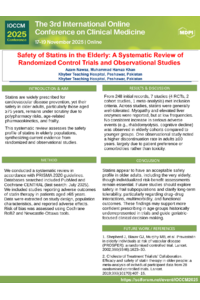
The use of statins for cardiovascular disease prevention is widespread, yet their safety in the elderly, particularly those aged ≥75 years, remains under scrutiny due to polypharmacy, altered pharmacokinetics, frailty, and age-related physiological changes. Evidence is further limited because older adults are frequently underrepresented in randomized trials, leaving uncertainty regarding long-term tolerability, functional outcomes, and interactions with commonly prescribed medications. This systematic review aims to assess the safety of statin use in elderly populations.
Methods:
We conducted a systematic review in accordance with the PRISMA 2020 guidelines. Databases searched included PubMed and Cochrane CENTRAL (last search conducted in July 2025). We included studies reporting adverse outcomes of statin therapy in patients aged ≥65 years. Data on study design, population characteristics, and reported adverse effects were extracted for review and analysis. The risk of bias was assessed using the Cochrane RoB2 and Newcastle–Ottawa tools.
Results:
Of the 248 initial articles, 7 studies (4 RCTs, 2 cohort studies, 1 meta-analysis) met the inclusion criteria. Across these studies, statins were generally well-tolerated. Myopathy and elevated liver enzymes were reported, but had a low incidence. No consistent increase in serious adverse events (e.g., rhabdomyolysis, cognitive decline) was observed in elderly cohorts compared to younger groups. One observational study noted a higher discontinuation rate in adults ≥80 years, largely due to patient preference or comorbidities rather than toxicity.
Conclusion:
Statins appear to have an acceptable safety profile in the elderly populations, including the very elderly, though individualized risk-benefit assessments remain essential. Future studies should explore safety in frail subpopulations and clarify long-term tolerability, particularly regarding drug–drug interactions, multimorbidity, and functional outcomes. These findings may support more confident prescribing in age groups that have been historically underrepresented in trials and guide geriatric-focused clinical decision-making.
Keywords
Statins
Elderly
Safety
Systematic Review
Randomized Control Trials
Poster
sciforum-147283.pdf
A Cross-Sectional Study of Risk Factors Associated with Hypertension in Heart and Kidney Disease Patients in Sana’a, Yemen
Temporal Trends in Sepsis-Associated Mortality Among Older Adults with Chronic Kidney Disease: A CDC WONDER Analysis