Event submissions
Published

This submission belongs to the session S1. General Organic Synthesis of the event The 29th International Electronic Conference on Synthetic Organic Chemistry
Published date
12 Nov, 2025
Academic Editor
'%3e%3cpath%20d='M12.6657%2010.9104C12.4185%2010.325%2012.0599%209.79327%2011.6097%209.34482C11.1609%208.89508%2010.6293%208.5365%2010.0442%208.28888C10.0389%208.28626%2010.0337%208.28495%2010.0285%208.28233C10.8446%207.69279%2011.3752%206.73249%2011.3752%205.64904C11.3752%203.8542%209.92103%202.39999%208.1262%202.39999C6.33136%202.39999%204.87715%203.8542%204.87715%205.64904C4.87715%206.73249%205.40774%207.69279%206.22393%208.28364C6.21869%208.28626%206.21345%208.28757%206.20821%208.29019C5.62129%208.5378%205.09463%208.89284%204.64265%209.34613C4.1929%209.79493%203.83432%2010.3266%203.58671%2010.9117C3.34345%2011.4845%203.21226%2012.0987%203.20023%2012.7209C3.19988%2012.7349%203.20233%2012.7488%203.20744%2012.7619C3.21255%2012.7749%203.22022%2012.7867%203.22998%2012.7968C3.23975%2012.8068%203.25142%2012.8147%203.26431%2012.8202C3.2772%2012.8256%203.29105%2012.8284%203.30504%2012.8284H4.09109C4.14874%2012.8284%204.19459%2012.7825%204.1959%2012.7262C4.2221%2011.7148%204.62823%2010.7676%205.34617%2010.0497C6.08899%209.30683%207.0755%208.89808%208.1262%208.89808C9.17689%208.89808%2010.1634%209.30683%2010.9062%2010.0497C11.6242%2010.7676%2012.0303%2011.7148%2012.0565%2012.7262C12.0578%2012.7838%2012.1037%2012.8284%2012.1613%2012.8284H12.9474C12.9613%2012.8284%2012.9752%2012.8256%2012.9881%2012.8202C13.001%2012.8147%2013.0126%2012.8068%2013.0224%2012.7968C13.0322%2012.7867%2013.0398%2012.7749%2013.0449%2012.7619C13.0501%2012.7488%2013.0525%2012.7349%2013.0522%2012.7209C13.0391%2012.0947%2012.9094%2011.4855%2012.6657%2010.9104ZM8.1262%207.9024C7.52486%207.9024%206.9589%207.6679%206.53312%207.24211C6.10733%206.81633%205.87283%206.25037%205.87283%205.64904C5.87283%205.0477%206.10733%204.48174%206.53312%204.05596C6.9589%203.63018%207.52486%203.39567%208.1262%203.39567C8.72753%203.39567%209.29349%203.63018%209.71927%204.05596C10.1451%204.48174%2010.3796%205.0477%2010.3796%205.64904C10.3796%206.25037%2010.1451%206.81633%209.71927%207.24211C9.29349%207.6679%208.72753%207.9024%208.1262%207.9024Z'%20fill='%235D1EE1'/%3e%3c/g%3e%3c/svg%3e) Julio A. Seijas
Julio A. SeijasCitation
Erika Madeleyne Ramos-Rivera, Cuauhtémoc Alvarado-Sánchez, Oswaldo Ignacio Hernández-Abreu, Quirino Torres-Sauret, Erika Alarcón-Matus, Luis Fernando Roa, Ever Arquímedes Blé-González, Nancy Romero-Ceronio, Synthesis of amphiphilic organocatalysts derived from L-proline, in Proceedings of The 29th International Electronic Conference on Synthetic Organic Chemistry, 14 November–28 November 2025, MDPI: Basel, Switzerland, doi: 10.3390/ecsoc-29-26866
Share
Email
Facebook
Twitter
LinkedIn
Synthesis of amphiphilic organocatalysts derived from L-proline
'%3e%3cpath%20d='M12.6647%2010.9104C12.4176%2010.325%2012.0589%209.7933%2011.6088%209.34485C11.16%208.89511%2010.6283%208.53653%2010.0432%208.28891C10.038%208.28629%2010.0327%208.28498%2010.0275%208.28236C10.8437%207.69282%2011.3743%206.73252%2011.3743%205.64907C11.3743%203.85423%209.92005%202.40002%208.12522%202.40002C6.33038%202.40002%204.87618%203.85423%204.87618%205.64907C4.87618%206.73252%205.40677%207.69282%206.22296%208.28367C6.21772%208.28629%206.21248%208.2876%206.20724%208.29022C5.62031%208.53783%205.09365%208.89287%204.64167%209.34616C4.19192%209.79496%203.83334%2010.3266%203.58573%2010.9117C3.34247%2011.4846%203.21128%2012.0987%203.19925%2012.721C3.1989%2012.735%203.20135%2012.7489%203.20646%2012.7619C3.21157%2012.7749%203.21924%2012.7868%203.22901%2012.7968C3.23877%2012.8068%203.25045%2012.8148%203.26334%2012.8202C3.27623%2012.8256%203.29007%2012.8284%203.30406%2012.8284H4.09012C4.14776%2012.8284%204.19362%2012.7825%204.19493%2012.7262C4.22113%2011.7148%204.62726%2010.7676%205.34519%2010.0497C6.08802%209.30686%207.07452%208.89811%208.12522%208.89811C9.17592%208.89811%2010.1624%209.30686%2010.9052%2010.0497C11.6232%2010.7676%2012.0293%2011.7148%2012.0555%2012.7262C12.0568%2012.7839%2012.1027%2012.8284%2012.1603%2012.8284H12.9464C12.9604%2012.8284%2012.9742%2012.8256%2012.9871%2012.8202C13%2012.8148%2013.0117%2012.8068%2013.0214%2012.7968C13.0312%2012.7868%2013.0389%2012.7749%2013.044%2012.7619C13.0491%2012.7489%2013.0515%2012.735%2013.0512%2012.721C13.0381%2012.0947%2012.9084%2011.4856%2012.6647%2010.9104ZM8.12522%207.90243C7.52388%207.90243%206.95792%207.66793%206.53214%207.24215C6.10636%206.81636%205.87185%206.2504%205.87185%205.64907C5.87185%205.04773%206.10636%204.48177%206.53214%204.05599C6.95792%203.63021%207.52388%203.3957%208.12522%203.3957C8.72655%203.3957%209.29252%203.63021%209.7183%204.05599C10.1441%204.48177%2010.3786%205.04773%2010.3786%205.64907C10.3786%206.2504%2010.1441%206.81636%209.7183%207.24215C9.29252%207.66793%208.72655%207.90243%208.12522%207.90243Z'%20fill='%235D1EE1'/%3e%3c/g%3e%3c/svg%3e)
Erika Madeleyne Ramos-Rivera 1
Cuauhtémoc Alvarado-Sánchez 1
Oswaldo Ignacio Hernández-Abreu 1
Quirino Torres-Sauret 1
Erika Alarcón-Matus 1
Luis Fernando Roa 1
Ever Arquímedes Blé-González 1
Nancy Romero-Ceronio 1
1. Centro de Investigación de Ciencia y Tecnología Aplicada de Tabasco, División Académica de Ciencias
Básicas, Universidad Juárez Autónoma de Tabasco, Carretera Cunduacán-Jalpa km 1, Col. La Esperanza,
Cunduacán 86690, Tabasco, Mexico
Abstract
Organocatalysis, as defined by MacMillan, involves the use of low-molecular-weight organic molecules as catalysts in organic reactions. In the 21st century, significant efforts have been made to develop more sustainable organocatalyzed processes, emphasizing the production of enantiomerically pure compounds while adhering to the 12 principles of Green Chemistry. Organocatalysts synthesized from L-proline have demonstrated effectiveness in catalyzing various asymmetric reactions. Additionally, the choice of reaction medium plays a crucial role; using environmentally friendly solvents, such as water or brine solutions, can facilitate the formation of stable emulsions that enhance the interaction between the organocatalyst and the reactants. This work describes the synthesis of two organocatalysts derived from L-proline through a five-step process. The resulting compounds are (S)-7-(pyrrolidin-2-yl)tridecan-7-amine and (S)-2-(7-azidotridecan-7-yl)pyrrolidine. These compounds have two key characteristics: they are pyrrolidine derivatives functionalized at the C-2 position and they possess aliphatic chains of six carbon atoms. The obtained products were characterized using ¹H-NMR, ¹³C-NMR, DEPT, COSY, HSQC, and HMBC, with the signals confirming their proposed structures. The compounds were achieved with overall yields of 37% and 5%, respectively. A significant advantage of these products is that they can be classified as amphiphilic catalysts due to the presence of both hydrophilic and hydrophobic components in their structures. This structural feature enables the catalysts to form stable emulsions, thus promoting organic reactions in aqueous media.
Keywords
L-proline
amphiphilic catalysts
water reaction
Manuscript
chemproc-sciforum_143542_S1_original_Manuscrito_organocaltalizadores_NRC2-done.pdf
Poster
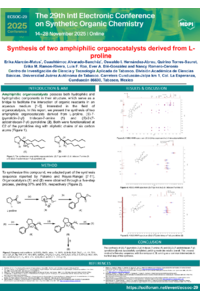
4Poster_NRC.pdf
Physicochemical Integrity and Sensory Profiling of Algerian Honeys: Insights into Floral Diversity and Consumer Perception
New synthetic applications of 2-benzylidene-1-indanones: Synthesis of 4b,10,10a,11-tetrahydro-5H-indeno[1,2-H]quinoline and 1'-(diisopropylamino)-2,2'-spirobi[indene]-1,3'(1'H,3H)-dione