Event submissions
Published
This submission belongs to the session S2. Nephrology & Urology of the event The 3rd International Online Conference on Clinical Medicine
Published date
12 Nov, 2025
Academic Editor
'%3e%3cpath%20d='M12.6657%2010.9104C12.4185%2010.325%2012.0599%209.79327%2011.6097%209.34482C11.1609%208.89508%2010.6293%208.5365%2010.0442%208.28888C10.0389%208.28626%2010.0337%208.28495%2010.0285%208.28233C10.8446%207.69279%2011.3752%206.73249%2011.3752%205.64904C11.3752%203.8542%209.92103%202.39999%208.1262%202.39999C6.33136%202.39999%204.87715%203.8542%204.87715%205.64904C4.87715%206.73249%205.40774%207.69279%206.22393%208.28364C6.21869%208.28626%206.21345%208.28757%206.20821%208.29019C5.62129%208.5378%205.09463%208.89284%204.64265%209.34613C4.1929%209.79493%203.83432%2010.3266%203.58671%2010.9117C3.34345%2011.4845%203.21226%2012.0987%203.20023%2012.7209C3.19988%2012.7349%203.20233%2012.7488%203.20744%2012.7619C3.21255%2012.7749%203.22022%2012.7867%203.22998%2012.7968C3.23975%2012.8068%203.25142%2012.8147%203.26431%2012.8202C3.2772%2012.8256%203.29105%2012.8284%203.30504%2012.8284H4.09109C4.14874%2012.8284%204.19459%2012.7825%204.1959%2012.7262C4.2221%2011.7148%204.62823%2010.7676%205.34617%2010.0497C6.08899%209.30683%207.0755%208.89808%208.1262%208.89808C9.17689%208.89808%2010.1634%209.30683%2010.9062%2010.0497C11.6242%2010.7676%2012.0303%2011.7148%2012.0565%2012.7262C12.0578%2012.7838%2012.1037%2012.8284%2012.1613%2012.8284H12.9474C12.9613%2012.8284%2012.9752%2012.8256%2012.9881%2012.8202C13.001%2012.8147%2013.0126%2012.8068%2013.0224%2012.7968C13.0322%2012.7867%2013.0398%2012.7749%2013.0449%2012.7619C13.0501%2012.7488%2013.0525%2012.7349%2013.0522%2012.7209C13.0391%2012.0947%2012.9094%2011.4855%2012.6657%2010.9104ZM8.1262%207.9024C7.52486%207.9024%206.9589%207.6679%206.53312%207.24211C6.10733%206.81633%205.87283%206.25037%205.87283%205.64904C5.87283%205.0477%206.10733%204.48174%206.53312%204.05596C6.9589%203.63018%207.52486%203.39567%208.1262%203.39567C8.72753%203.39567%209.29349%203.63018%209.71927%204.05596C10.1451%204.48174%2010.3796%205.0477%2010.3796%205.64904C10.3796%206.25037%2010.1451%206.81633%209.71927%207.24211C9.29349%207.6679%208.72753%207.9024%208.1262%207.9024Z'%20fill='%235D1EE1'/%3e%3c/g%3e%3c/svg%3e) Emmanuel Andrès
Emmanuel AndrèsCitation
Daniyal Ali Khan, Syed Haider Ali Gardezi, Mustafa Aman, Syed Ali Tayyeb Hasan, Mahnoor Khan, Shahzaib Khan, Munir Mehmood, Ali Bin Abdul Jabbar, Temporal Trends in Sepsis-Associated Mortality Among Older Adults with Chronic Kidney Disease: A CDC WONDER Analysis, in Proceedings of The 3rd International Online Conference on Clinical Medicine, 17 November–19 November 2025, MDPI: Basel, Switzerland
Share
Email
Facebook
Twitter
LinkedIn
Temporal Trends in Sepsis-Associated Mortality Among Older Adults with Chronic Kidney Disease: A CDC WONDER Analysis
'%3e%3cpath%20d='M12.6647%2010.9104C12.4176%2010.325%2012.0589%209.7933%2011.6088%209.34485C11.16%208.89511%2010.6283%208.53653%2010.0432%208.28891C10.038%208.28629%2010.0327%208.28498%2010.0275%208.28236C10.8437%207.69282%2011.3743%206.73252%2011.3743%205.64907C11.3743%203.85423%209.92005%202.40002%208.12522%202.40002C6.33038%202.40002%204.87618%203.85423%204.87618%205.64907C4.87618%206.73252%205.40677%207.69282%206.22296%208.28367C6.21772%208.28629%206.21248%208.2876%206.20724%208.29022C5.62031%208.53783%205.09365%208.89287%204.64167%209.34616C4.19192%209.79496%203.83334%2010.3266%203.58573%2010.9117C3.34247%2011.4846%203.21128%2012.0987%203.19925%2012.721C3.1989%2012.735%203.20135%2012.7489%203.20646%2012.7619C3.21157%2012.7749%203.21924%2012.7868%203.22901%2012.7968C3.23877%2012.8068%203.25045%2012.8148%203.26334%2012.8202C3.27623%2012.8256%203.29007%2012.8284%203.30406%2012.8284H4.09012C4.14776%2012.8284%204.19362%2012.7825%204.19493%2012.7262C4.22113%2011.7148%204.62726%2010.7676%205.34519%2010.0497C6.08802%209.30686%207.07452%208.89811%208.12522%208.89811C9.17592%208.89811%2010.1624%209.30686%2010.9052%2010.0497C11.6232%2010.7676%2012.0293%2011.7148%2012.0555%2012.7262C12.0568%2012.7839%2012.1027%2012.8284%2012.1603%2012.8284H12.9464C12.9604%2012.8284%2012.9742%2012.8256%2012.9871%2012.8202C13%2012.8148%2013.0117%2012.8068%2013.0214%2012.7968C13.0312%2012.7868%2013.0389%2012.7749%2013.044%2012.7619C13.0491%2012.7489%2013.0515%2012.735%2013.0512%2012.721C13.0381%2012.0947%2012.9084%2011.4856%2012.6647%2010.9104ZM8.12522%207.90243C7.52388%207.90243%206.95792%207.66793%206.53214%207.24215C6.10636%206.81636%205.87185%206.2504%205.87185%205.64907C5.87185%205.04773%206.10636%204.48177%206.53214%204.05599C6.95792%203.63021%207.52388%203.3957%208.12522%203.3957C8.72655%203.3957%209.29252%203.63021%209.7183%204.05599C10.1441%204.48177%2010.3786%205.04773%2010.3786%205.64907C10.3786%206.2504%2010.1441%206.81636%209.7183%207.24215C9.29252%207.66793%208.72655%207.90243%208.12522%207.90243Z'%20fill='%235D1EE1'/%3e%3c/g%3e%3c/svg%3e)
Daniyal Ali Khan 1
Syed Haider Ali Gardezi 1
Mustafa Aman 1
Syed Ali Tayyeb Hasan 1
Mahnoor Khan 2
Shahzaib Khan 3
Munir Mehmood 1
Ali Bin Abdul Jabbar 4
1. Medical College, Aga Khan University, Karachi 74800, Pakistan
2. Medical College, Shaikh Khalifa Bin Zayed Al Nahyan Medical & Dental College, Lahore 54600, Pakistan
3. Division of Internal Medicine, Department of Medicine, Rutgers Health Community Medical Center, Toms River 08755, NJ, USA
4. Department of Medicine, Division of Internal Medicine, Creighton University School of Medicine, Omaha 68124, NE, USA
Abstract
Background
Sepsis and chronic kidney disease (CKD) are major causes of mortality in the U.S. However, national trends in mortality involving both conditions remain poorly defined.
Methods
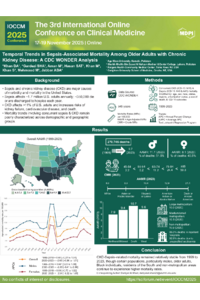
This cross-sectional study analyzed CDC WONDER data (1999–2023) to examine mortality trends related to CKD–sepsis (ICD-10: N18, A40, A41) among U.S. adults aged 45 years or older. Age-adjusted and crude mortality rates (AAMRs, CMRs) were calculated per 100,000 population and stratified by gender, age, race, urbanization, region, state, place of death, and ICD-10 subcodes. Annual and average annual percentage changes (APCs, AAPCs) in trends were assessed using Joinpoint regression.
Results
CKD–sepsis mortality remained stable from 1999 to 2023, with AAMR rising from 7.5 to 9.0 per 100,000 by 2019 (APC = 0.60%, 95% CI: -0.21 to 1.51), then declining from 10.3 in 2020 to 9.7 in 2023 (APC = -2.6%, 95% CI: -6.96 to 1.81). Of 270,746 CKD–sepsis-related deaths, 51.5% were male, with consistently higher AAMRs and a significant rise through 2019. Black individuals consistently had the highest AAMRs throughout the study. From 1999 to 2019, rates declined across all racial groups except Whites. By 2023, Black AAMR (21.1) remained over twice that of Whites (8.0), Asian/Pacific Islanders (8.3), and Hispanics (10.4). The CMR gap between the 45-54 and ≥85 groups widened from a 9-fold to a 23-fold difference over the study period. DC had the highest AAMR (22.5), while Montana had the lowest (4.1). AAMRs in medium-sized and small, as well as non-metropolitan areas, rose significantly, surpassing those in large metropolitan areas. Regionally, the South had the highest AAMR throughout, increasing from 8.8 to 10.7. The majority (92.91%) of deaths were attributed to unspecified septicemia.
Conclusion
CKD–sepsis-related mortality remained relatively stable from 1999 to 2023, though certain populations, particularly males, older adults, Black individuals, and residents of the South, experienced consistently higher mortality rates.
Keywords
Chronic renal insufficiency
Sepsis
Health inequities
Epidemiology
Mortality
United States
Poster
Poster - sciforum-139557.pdf
Safety of Statins in the Elderly: A Systematic Review of Randomized Control Trials and Observational Studies
Endovascular thrombectomy for acute ischemic stroke with a large infarct area: an updated systematic review and meta-analysis of randomized controlled trials