Event submissions
Published

This submission belongs to the session S2. Chemistry of Bioorganics, Medicinal and Natural Products of the event The 29th International Electronic Conference on Synthetic Organic Chemistry
Published date
12 Nov, 2025
Academic Editor
'%3e%3cpath%20d='M12.6657%2010.9104C12.4185%2010.325%2012.0599%209.79327%2011.6097%209.34482C11.1609%208.89508%2010.6293%208.5365%2010.0442%208.28888C10.0389%208.28626%2010.0337%208.28495%2010.0285%208.28233C10.8446%207.69279%2011.3752%206.73249%2011.3752%205.64904C11.3752%203.8542%209.92103%202.39999%208.1262%202.39999C6.33136%202.39999%204.87715%203.8542%204.87715%205.64904C4.87715%206.73249%205.40774%207.69279%206.22393%208.28364C6.21869%208.28626%206.21345%208.28757%206.20821%208.29019C5.62129%208.5378%205.09463%208.89284%204.64265%209.34613C4.1929%209.79493%203.83432%2010.3266%203.58671%2010.9117C3.34345%2011.4845%203.21226%2012.0987%203.20023%2012.7209C3.19988%2012.7349%203.20233%2012.7488%203.20744%2012.7619C3.21255%2012.7749%203.22022%2012.7867%203.22998%2012.7968C3.23975%2012.8068%203.25142%2012.8147%203.26431%2012.8202C3.2772%2012.8256%203.29105%2012.8284%203.30504%2012.8284H4.09109C4.14874%2012.8284%204.19459%2012.7825%204.1959%2012.7262C4.2221%2011.7148%204.62823%2010.7676%205.34617%2010.0497C6.08899%209.30683%207.0755%208.89808%208.1262%208.89808C9.17689%208.89808%2010.1634%209.30683%2010.9062%2010.0497C11.6242%2010.7676%2012.0303%2011.7148%2012.0565%2012.7262C12.0578%2012.7838%2012.1037%2012.8284%2012.1613%2012.8284H12.9474C12.9613%2012.8284%2012.9752%2012.8256%2012.9881%2012.8202C13.001%2012.8147%2013.0126%2012.8068%2013.0224%2012.7968C13.0322%2012.7867%2013.0398%2012.7749%2013.0449%2012.7619C13.0501%2012.7488%2013.0525%2012.7349%2013.0522%2012.7209C13.0391%2012.0947%2012.9094%2011.4855%2012.6657%2010.9104ZM8.1262%207.9024C7.52486%207.9024%206.9589%207.6679%206.53312%207.24211C6.10733%206.81633%205.87283%206.25037%205.87283%205.64904C5.87283%205.0477%206.10733%204.48174%206.53312%204.05596C6.9589%203.63018%207.52486%203.39567%208.1262%203.39567C8.72753%203.39567%209.29349%203.63018%209.71927%204.05596C10.1451%204.48174%2010.3796%205.0477%2010.3796%205.64904C10.3796%206.25037%2010.1451%206.81633%209.71927%207.24211C9.29349%207.6679%208.72753%207.9024%208.1262%207.9024Z'%20fill='%235D1EE1'/%3e%3c/g%3e%3c/svg%3e) Julio A. Seijas
Julio A. SeijasCitation
Meriem FERFAR, Youssouf DRIOUCHE, Amina Dridi, Souad Narsis, El fahem Sakher, Aissa Benselhoub, Nanostructured Algerian Coal: A Sustainable Carbon Source for Advanced Synthetic Applications, in Proceedings of The 29th International Electronic Conference on Synthetic Organic Chemistry, 14 November–28 November 2025, MDPI: Basel, Switzerland, doi: 10.3390/ecsoc-29-26871
Share
Email
Facebook
Twitter
LinkedIn
Nanostructured Algerian Coal: A Sustainable Carbon Source for Advanced Synthetic Applications

Meriem FERFAR 1
'%3e%3cpath%20d='M12.6647%2010.9104C12.4176%2010.325%2012.0589%209.7933%2011.6088%209.34485C11.16%208.89511%2010.6283%208.53653%2010.0432%208.28891C10.038%208.28629%2010.0327%208.28498%2010.0275%208.28236C10.8437%207.69282%2011.3743%206.73252%2011.3743%205.64907C11.3743%203.85423%209.92005%202.40002%208.12522%202.40002C6.33038%202.40002%204.87618%203.85423%204.87618%205.64907C4.87618%206.73252%205.40677%207.69282%206.22296%208.28367C6.21772%208.28629%206.21248%208.2876%206.20724%208.29022C5.62031%208.53783%205.09365%208.89287%204.64167%209.34616C4.19192%209.79496%203.83334%2010.3266%203.58573%2010.9117C3.34247%2011.4846%203.21128%2012.0987%203.19925%2012.721C3.1989%2012.735%203.20135%2012.7489%203.20646%2012.7619C3.21157%2012.7749%203.21924%2012.7868%203.22901%2012.7968C3.23877%2012.8068%203.25045%2012.8148%203.26334%2012.8202C3.27623%2012.8256%203.29007%2012.8284%203.30406%2012.8284H4.09012C4.14776%2012.8284%204.19362%2012.7825%204.19493%2012.7262C4.22113%2011.7148%204.62726%2010.7676%205.34519%2010.0497C6.08802%209.30686%207.07452%208.89811%208.12522%208.89811C9.17592%208.89811%2010.1624%209.30686%2010.9052%2010.0497C11.6232%2010.7676%2012.0293%2011.7148%2012.0555%2012.7262C12.0568%2012.7839%2012.1027%2012.8284%2012.1603%2012.8284H12.9464C12.9604%2012.8284%2012.9742%2012.8256%2012.9871%2012.8202C13%2012.8148%2013.0117%2012.8068%2013.0214%2012.7968C13.0312%2012.7868%2013.0389%2012.7749%2013.044%2012.7619C13.0491%2012.7489%2013.0515%2012.735%2013.0512%2012.721C13.0381%2012.0947%2012.9084%2011.4856%2012.6647%2010.9104ZM8.12522%207.90243C7.52388%207.90243%206.95792%207.66793%206.53214%207.24215C6.10636%206.81636%205.87185%206.2504%205.87185%205.64907C5.87185%205.04773%206.10636%204.48177%206.53214%204.05599C6.95792%203.63021%207.52388%203.3957%208.12522%203.3957C8.72655%203.3957%209.29252%203.63021%209.7183%204.05599C10.1441%204.48177%2010.3786%205.04773%2010.3786%205.64907C10.3786%206.2504%2010.1441%206.81636%209.7183%207.24215C9.29252%207.66793%208.72655%207.90243%208.12522%207.90243Z'%20fill='%235D1EE1'/%3e%3c/g%3e%3c/svg%3e)
Youssouf DRIOUCHE 1
Amina Dridi 1
Souad Narsis 1
El fahem Sakher 2
Aissa Benselhoub 1
1. Environmental Research Center (CRE), Annaba 23000, Algeria
2. Laboratory of Energy, Environment and Information System (LEEIS), Department of Material Science, Adrar, Algeria
Abstract
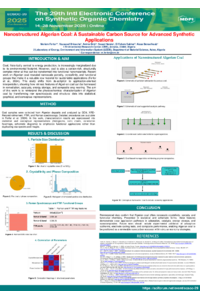
In response to the growing demand for sustainable and resource-efficient alternatives in synthetic chemistry, this study explores the untapped potential of Algerian coal as a renewable, nanostructured, carbon-rich material. Traditionally perceived as a fossil energy source, this indigenous and underutilized resource is revisited for its suitability in eco-friendly and advanced synthetic organic applications.
A comprehensive physicochemical characterization was carried out using Scanning Electron Microscopy (SEM), X-ray Diffraction (XRD) with Rietveld refinement, Fourier Transform Infrared Spectroscopy (FTIR), and Raman Spectroscopy. The analyses revealed a heterogeneous, porous structure dominated by carbon (98.8%) and silica (1.2%), with nanocrystallites averaging ~18 nm in size. Raman spectroscopy confirmed the presence of both graphitic and disordered carbon domains—an ideal structural configuration for molecular adsorption, surface functionalization, redox reactivity, and catalytic activity.
These findings suggest a transformative role for Algerian coal as a sustainable feedstock in the design of porous nanocomposites, supramolecular carbon-based architectures, hybrid polymer systems, and smart functional materials. This study presents the first nanoscale investigation of this local raw material, opening new interdisciplinary perspectives for its integration into green synthetic processes and emerging materials chemistry.
By reimagining coal as a functional platform rather than merely a fuel, this research contributes to circular economy strategies and advances innovation within synthetic organic, environmental, and materials chemistry.
Keywords
Nanostructured carbon
Sustainable synthesis
Green chemistry
Functional materials
Carbon-based nanocomposites
Organic functionalization
Manuscript
chemproc-sciforum_136513_S2_original_Manuscript_FERFAR_Meriem_ECSOC_27102025-done.pdf
Poster
Poster Ferfar Meriem ECSOC-27102025.pdf
Lignin-Catalyzed Synthesis of Phenoxyacetic Acid: A Green Approach to Functional Molecule Development
A Green and Efficient One-Pot Synthesis of 2,3-Diphenylquinoxaline Using Sodium Hypochlorite as a Sustainable Oxidant