Event submissions
Published

This submission belongs to the session S4. Computational Chemistry of the event The 29th International Electronic Conference on Synthetic Organic Chemistry
Published date
13 Nov, 2025
Academic Editor
'%3e%3cpath%20d='M12.6657%2010.9104C12.4185%2010.325%2012.0599%209.79327%2011.6097%209.34482C11.1609%208.89508%2010.6293%208.5365%2010.0442%208.28888C10.0389%208.28626%2010.0337%208.28495%2010.0285%208.28233C10.8446%207.69279%2011.3752%206.73249%2011.3752%205.64904C11.3752%203.8542%209.92103%202.39999%208.1262%202.39999C6.33136%202.39999%204.87715%203.8542%204.87715%205.64904C4.87715%206.73249%205.40774%207.69279%206.22393%208.28364C6.21869%208.28626%206.21345%208.28757%206.20821%208.29019C5.62129%208.5378%205.09463%208.89284%204.64265%209.34613C4.1929%209.79493%203.83432%2010.3266%203.58671%2010.9117C3.34345%2011.4845%203.21226%2012.0987%203.20023%2012.7209C3.19988%2012.7349%203.20233%2012.7488%203.20744%2012.7619C3.21255%2012.7749%203.22022%2012.7867%203.22998%2012.7968C3.23975%2012.8068%203.25142%2012.8147%203.26431%2012.8202C3.2772%2012.8256%203.29105%2012.8284%203.30504%2012.8284H4.09109C4.14874%2012.8284%204.19459%2012.7825%204.1959%2012.7262C4.2221%2011.7148%204.62823%2010.7676%205.34617%2010.0497C6.08899%209.30683%207.0755%208.89808%208.1262%208.89808C9.17689%208.89808%2010.1634%209.30683%2010.9062%2010.0497C11.6242%2010.7676%2012.0303%2011.7148%2012.0565%2012.7262C12.0578%2012.7838%2012.1037%2012.8284%2012.1613%2012.8284H12.9474C12.9613%2012.8284%2012.9752%2012.8256%2012.9881%2012.8202C13.001%2012.8147%2013.0126%2012.8068%2013.0224%2012.7968C13.0322%2012.7867%2013.0398%2012.7749%2013.0449%2012.7619C13.0501%2012.7488%2013.0525%2012.7349%2013.0522%2012.7209C13.0391%2012.0947%2012.9094%2011.4855%2012.6657%2010.9104ZM8.1262%207.9024C7.52486%207.9024%206.9589%207.6679%206.53312%207.24211C6.10733%206.81633%205.87283%206.25037%205.87283%205.64904C5.87283%205.0477%206.10733%204.48174%206.53312%204.05596C6.9589%203.63018%207.52486%203.39567%208.1262%203.39567C8.72753%203.39567%209.29349%203.63018%209.71927%204.05596C10.1451%204.48174%2010.3796%205.0477%2010.3796%205.64904C10.3796%206.25037%2010.1451%206.81633%209.71927%207.24211C9.29349%207.6679%208.72753%207.9024%208.1262%207.9024Z'%20fill='%235D1EE1'/%3e%3c/g%3e%3c/svg%3e) Julio A. Seijas
Julio A. SeijasCitation
Yukti Sabikhi, Anshika Singh, Chhavi Dudeja, Sameen Masroor, Richa Gupta, CRISPR-Cas as a Chemically Programmable System: Advances in Modulation and Delivery, in Proceedings of The 29th International Electronic Conference on Synthetic Organic Chemistry, 14 November–28 November 2025, MDPI: Basel, Switzerland, doi: 10.3390/ecsoc-29-26883
Share
Email
Facebook
Twitter
LinkedIn
CRISPR-Cas as a Chemically Programmable System: Advances in Modulation and Delivery

Yukti Sabikhi 1
'%3e%3cpath%20d='M12.6647%2010.9104C12.4176%2010.325%2012.0589%209.7933%2011.6088%209.34485C11.16%208.89511%2010.6283%208.53653%2010.0432%208.28891C10.038%208.28629%2010.0327%208.28498%2010.0275%208.28236C10.8437%207.69282%2011.3743%206.73252%2011.3743%205.64907C11.3743%203.85423%209.92005%202.40002%208.12522%202.40002C6.33038%202.40002%204.87618%203.85423%204.87618%205.64907C4.87618%206.73252%205.40677%207.69282%206.22296%208.28367C6.21772%208.28629%206.21248%208.2876%206.20724%208.29022C5.62031%208.53783%205.09365%208.89287%204.64167%209.34616C4.19192%209.79496%203.83334%2010.3266%203.58573%2010.9117C3.34247%2011.4846%203.21128%2012.0987%203.19925%2012.721C3.1989%2012.735%203.20135%2012.7489%203.20646%2012.7619C3.21157%2012.7749%203.21924%2012.7868%203.22901%2012.7968C3.23877%2012.8068%203.25045%2012.8148%203.26334%2012.8202C3.27623%2012.8256%203.29007%2012.8284%203.30406%2012.8284H4.09012C4.14776%2012.8284%204.19362%2012.7825%204.19493%2012.7262C4.22113%2011.7148%204.62726%2010.7676%205.34519%2010.0497C6.08802%209.30686%207.07452%208.89811%208.12522%208.89811C9.17592%208.89811%2010.1624%209.30686%2010.9052%2010.0497C11.6232%2010.7676%2012.0293%2011.7148%2012.0555%2012.7262C12.0568%2012.7839%2012.1027%2012.8284%2012.1603%2012.8284H12.9464C12.9604%2012.8284%2012.9742%2012.8256%2012.9871%2012.8202C13%2012.8148%2013.0117%2012.8068%2013.0214%2012.7968C13.0312%2012.7868%2013.0389%2012.7749%2013.044%2012.7619C13.0491%2012.7489%2013.0515%2012.735%2013.0512%2012.721C13.0381%2012.0947%2012.9084%2011.4856%2012.6647%2010.9104ZM8.12522%207.90243C7.52388%207.90243%206.95792%207.66793%206.53214%207.24215C6.10636%206.81636%205.87185%206.2504%205.87185%205.64907C5.87185%205.04773%206.10636%204.48177%206.53214%204.05599C6.95792%203.63021%207.52388%203.3957%208.12522%203.3957C8.72655%203.3957%209.29252%203.63021%209.7183%204.05599C10.1441%204.48177%2010.3786%205.04773%2010.3786%205.64907C10.3786%206.2504%2010.1441%206.81636%209.7183%207.24215C9.29252%207.66793%208.72655%207.90243%208.12522%207.90243Z'%20fill='%235D1EE1'/%3e%3c/g%3e%3c/svg%3e)
Anshika Singh 1
Chhavi Dudeja 1
Sameen Masroor 1
Richa Gupta 1
1. School of Engineering Science and Technology, Jamia Hamdard University, New Delhi-110062, India
Abstract
CRISPR-Cas systems have revolutionized genome engineering due to their exceptional precision, programmability, and cost-effectiveness. While rooted in microbial defense mechanisms, expanding their application particularly in therapeutics demands a chemically oriented framework that enables tunable, reversible, and safe gene editing.This review presents a multidisciplinary exploration of recent advances in the structural, synthetic, and computational dimensions of CRISPR-Cas technologies. Structural analyses focus on domain architectures of Cas enzymes, including the recognition (REC), nuclease (HNH and RuvC), and PAM-interacting domains, emphasizing the catalytic role of divalent metal ions. Comparative insights into Cas9, Cas12, and Cas13 reveal functional diversity across DNA- and RNA-targeting systems, supported by high-resolution structural data on guide RNA pairing and conformational dynamics.The review highlights advances in chemical modulation, such as anti-CRISPR proteins, small molecule inhibitors, and stimuli-responsive switches, with emphasis on structure–activity relationships. Additionally, bioorganic delivery system lipid nanoparticles, polymers, and cell-penetrating peptides are examined for their role in enhancing in vivo delivery through formulation chemistry.Finally, computational chemistry approaches molecular docking, molecular dynamics simulations, and virtual screening are discussed as key enablers in modulator discovery and optimization. Integration with AI-driven tools is proposed as a promising direction for rational CRISPR design. Overall, this chemistry-centric perspective highlights the importance of molecular-level control in developing the next generation of programmable and clinically safe CRISPR-based interventions.
Keywords
CRISPR-Cas systems
Cas9
gene editing
chemical modulation
anti-CRISPR proteins
lipid nanoparticles
structure–activity relationship
computational chemistry
molecular docking
Manuscript
chemproc-sciforum_143078_S4_original_Camera_Ready_Paper_MDPI-done.pdf
Poster
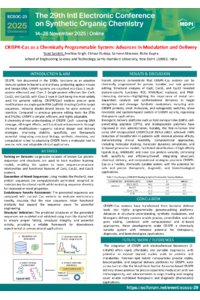
poster presentation.pdf
Structure-Based Discovery of TEAD Protein Inhibitors Targeting the Hippo Pathway in Cancer: An Integrative Computational Study
Pest Control from Sustainable Resources: A Virtual Screening for Modulators of Odour Receptors in Drosophila melanogaster