Event submissions
Published

This submission belongs to the session S4. Computational Chemistry of the event The 29th International Electronic Conference on Synthetic Organic Chemistry
Published date
13 Nov, 2025
Academic Editor
'%3e%3cpath%20d='M12.6657%2010.9104C12.4185%2010.325%2012.0599%209.79327%2011.6097%209.34482C11.1609%208.89508%2010.6293%208.5365%2010.0442%208.28888C10.0389%208.28626%2010.0337%208.28495%2010.0285%208.28233C10.8446%207.69279%2011.3752%206.73249%2011.3752%205.64904C11.3752%203.8542%209.92103%202.39999%208.1262%202.39999C6.33136%202.39999%204.87715%203.8542%204.87715%205.64904C4.87715%206.73249%205.40774%207.69279%206.22393%208.28364C6.21869%208.28626%206.21345%208.28757%206.20821%208.29019C5.62129%208.5378%205.09463%208.89284%204.64265%209.34613C4.1929%209.79493%203.83432%2010.3266%203.58671%2010.9117C3.34345%2011.4845%203.21226%2012.0987%203.20023%2012.7209C3.19988%2012.7349%203.20233%2012.7488%203.20744%2012.7619C3.21255%2012.7749%203.22022%2012.7867%203.22998%2012.7968C3.23975%2012.8068%203.25142%2012.8147%203.26431%2012.8202C3.2772%2012.8256%203.29105%2012.8284%203.30504%2012.8284H4.09109C4.14874%2012.8284%204.19459%2012.7825%204.1959%2012.7262C4.2221%2011.7148%204.62823%2010.7676%205.34617%2010.0497C6.08899%209.30683%207.0755%208.89808%208.1262%208.89808C9.17689%208.89808%2010.1634%209.30683%2010.9062%2010.0497C11.6242%2010.7676%2012.0303%2011.7148%2012.0565%2012.7262C12.0578%2012.7838%2012.1037%2012.8284%2012.1613%2012.8284H12.9474C12.9613%2012.8284%2012.9752%2012.8256%2012.9881%2012.8202C13.001%2012.8147%2013.0126%2012.8068%2013.0224%2012.7968C13.0322%2012.7867%2013.0398%2012.7749%2013.0449%2012.7619C13.0501%2012.7488%2013.0525%2012.7349%2013.0522%2012.7209C13.0391%2012.0947%2012.9094%2011.4855%2012.6657%2010.9104ZM8.1262%207.9024C7.52486%207.9024%206.9589%207.6679%206.53312%207.24211C6.10733%206.81633%205.87283%206.25037%205.87283%205.64904C5.87283%205.0477%206.10733%204.48174%206.53312%204.05596C6.9589%203.63018%207.52486%203.39567%208.1262%203.39567C8.72753%203.39567%209.29349%203.63018%209.71927%204.05596C10.1451%204.48174%2010.3796%205.0477%2010.3796%205.64904C10.3796%206.25037%2010.1451%206.81633%209.71927%207.24211C9.29349%207.6679%208.72753%207.9024%208.1262%207.9024Z'%20fill='%235D1EE1'/%3e%3c/g%3e%3c/svg%3e) Julio A. Seijas
Julio A. SeijasCitation
Enayi Onaji, Yusuf Jimoh, Asmau Nasir Hamza, Maryam Abdullahi, Novel Chalcone Derivatives as Potent Lyn Tyrosine Kinase Inhibitors: A Promising In Silico Approach for Targeted Therapy in Triple-Negative Breast Cancer, in Proceedings of The 29th International Electronic Conference on Synthetic Organic Chemistry, 14 November–28 November 2025, MDPI: Basel, Switzerland, doi: 10.3390/ecsoc-29-26887
Share
Email
Facebook
Twitter
LinkedIn
Novel Chalcone Derivatives as Potent Lyn Tyrosine Kinase Inhibitors: A Promising In Silico Approach for Targeted Therapy in Triple-Negative Breast Cancer
'%3e%3cpath%20d='M12.6647%2010.9104C12.4176%2010.325%2012.0589%209.7933%2011.6088%209.34485C11.16%208.89511%2010.6283%208.53653%2010.0432%208.28891C10.038%208.28629%2010.0327%208.28498%2010.0275%208.28236C10.8437%207.69282%2011.3743%206.73252%2011.3743%205.64907C11.3743%203.85423%209.92005%202.40002%208.12522%202.40002C6.33038%202.40002%204.87618%203.85423%204.87618%205.64907C4.87618%206.73252%205.40677%207.69282%206.22296%208.28367C6.21772%208.28629%206.21248%208.2876%206.20724%208.29022C5.62031%208.53783%205.09365%208.89287%204.64167%209.34616C4.19192%209.79496%203.83334%2010.3266%203.58573%2010.9117C3.34247%2011.4846%203.21128%2012.0987%203.19925%2012.721C3.1989%2012.735%203.20135%2012.7489%203.20646%2012.7619C3.21157%2012.7749%203.21924%2012.7868%203.22901%2012.7968C3.23877%2012.8068%203.25045%2012.8148%203.26334%2012.8202C3.27623%2012.8256%203.29007%2012.8284%203.30406%2012.8284H4.09012C4.14776%2012.8284%204.19362%2012.7825%204.19493%2012.7262C4.22113%2011.7148%204.62726%2010.7676%205.34519%2010.0497C6.08802%209.30686%207.07452%208.89811%208.12522%208.89811C9.17592%208.89811%2010.1624%209.30686%2010.9052%2010.0497C11.6232%2010.7676%2012.0293%2011.7148%2012.0555%2012.7262C12.0568%2012.7839%2012.1027%2012.8284%2012.1603%2012.8284H12.9464C12.9604%2012.8284%2012.9742%2012.8256%2012.9871%2012.8202C13%2012.8148%2013.0117%2012.8068%2013.0214%2012.7968C13.0312%2012.7868%2013.0389%2012.7749%2013.044%2012.7619C13.0491%2012.7489%2013.0515%2012.735%2013.0512%2012.721C13.0381%2012.0947%2012.9084%2011.4856%2012.6647%2010.9104ZM8.12522%207.90243C7.52388%207.90243%206.95792%207.66793%206.53214%207.24215C6.10636%206.81636%205.87185%206.2504%205.87185%205.64907C5.87185%205.04773%206.10636%204.48177%206.53214%204.05599C6.95792%203.63021%207.52388%203.3957%208.12522%203.3957C8.72655%203.3957%209.29252%203.63021%209.7183%204.05599C10.1441%204.48177%2010.3786%205.04773%2010.3786%205.64907C10.3786%206.2504%2010.1441%206.81636%209.7183%207.24215C9.29252%207.66793%208.72655%207.90243%208.12522%207.90243Z'%20fill='%235D1EE1'/%3e%3c/g%3e%3c/svg%3e)
Enayi Onaji 1
Yusuf Jimoh 1
Asmau Nasir Hamza 1
Maryam Abdullahi 1
1. Department of Pharmaceutical and Medicinal Chemistry, Ahmadu Bello University, Zaria 810107, Nigeria
Abstract
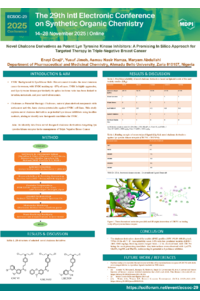
Triple-negative breast cancer (TNBC) accounts for approximately 10–15% of breast cancer cases and poses a significant clinical challenge due to its aggressive nature and poorer survival outcomes compared to other subtypes. This is primarily attributed to the lack of estrogen, progesterone, and HER2 receptors, which renders conventional hormone-based therapies ineffective. In this study, we employed in silico approaches to design and evaluate novel chalcone derivatives as potential inhibitors of Lyn tyrosine kinase, a critical enzyme implicated in TNBC progression. The designed compounds were screened for drug-likeness and toxicity, all meeting Lipinski’s rule of five and demonstrating favorable toxicity profiles. Molecular docking studies and post dock analysis identified five promising ligands; CHCN1, CHCN19, CHCN48, CHCN333, and CHCN94 that exhibited strong binding affinities to key active site residues of Lyn kinase, including Asp385, Phe386, Gly387, Lys275, and Glu290. Among these, CHCN1 showed the highest binding affinity at –8.4 kcal/mol, likely due to interactions with Asp385 and Lys275. These results suggest that the chalcone derivatives may effectively disrupt Lyn-mediated signaling pathways essential for cancer cell survival, potentially inhibiting proliferation, metastasis, and invasion. Overall, this study provides valuable insights into the therapeutic potential of chalcone derivatives for Triple Negative Breast Cancer, offering promising avenues for targeted intervention.
Keywords
Keywords: Triple-negative breast cancer (TNBC)
Chalcone derivatives
Lyn tyrosine kinase inhibition
Molecular docking
Drug-likeness
Targeted cancer therapy
Manuscript
chemproc-sciforum_137994_S4_original_24thOct-done.pdf
Poster
my poster29th sept..pdf
Advanced computational frameworks for characterizing abnormal DNA architectures and their implications in genome dynamics
Explainability of Diabetic Retinopathy Detection & classification with Deep Learning Hybrid Architecture: AlterNet-k & ResNet-101