Event submissions
Published

This submission belongs to the session S1. General Organic Synthesis of the event The 29th International Electronic Conference on Synthetic Organic Chemistry
Published date
13 Nov, 2025
Academic Editor
'%3e%3cpath%20d='M12.6657%2010.9104C12.4185%2010.325%2012.0599%209.79327%2011.6097%209.34482C11.1609%208.89508%2010.6293%208.5365%2010.0442%208.28888C10.0389%208.28626%2010.0337%208.28495%2010.0285%208.28233C10.8446%207.69279%2011.3752%206.73249%2011.3752%205.64904C11.3752%203.8542%209.92103%202.39999%208.1262%202.39999C6.33136%202.39999%204.87715%203.8542%204.87715%205.64904C4.87715%206.73249%205.40774%207.69279%206.22393%208.28364C6.21869%208.28626%206.21345%208.28757%206.20821%208.29019C5.62129%208.5378%205.09463%208.89284%204.64265%209.34613C4.1929%209.79493%203.83432%2010.3266%203.58671%2010.9117C3.34345%2011.4845%203.21226%2012.0987%203.20023%2012.7209C3.19988%2012.7349%203.20233%2012.7488%203.20744%2012.7619C3.21255%2012.7749%203.22022%2012.7867%203.22998%2012.7968C3.23975%2012.8068%203.25142%2012.8147%203.26431%2012.8202C3.2772%2012.8256%203.29105%2012.8284%203.30504%2012.8284H4.09109C4.14874%2012.8284%204.19459%2012.7825%204.1959%2012.7262C4.2221%2011.7148%204.62823%2010.7676%205.34617%2010.0497C6.08899%209.30683%207.0755%208.89808%208.1262%208.89808C9.17689%208.89808%2010.1634%209.30683%2010.9062%2010.0497C11.6242%2010.7676%2012.0303%2011.7148%2012.0565%2012.7262C12.0578%2012.7838%2012.1037%2012.8284%2012.1613%2012.8284H12.9474C12.9613%2012.8284%2012.9752%2012.8256%2012.9881%2012.8202C13.001%2012.8147%2013.0126%2012.8068%2013.0224%2012.7968C13.0322%2012.7867%2013.0398%2012.7749%2013.0449%2012.7619C13.0501%2012.7488%2013.0525%2012.7349%2013.0522%2012.7209C13.0391%2012.0947%2012.9094%2011.4855%2012.6657%2010.9104ZM8.1262%207.9024C7.52486%207.9024%206.9589%207.6679%206.53312%207.24211C6.10733%206.81633%205.87283%206.25037%205.87283%205.64904C5.87283%205.0477%206.10733%204.48174%206.53312%204.05596C6.9589%203.63018%207.52486%203.39567%208.1262%203.39567C8.72753%203.39567%209.29349%203.63018%209.71927%204.05596C10.1451%204.48174%2010.3796%205.0477%2010.3796%205.64904C10.3796%206.25037%2010.1451%206.81633%209.71927%207.24211C9.29349%207.6679%208.72753%207.9024%208.1262%207.9024Z'%20fill='%235D1EE1'/%3e%3c/g%3e%3c/svg%3e) Julio A. Seijas
Julio A. SeijasCitation
Daniela Soledad Mansilla, Silvia Elizabeth Asís, Gisela Celeste Muscia, Convenient Gould-Jacobs synthesis of 4-quinolone core using Eaton's reagent, in Proceedings of The 29th International Electronic Conference on Synthetic Organic Chemistry, 14 November–28 November 2025, MDPI: Basel, Switzerland, doi: 10.3390/ecsoc-29-26900
Share
Email
Facebook
Twitter
LinkedIn
Convenient Gould-Jacobs synthesis of 4-quinolone core using Eaton's reagent
'%3e%3cpath%20d='M12.6647%2010.9104C12.4176%2010.325%2012.0589%209.7933%2011.6088%209.34485C11.16%208.89511%2010.6283%208.53653%2010.0432%208.28891C10.038%208.28629%2010.0327%208.28498%2010.0275%208.28236C10.8437%207.69282%2011.3743%206.73252%2011.3743%205.64907C11.3743%203.85423%209.92005%202.40002%208.12522%202.40002C6.33038%202.40002%204.87618%203.85423%204.87618%205.64907C4.87618%206.73252%205.40677%207.69282%206.22296%208.28367C6.21772%208.28629%206.21248%208.2876%206.20724%208.29022C5.62031%208.53783%205.09365%208.89287%204.64167%209.34616C4.19192%209.79496%203.83334%2010.3266%203.58573%2010.9117C3.34247%2011.4846%203.21128%2012.0987%203.19925%2012.721C3.1989%2012.735%203.20135%2012.7489%203.20646%2012.7619C3.21157%2012.7749%203.21924%2012.7868%203.22901%2012.7968C3.23877%2012.8068%203.25045%2012.8148%203.26334%2012.8202C3.27623%2012.8256%203.29007%2012.8284%203.30406%2012.8284H4.09012C4.14776%2012.8284%204.19362%2012.7825%204.19493%2012.7262C4.22113%2011.7148%204.62726%2010.7676%205.34519%2010.0497C6.08802%209.30686%207.07452%208.89811%208.12522%208.89811C9.17592%208.89811%2010.1624%209.30686%2010.9052%2010.0497C11.6232%2010.7676%2012.0293%2011.7148%2012.0555%2012.7262C12.0568%2012.7839%2012.1027%2012.8284%2012.1603%2012.8284H12.9464C12.9604%2012.8284%2012.9742%2012.8256%2012.9871%2012.8202C13%2012.8148%2013.0117%2012.8068%2013.0214%2012.7968C13.0312%2012.7868%2013.0389%2012.7749%2013.044%2012.7619C13.0491%2012.7489%2013.0515%2012.735%2013.0512%2012.721C13.0381%2012.0947%2012.9084%2011.4856%2012.6647%2010.9104ZM8.12522%207.90243C7.52388%207.90243%206.95792%207.66793%206.53214%207.24215C6.10636%206.81636%205.87185%206.2504%205.87185%205.64907C5.87185%205.04773%206.10636%204.48177%206.53214%204.05599C6.95792%203.63021%207.52388%203.3957%208.12522%203.3957C8.72655%203.3957%209.29252%203.63021%209.7183%204.05599C10.1441%204.48177%2010.3786%205.04773%2010.3786%205.64907C10.3786%206.2504%2010.1441%206.81636%209.7183%207.24215C9.29252%207.66793%208.72655%207.90243%208.12522%207.90243Z'%20fill='%235D1EE1'/%3e%3c/g%3e%3c/svg%3e)
Daniela Soledad Mansilla 1
Silvia Elizabeth Asís 1
Gisela Celeste Muscia 1
1. Facultad de Farmacia & Bioquímica, Universidad de Buenos Aires, Junín 956,
Ciudad Autónoma de Buenos Aires C1113AAB, Argentina
Abstract
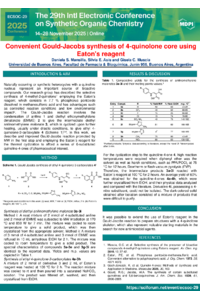
The use of Eaton´s reagent for the selective synthesis of 4-methyl-2-quinolone, avoiding the use of mineral acids or expensive metal catalysts as shown in the literature, was previously reported by our research group [1]. This reagent, which consists in 7.7 % phosphorus pentoxide dissolved in methanesulfonic acid, is easily available and has advantages such as controlled reaction conditions and low environmental impact [2]. In this work, we describe the Gould-Jacobs reaction [3] for the synthesis of 6-substituted ethyl 4-oxo-1,4-dihydroquinoline-3-carboxylate. Thus, the condensation of 4-subtituted anilines and diethyl ethoxymethylenemalonate (EMME) to give the corresponding diethyl anilinomethylene malonate was carried out via neat microwave irradiation (MW) and also under refluxing ethanol, in order to compare the performance of both methods. These intermediates underwent the Eaton's reagent catalyzed cyclisation in good to excellent yields, after 2 hours reaction at 100 °C. For the first step, the MW reaction took only 7 minutes compared to the two hours required for the conventional heating, yet the yields were comparable in almost all cases. The subsequent cyclization reaction using Eaton's reagent has only been reported once to prepare the diethyl 2-((phenylamino)methylene)malonate [4]. Meanwhile, the cyclization of 4-substituted anilinomethylene malonates requires high-boiling solvents such as diphenyl ether or Dowtherm, polyphosphoric acid (PPA) catalysis or even flash vacuum pyrolysis (FVP) [5]. In conclusion, a series of ten 4-quinolone derivatives was obtained in good yields under mild conditions and short reaction times. Many of them possess a pharmacophoric 6-substituent group such as sulfonamide, thiazole and sulfamethoxazole derivatives.
Keywords
synthesis
4-quinolones
Eaton´s reagent
Manuscript
chemproc-sciforum_143761_S1_original_ChemProceedings_template_Asis-done.pdf
Poster
ecsoc Asis.pdf
DFT simulation for properties determination of chelating spironaphthoxazine derivatives
Synthesis, Characterization, DFT Study, and In Silico Evaluation of a Thiophene-Thiazole Scaffolds as a Potential Mycobacterium tuberculosis CYP51 Inhibitor