Event submissions
Published

This submission belongs to the session S3. Polymers and Supramolecular Chemistry of the event The 29th International Electronic Conference on Synthetic Organic Chemistry
Published date
13 Nov, 2025
Academic Editor
'%3e%3cpath%20d='M12.6657%2010.9104C12.4185%2010.325%2012.0599%209.79327%2011.6097%209.34482C11.1609%208.89508%2010.6293%208.5365%2010.0442%208.28888C10.0389%208.28626%2010.0337%208.28495%2010.0285%208.28233C10.8446%207.69279%2011.3752%206.73249%2011.3752%205.64904C11.3752%203.8542%209.92103%202.39999%208.1262%202.39999C6.33136%202.39999%204.87715%203.8542%204.87715%205.64904C4.87715%206.73249%205.40774%207.69279%206.22393%208.28364C6.21869%208.28626%206.21345%208.28757%206.20821%208.29019C5.62129%208.5378%205.09463%208.89284%204.64265%209.34613C4.1929%209.79493%203.83432%2010.3266%203.58671%2010.9117C3.34345%2011.4845%203.21226%2012.0987%203.20023%2012.7209C3.19988%2012.7349%203.20233%2012.7488%203.20744%2012.7619C3.21255%2012.7749%203.22022%2012.7867%203.22998%2012.7968C3.23975%2012.8068%203.25142%2012.8147%203.26431%2012.8202C3.2772%2012.8256%203.29105%2012.8284%203.30504%2012.8284H4.09109C4.14874%2012.8284%204.19459%2012.7825%204.1959%2012.7262C4.2221%2011.7148%204.62823%2010.7676%205.34617%2010.0497C6.08899%209.30683%207.0755%208.89808%208.1262%208.89808C9.17689%208.89808%2010.1634%209.30683%2010.9062%2010.0497C11.6242%2010.7676%2012.0303%2011.7148%2012.0565%2012.7262C12.0578%2012.7838%2012.1037%2012.8284%2012.1613%2012.8284H12.9474C12.9613%2012.8284%2012.9752%2012.8256%2012.9881%2012.8202C13.001%2012.8147%2013.0126%2012.8068%2013.0224%2012.7968C13.0322%2012.7867%2013.0398%2012.7749%2013.0449%2012.7619C13.0501%2012.7488%2013.0525%2012.7349%2013.0522%2012.7209C13.0391%2012.0947%2012.9094%2011.4855%2012.6657%2010.9104ZM8.1262%207.9024C7.52486%207.9024%206.9589%207.6679%206.53312%207.24211C6.10733%206.81633%205.87283%206.25037%205.87283%205.64904C5.87283%205.0477%206.10733%204.48174%206.53312%204.05596C6.9589%203.63018%207.52486%203.39567%208.1262%203.39567C8.72753%203.39567%209.29349%203.63018%209.71927%204.05596C10.1451%204.48174%2010.3796%205.0477%2010.3796%205.64904C10.3796%206.25037%2010.1451%206.81633%209.71927%207.24211C9.29349%207.6679%208.72753%207.9024%208.1262%207.9024Z'%20fill='%235D1EE1'/%3e%3c/g%3e%3c/svg%3e) Julio A. Seijas
Julio A. SeijasCitation
Alejandra González, Nestor Mariano Correa, Fernando Moyano, Ruben Dario Falcone, Transforming Anionic Reverse Micelles: The Potential of Hydrophobic Natural Deep Eutectic Solvents. How the mixture between camphor and menthol can be an excellent choice for reverse micelle preparation., in Proceedings of The 29th International Electronic Conference on Synthetic Organic Chemistry, 14 November–28 November 2025, MDPI: Basel, Switzerland, doi: 10.3390/ecsoc-29-26920
Share
Email
Facebook
Twitter
LinkedIn
Transforming Anionic Reverse Micelles: The Potential of Hydrophobic Natural Deep Eutectic Solvents. How the mixture between camphor and menthol can be an excellent choice for reverse micelle preparation.
'%3e%3cpath%20d='M12.6647%2010.9104C12.4176%2010.325%2012.0589%209.7933%2011.6088%209.34485C11.16%208.89511%2010.6283%208.53653%2010.0432%208.28891C10.038%208.28629%2010.0327%208.28498%2010.0275%208.28236C10.8437%207.69282%2011.3743%206.73252%2011.3743%205.64907C11.3743%203.85423%209.92005%202.40002%208.12522%202.40002C6.33038%202.40002%204.87618%203.85423%204.87618%205.64907C4.87618%206.73252%205.40677%207.69282%206.22296%208.28367C6.21772%208.28629%206.21248%208.2876%206.20724%208.29022C5.62031%208.53783%205.09365%208.89287%204.64167%209.34616C4.19192%209.79496%203.83334%2010.3266%203.58573%2010.9117C3.34247%2011.4846%203.21128%2012.0987%203.19925%2012.721C3.1989%2012.735%203.20135%2012.7489%203.20646%2012.7619C3.21157%2012.7749%203.21924%2012.7868%203.22901%2012.7968C3.23877%2012.8068%203.25045%2012.8148%203.26334%2012.8202C3.27623%2012.8256%203.29007%2012.8284%203.30406%2012.8284H4.09012C4.14776%2012.8284%204.19362%2012.7825%204.19493%2012.7262C4.22113%2011.7148%204.62726%2010.7676%205.34519%2010.0497C6.08802%209.30686%207.07452%208.89811%208.12522%208.89811C9.17592%208.89811%2010.1624%209.30686%2010.9052%2010.0497C11.6232%2010.7676%2012.0293%2011.7148%2012.0555%2012.7262C12.0568%2012.7839%2012.1027%2012.8284%2012.1603%2012.8284H12.9464C12.9604%2012.8284%2012.9742%2012.8256%2012.9871%2012.8202C13%2012.8148%2013.0117%2012.8068%2013.0214%2012.7968C13.0312%2012.7868%2013.0389%2012.7749%2013.044%2012.7619C13.0491%2012.7489%2013.0515%2012.735%2013.0512%2012.721C13.0381%2012.0947%2012.9084%2011.4856%2012.6647%2010.9104ZM8.12522%207.90243C7.52388%207.90243%206.95792%207.66793%206.53214%207.24215C6.10636%206.81636%205.87185%206.2504%205.87185%205.64907C5.87185%205.04773%206.10636%204.48177%206.53214%204.05599C6.95792%203.63021%207.52388%203.3957%208.12522%203.3957C8.72655%203.3957%209.29252%203.63021%209.7183%204.05599C10.1441%204.48177%2010.3786%205.04773%2010.3786%205.64907C10.3786%206.2504%2010.1441%206.81636%209.7183%207.24215C9.29252%207.66793%208.72655%207.90243%208.12522%207.90243Z'%20fill='%235D1EE1'/%3e%3c/g%3e%3c/svg%3e)
Alejandra González 1
Nestor Mariano Correa 1

Fernando Moyano 1

Ruben Dario Falcone 1
1. Departamento de Química, Instituto para el Desarrollo Agroindustrial y de la Salud (IDAS). CONICET – UNRC, Río Cuarto, Argentina.
Abstract
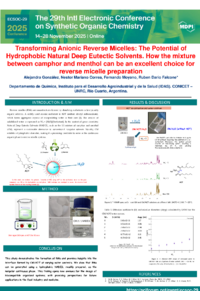
Introduction: Reverse micelles are nanostructures formed by dissolving surfactants in low-polarity organic solvents. A commonly used anionic surfactant is AOT (sodium dioctyl sulfosuccinate), which forms aggregates capable of encapsulating water in their core. The amount of water solubilized is expressed as W₀ = [H₂O]/[Surfactant]. In green chemistry, Natural Deep Eutectic Solvents (NADES), such as the 1:1 mixture of camphor and menthol (CM), offer a sustainable alternative as non-polar external phases. This study evaluated the formation of reverse micelles with AOT, water, and CM, using NMR techniques.
Results: The CM NADES dissolved AOT up to 0.5 M and allowed the incorporation of water, achieving a maximum W₀ of 5. DOSY NMR studies confirmed the presence of reverse micelles and the encapsulation of water. Micellar diameters ranged from 1.5 to 3.5 nm, increasing with water content. ¹H NMR chemical shift changes revealed hydrogen bonding interactions between water and the polar region of AOT, affecting the interfacial conformation and reducing NADES penetration into the polar core.
Conclusion: The study demonstrated the formation of reverse micelles and allowed for the evaluation of the interface formed by CM/AOT at different water contents. Thus, it is possible to generate reverse micelles using a hydrophobic NADES, easily prepared, as the non-polar external solvent, paving the way for a new era in biocompatible organized systems. This is particularly interesting for future applications in the food industry or medicine.
Keywords
NADES
AOT
Reverse micelles
NMR
DOSY
Camphor
Menthol.
Manuscript
chemproc-sciforum_141608_S3_original_Gonzalez_et_al-done.pdf
Poster
poster.pdf
Chitosan-Based Biosorption: A Sustainable Approach for Heavy Metal Removal from Wastewater
Supramolecular assemblies driven by N-H…O and O-H…O hydrogen bonding interactions: Experimental and theoretical investigation into the supramolecular architectures of dihydropyrimidin-2(1H)-ones