Event submissions
Published
 10.3390/ecsoc-29-26924 (registering DOI)
 This submission belongs to the session S3. Polymers and Supramolecular Chemistry of the event The 29th International Electronic Conference on Synthetic Organic Chemistry
Published date
13 Nov, 2025
Academic Editor
'%3e%3cpath%20d='M12.6657%2010.9104C12.4185%2010.325%2012.0599%209.79327%2011.6097%209.34482C11.1609%208.89508%2010.6293%208.5365%2010.0442%208.28888C10.0389%208.28626%2010.0337%208.28495%2010.0285%208.28233C10.8446%207.69279%2011.3752%206.73249%2011.3752%205.64904C11.3752%203.8542%209.92103%202.39999%208.1262%202.39999C6.33136%202.39999%204.87715%203.8542%204.87715%205.64904C4.87715%206.73249%205.40774%207.69279%206.22393%208.28364C6.21869%208.28626%206.21345%208.28757%206.20821%208.29019C5.62129%208.5378%205.09463%208.89284%204.64265%209.34613C4.1929%209.79493%203.83432%2010.3266%203.58671%2010.9117C3.34345%2011.4845%203.21226%2012.0987%203.20023%2012.7209C3.19988%2012.7349%203.20233%2012.7488%203.20744%2012.7619C3.21255%2012.7749%203.22022%2012.7867%203.22998%2012.7968C3.23975%2012.8068%203.25142%2012.8147%203.26431%2012.8202C3.2772%2012.8256%203.29105%2012.8284%203.30504%2012.8284H4.09109C4.14874%2012.8284%204.19459%2012.7825%204.1959%2012.7262C4.2221%2011.7148%204.62823%2010.7676%205.34617%2010.0497C6.08899%209.30683%207.0755%208.89808%208.1262%208.89808C9.17689%208.89808%2010.1634%209.30683%2010.9062%2010.0497C11.6242%2010.7676%2012.0303%2011.7148%2012.0565%2012.7262C12.0578%2012.7838%2012.1037%2012.8284%2012.1613%2012.8284H12.9474C12.9613%2012.8284%2012.9752%2012.8256%2012.9881%2012.8202C13.001%2012.8147%2013.0126%2012.8068%2013.0224%2012.7968C13.0322%2012.7867%2013.0398%2012.7749%2013.0449%2012.7619C13.0501%2012.7488%2013.0525%2012.7349%2013.0522%2012.7209C13.0391%2012.0947%2012.9094%2011.4855%2012.6657%2010.9104ZM8.1262%207.9024C7.52486%207.9024%206.9589%207.6679%206.53312%207.24211C6.10733%206.81633%205.87283%206.25037%205.87283%205.64904C5.87283%205.0477%206.10733%204.48174%206.53312%204.05596C6.9589%203.63018%207.52486%203.39567%208.1262%203.39567C8.72753%203.39567%209.29349%203.63018%209.71927%204.05596C10.1451%204.48174%2010.3796%205.0477%2010.3796%205.64904C10.3796%206.25037%2010.1451%206.81633%209.71927%207.24211C9.29349%207.6679%208.72753%207.9024%208.1262%207.9024Z'%20fill='%235D1EE1'/%3e%3c/g%3e%3c/svg%3e) Julio A. Seijas
Julio A. SeijasCitation
Carolina del Pilar Urquiza, María Eugenia Pérez, Sofía Carla Santamarina, María Elisa Milanesio, Edgardo Néstor Durantini, Synthesis and Characterization of a Cationic BODIPY-Conjugated Polymer as a Fluorescent Probe for Bacterial Sensing, in Proceedings of The 29th International Electronic Conference on Synthetic Organic Chemistry, 14 November–28 November 2025, MDPI: Basel, Switzerland, doi: 10.3390/ecsoc-29-26924
Share
Email
Facebook
Twitter
LinkedIn
Synthesis and Characterization of a Cationic BODIPY-Conjugated Polymer as a Fluorescent Probe for Bacterial Sensing
'%3e%3cpath%20d='M12.6647%2010.9104C12.4176%2010.325%2012.0589%209.7933%2011.6088%209.34485C11.16%208.89511%2010.6283%208.53653%2010.0432%208.28891C10.038%208.28629%2010.0327%208.28498%2010.0275%208.28236C10.8437%207.69282%2011.3743%206.73252%2011.3743%205.64907C11.3743%203.85423%209.92005%202.40002%208.12522%202.40002C6.33038%202.40002%204.87618%203.85423%204.87618%205.64907C4.87618%206.73252%205.40677%207.69282%206.22296%208.28367C6.21772%208.28629%206.21248%208.2876%206.20724%208.29022C5.62031%208.53783%205.09365%208.89287%204.64167%209.34616C4.19192%209.79496%203.83334%2010.3266%203.58573%2010.9117C3.34247%2011.4846%203.21128%2012.0987%203.19925%2012.721C3.1989%2012.735%203.20135%2012.7489%203.20646%2012.7619C3.21157%2012.7749%203.21924%2012.7868%203.22901%2012.7968C3.23877%2012.8068%203.25045%2012.8148%203.26334%2012.8202C3.27623%2012.8256%203.29007%2012.8284%203.30406%2012.8284H4.09012C4.14776%2012.8284%204.19362%2012.7825%204.19493%2012.7262C4.22113%2011.7148%204.62726%2010.7676%205.34519%2010.0497C6.08802%209.30686%207.07452%208.89811%208.12522%208.89811C9.17592%208.89811%2010.1624%209.30686%2010.9052%2010.0497C11.6232%2010.7676%2012.0293%2011.7148%2012.0555%2012.7262C12.0568%2012.7839%2012.1027%2012.8284%2012.1603%2012.8284H12.9464C12.9604%2012.8284%2012.9742%2012.8256%2012.9871%2012.8202C13%2012.8148%2013.0117%2012.8068%2013.0214%2012.7968C13.0312%2012.7868%2013.0389%2012.7749%2013.044%2012.7619C13.0491%2012.7489%2013.0515%2012.735%2013.0512%2012.721C13.0381%2012.0947%2012.9084%2011.4856%2012.6647%2010.9104ZM8.12522%207.90243C7.52388%207.90243%206.95792%207.66793%206.53214%207.24215C6.10636%206.81636%205.87185%206.2504%205.87185%205.64907C5.87185%205.04773%206.10636%204.48177%206.53214%204.05599C6.95792%203.63021%207.52388%203.3957%208.12522%203.3957C8.72655%203.3957%209.29252%203.63021%209.7183%204.05599C10.1441%204.48177%2010.3786%205.04773%2010.3786%205.64907C10.3786%206.2504%2010.1441%206.81636%209.7183%207.24215C9.29252%207.66793%208.72655%207.90243%208.12522%207.90243Z'%20fill='%235D1EE1'/%3e%3c/g%3e%3c/svg%3e)
Carolina del Pilar Urquiza 1
María Eugenia Pérez 1,2
Sofía Carla Santamarina 1,2
María Elisa Milanesio 1,2
Edgardo Néstor Durantini 1,2
1. Instituto para el Desarrollo Agroindustrial y de la Salud (IDAS), Consejo Nacional de Investigaciones Cien-tíficas y Técnicas (CONICET), Ruta Nacional 36 Km 601, X5804BYA Río Cuarto, Córdoba, Argentina.
2. Departamento de Química, Facultad de Ciencias Exactas, Físico-Químicas y Naturales, Universidad Na-cional de Río Cuarto, Ruta Nacional 36 Km 601, X5804BYA Río Cuarto, Córdoba, Argentina.
Abstract
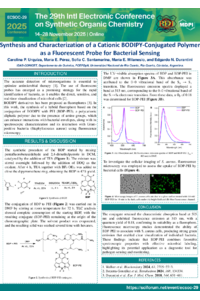
The incidence of infections caused by resistant pathogens has been steadily increasing. In this context, the accurate detection of microorganisms is essential to optimize antimicrobial therapy. This approach enables a rapid response to infections, reduces the indiscriminate use of antimicrobials, and allows for efficient treatment monitoring. Therefore, the development of fluorophores capable of detecting pathogens represents a promising strategy for the diagnosis and control of resistant infections. In this work, 8-pentafluorophenyl-1,3,5,7-tetramethyl pyrromethene fluoroborate (BDP) was synthesized from pentafluorobenzaldehyde and 2,4-dimethylpyrrole in dichloromethane, catalyzed by trifluoroacetic acid. The mixture was then treated with 2,3-dichloro-5,6-dicyano-1,4-benzoquinone as an oxidizing agent. After 6 h, triethylamine and boron trifluoride diethyl etherate were added to close the dipyrromethene ring, yielding BDP (14%). The conjugation of BDP to polyethylenimine (PEI) was carried out by stirring at room temperature for 72 h. At the end of the reaction, TLC analysis showed complete consumption of the starting BDP, with the resulting conjugate (BDP-PEI) remaining at the origin of the chromatographic plate. The UV-visible absorption spectra of these compounds in N,N-dimethylformamide showed a main absorption band around 505 nm. The fluorescence emission band at 515 nm was assigned to the 0-0 vibrational band of the S₁→S₀ electronic transition. Fluorescence quantum yields of 0.98 and 0.18 were obtained for BDP and BDP-PEI, respectively. Furthermore, BDP-PEI exhibited strong green fluorescence emission in Staphylococcus aureus cells, indicating its potential application as a fluorophore for pathogen sensing.
Keywords
polyethyleneimine
BODIPY
fluorophore
microorganism
Manuscript
chemproc-sciforum_138040_S3_original_Proceeding_paper_Urquiza-done.pdf
Poster
Poster Urquiza.pdf
Electrochemical Generation of Aza-BODIPY Polymers as NIR-Absorbing Electrochromic Materials
Synthesis and Characterization of a Functionalized Graphene Oxide Hydrogel Nanocomposite for Efficient Lithium Ion Adsorption from Aqueous Solutions