Event submissions
Published
This submission belongs to the session S4. Polymer Composites and Nanocomposites of the event The 3rd International Online Conference on Polymer Science
Published date
14 Nov, 2025
Academic Editor
'%3e%3cpath%20d='M12.6657%2010.9104C12.4185%2010.325%2012.0599%209.79327%2011.6097%209.34482C11.1609%208.89508%2010.6293%208.5365%2010.0442%208.28888C10.0389%208.28626%2010.0337%208.28495%2010.0285%208.28233C10.8446%207.69279%2011.3752%206.73249%2011.3752%205.64904C11.3752%203.8542%209.92103%202.39999%208.1262%202.39999C6.33136%202.39999%204.87715%203.8542%204.87715%205.64904C4.87715%206.73249%205.40774%207.69279%206.22393%208.28364C6.21869%208.28626%206.21345%208.28757%206.20821%208.29019C5.62129%208.5378%205.09463%208.89284%204.64265%209.34613C4.1929%209.79493%203.83432%2010.3266%203.58671%2010.9117C3.34345%2011.4845%203.21226%2012.0987%203.20023%2012.7209C3.19988%2012.7349%203.20233%2012.7488%203.20744%2012.7619C3.21255%2012.7749%203.22022%2012.7867%203.22998%2012.7968C3.23975%2012.8068%203.25142%2012.8147%203.26431%2012.8202C3.2772%2012.8256%203.29105%2012.8284%203.30504%2012.8284H4.09109C4.14874%2012.8284%204.19459%2012.7825%204.1959%2012.7262C4.2221%2011.7148%204.62823%2010.7676%205.34617%2010.0497C6.08899%209.30683%207.0755%208.89808%208.1262%208.89808C9.17689%208.89808%2010.1634%209.30683%2010.9062%2010.0497C11.6242%2010.7676%2012.0303%2011.7148%2012.0565%2012.7262C12.0578%2012.7838%2012.1037%2012.8284%2012.1613%2012.8284H12.9474C12.9613%2012.8284%2012.9752%2012.8256%2012.9881%2012.8202C13.001%2012.8147%2013.0126%2012.8068%2013.0224%2012.7968C13.0322%2012.7867%2013.0398%2012.7749%2013.0449%2012.7619C13.0501%2012.7488%2013.0525%2012.7349%2013.0522%2012.7209C13.0391%2012.0947%2012.9094%2011.4855%2012.6657%2010.9104ZM8.1262%207.9024C7.52486%207.9024%206.9589%207.6679%206.53312%207.24211C6.10733%206.81633%205.87283%206.25037%205.87283%205.64904C5.87283%205.0477%206.10733%204.48174%206.53312%204.05596C6.9589%203.63018%207.52486%203.39567%208.1262%203.39567C8.72753%203.39567%209.29349%203.63018%209.71927%204.05596C10.1451%204.48174%2010.3796%205.0477%2010.3796%205.64904C10.3796%206.25037%2010.1451%206.81633%209.71927%207.24211C9.29349%207.6679%208.72753%207.9024%208.1262%207.9024Z'%20fill='%235D1EE1'/%3e%3c/g%3e%3c/svg%3e) Alessandro Pegoretti
Alessandro PegorettiCitation
Fabio Jr de la Victoria Guno, Lotis E. Mopera, Dennis Marvin O. Santiago, Francisco B. Elegado, Phoebe L. Galeon, Characterization of copper oxide (CuO) nanoparticle-reinforced Bionanocomposite films from taro (Colocasia esculenta (L.) Schott) starch and Aloe Vera (Aloe barbadensis (L.) Burm.f.) gel blend, in Proceedings of The 3rd International Online Conference on Polymer Science, 19 November–21 November 2025, MDPI: Basel, Switzerland
Share
Email
Facebook
Twitter
LinkedIn
Characterization of copper oxide (CuO) nanoparticle-reinforced Bionanocomposite films from taro (Colocasia esculenta (L.) Schott) starch and Aloe Vera (Aloe barbadensis (L.) Burm.f.) gel blend

Fabio Jr de la Victoria Guno 1,2
'%3e%3cpath%20d='M12.6647%2010.9104C12.4176%2010.325%2012.0589%209.7933%2011.6088%209.34485C11.16%208.89511%2010.6283%208.53653%2010.0432%208.28891C10.038%208.28629%2010.0327%208.28498%2010.0275%208.28236C10.8437%207.69282%2011.3743%206.73252%2011.3743%205.64907C11.3743%203.85423%209.92005%202.40002%208.12522%202.40002C6.33038%202.40002%204.87618%203.85423%204.87618%205.64907C4.87618%206.73252%205.40677%207.69282%206.22296%208.28367C6.21772%208.28629%206.21248%208.2876%206.20724%208.29022C5.62031%208.53783%205.09365%208.89287%204.64167%209.34616C4.19192%209.79496%203.83334%2010.3266%203.58573%2010.9117C3.34247%2011.4846%203.21128%2012.0987%203.19925%2012.721C3.1989%2012.735%203.20135%2012.7489%203.20646%2012.7619C3.21157%2012.7749%203.21924%2012.7868%203.22901%2012.7968C3.23877%2012.8068%203.25045%2012.8148%203.26334%2012.8202C3.27623%2012.8256%203.29007%2012.8284%203.30406%2012.8284H4.09012C4.14776%2012.8284%204.19362%2012.7825%204.19493%2012.7262C4.22113%2011.7148%204.62726%2010.7676%205.34519%2010.0497C6.08802%209.30686%207.07452%208.89811%208.12522%208.89811C9.17592%208.89811%2010.1624%209.30686%2010.9052%2010.0497C11.6232%2010.7676%2012.0293%2011.7148%2012.0555%2012.7262C12.0568%2012.7839%2012.1027%2012.8284%2012.1603%2012.8284H12.9464C12.9604%2012.8284%2012.9742%2012.8256%2012.9871%2012.8202C13%2012.8148%2013.0117%2012.8068%2013.0214%2012.7968C13.0312%2012.7868%2013.0389%2012.7749%2013.044%2012.7619C13.0491%2012.7489%2013.0515%2012.735%2013.0512%2012.721C13.0381%2012.0947%2012.9084%2011.4856%2012.6647%2010.9104ZM8.12522%207.90243C7.52388%207.90243%206.95792%207.66793%206.53214%207.24215C6.10636%206.81636%205.87185%206.2504%205.87185%205.64907C5.87185%205.04773%206.10636%204.48177%206.53214%204.05599C6.95792%203.63021%207.52388%203.3957%208.12522%203.3957C8.72655%203.3957%209.29252%203.63021%209.7183%204.05599C10.1441%204.48177%2010.3786%205.04773%2010.3786%205.64907C10.3786%206.2504%2010.1441%206.81636%209.7183%207.24215C9.29252%207.66793%208.72655%207.90243%208.12522%207.90243Z'%20fill='%235D1EE1'/%3e%3c/g%3e%3c/svg%3e)
Lotis E. Mopera 3
Dennis Marvin O. Santiago 3
Francisco B. Elegado 4
Phoebe L. Galeon 1,2
1. Department of Food Science and Technology, College of Science and Mathematics, University of Science and Technology of Southern Philippines, Cagayan de Oro City 9000, Philippines
2. Northern Mindanao Food Innovation Center, University of Science and Technology of Southern Philippines, Cagayan de Oro City 9000, Philippines
3. Institute of Food Science and Technology, College of Agriculture and Food Science, University of the Philippines Los Baños, Los Baños, Laguna 4031, Philippines
4. National Institute of Molecular Biology and Biotechnology (BIOTECH), University of the Philippines Los Baños, Los Baños, Laguna 4031, Philippines
Abstract
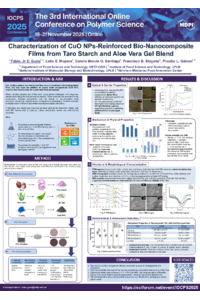
The current study investigated the effects of increasing the concentration of CuO NPs on the performance of biocomposite films derived from taro starch and Aloe vera gel. The CuO NPs synthesized through chemical co-precipitation and calcification were mixed with taro starch and aloe vera gel to obtain biodegradable bio-nanocomposites films. The glycerol, biopolymers and the CuO NPs were mixed and cast and dried in the oven to create uniform films. The bionanocomposite film was characterized by optical, mechanical, physical, chemical, morphological analysis, antimicrobial and antioxidant properties. Results show that as the concentration of CuO NP increases, the film's opacity also increases as the film absorbs more light. Although the optimum percentage of CuO NPs enhanced the film thickness, the tensile strength decreased at higher concentrations (1. 5% and 2. 0%)
because of agglomeration. Moreover, adding the CuO NPs to the biopolymer matrix had no new chemical interaction. However, the agglomeration was caused by physical factors. The glass transition temperature (Tg) and melting point temperature (Tm) rise with increasing CuO NPs, indicating a significant relationship between CuO NPs and the biopolymer film. The antibacterial activity of the film raised with increasing CuO concentration against all bacterial strains due to the leaching of copper ions. There was no considerable impact on the antioxidant property of the bio-nanocomposite film. Therefore, Copper Oxide nanoparticles (CuO NPs) have benefits such as a high light barrier effect, possible antibacterial properties, and possibly enhanced thermal stability, making them suitable for active food packaging applications.
Keywords
Taro starch
aloe vera gel
CuO nanoparticles
bio-nanocomposite film
Poster
3rd Conference on Polymer Science_GUNO et al.pdf
Polyvinylpyrrolidone-Mediated Engineering of NiMn2O4 Nanocubes for Enhanced Energy Storage and Non-Enzymatic H2O2 Detection
Iron-Modified Illite-Chitosan Composite as an Efficient Catalyst for Environmental Pollutant Degradation