Event submissions
Published
This submission belongs to the session S4. Polymer Composites and Nanocomposites of the event The 3rd International Online Conference on Polymer Science
Published date
14 Nov, 2025
Academic Editor
'%3e%3cpath%20d='M12.6657%2010.9104C12.4185%2010.325%2012.0599%209.79327%2011.6097%209.34482C11.1609%208.89508%2010.6293%208.5365%2010.0442%208.28888C10.0389%208.28626%2010.0337%208.28495%2010.0285%208.28233C10.8446%207.69279%2011.3752%206.73249%2011.3752%205.64904C11.3752%203.8542%209.92103%202.39999%208.1262%202.39999C6.33136%202.39999%204.87715%203.8542%204.87715%205.64904C4.87715%206.73249%205.40774%207.69279%206.22393%208.28364C6.21869%208.28626%206.21345%208.28757%206.20821%208.29019C5.62129%208.5378%205.09463%208.89284%204.64265%209.34613C4.1929%209.79493%203.83432%2010.3266%203.58671%2010.9117C3.34345%2011.4845%203.21226%2012.0987%203.20023%2012.7209C3.19988%2012.7349%203.20233%2012.7488%203.20744%2012.7619C3.21255%2012.7749%203.22022%2012.7867%203.22998%2012.7968C3.23975%2012.8068%203.25142%2012.8147%203.26431%2012.8202C3.2772%2012.8256%203.29105%2012.8284%203.30504%2012.8284H4.09109C4.14874%2012.8284%204.19459%2012.7825%204.1959%2012.7262C4.2221%2011.7148%204.62823%2010.7676%205.34617%2010.0497C6.08899%209.30683%207.0755%208.89808%208.1262%208.89808C9.17689%208.89808%2010.1634%209.30683%2010.9062%2010.0497C11.6242%2010.7676%2012.0303%2011.7148%2012.0565%2012.7262C12.0578%2012.7838%2012.1037%2012.8284%2012.1613%2012.8284H12.9474C12.9613%2012.8284%2012.9752%2012.8256%2012.9881%2012.8202C13.001%2012.8147%2013.0126%2012.8068%2013.0224%2012.7968C13.0322%2012.7867%2013.0398%2012.7749%2013.0449%2012.7619C13.0501%2012.7488%2013.0525%2012.7349%2013.0522%2012.7209C13.0391%2012.0947%2012.9094%2011.4855%2012.6657%2010.9104ZM8.1262%207.9024C7.52486%207.9024%206.9589%207.6679%206.53312%207.24211C6.10733%206.81633%205.87283%206.25037%205.87283%205.64904C5.87283%205.0477%206.10733%204.48174%206.53312%204.05596C6.9589%203.63018%207.52486%203.39567%208.1262%203.39567C8.72753%203.39567%209.29349%203.63018%209.71927%204.05596C10.1451%204.48174%2010.3796%205.0477%2010.3796%205.64904C10.3796%206.25037%2010.1451%206.81633%209.71927%207.24211C9.29349%207.6679%208.72753%207.9024%208.1262%207.9024Z'%20fill='%235D1EE1'/%3e%3c/g%3e%3c/svg%3e) Alberto Jiménez Suárez
Alberto Jiménez SuárezCitation
Davide Palamara, Mengistu Gelaw, Luigi Calabrese, Edoardo Proverbio, Hydrothermal Aging of SAPO-34/Nexar Composite Coatings for Thermal Energy Storage, in Proceedings of The 3rd International Online Conference on Polymer Science, 19 November–21 November 2025, MDPI: Basel, Switzerland
Share
Email
Facebook
Twitter
LinkedIn
Hydrothermal Aging of SAPO-34/Nexar Composite Coatings for Thermal Energy Storage
'%3e%3cpath%20d='M12.6647%2010.9104C12.4176%2010.325%2012.0589%209.7933%2011.6088%209.34485C11.16%208.89511%2010.6283%208.53653%2010.0432%208.28891C10.038%208.28629%2010.0327%208.28498%2010.0275%208.28236C10.8437%207.69282%2011.3743%206.73252%2011.3743%205.64907C11.3743%203.85423%209.92005%202.40002%208.12522%202.40002C6.33038%202.40002%204.87618%203.85423%204.87618%205.64907C4.87618%206.73252%205.40677%207.69282%206.22296%208.28367C6.21772%208.28629%206.21248%208.2876%206.20724%208.29022C5.62031%208.53783%205.09365%208.89287%204.64167%209.34616C4.19192%209.79496%203.83334%2010.3266%203.58573%2010.9117C3.34247%2011.4846%203.21128%2012.0987%203.19925%2012.721C3.1989%2012.735%203.20135%2012.7489%203.20646%2012.7619C3.21157%2012.7749%203.21924%2012.7868%203.22901%2012.7968C3.23877%2012.8068%203.25045%2012.8148%203.26334%2012.8202C3.27623%2012.8256%203.29007%2012.8284%203.30406%2012.8284H4.09012C4.14776%2012.8284%204.19362%2012.7825%204.19493%2012.7262C4.22113%2011.7148%204.62726%2010.7676%205.34519%2010.0497C6.08802%209.30686%207.07452%208.89811%208.12522%208.89811C9.17592%208.89811%2010.1624%209.30686%2010.9052%2010.0497C11.6232%2010.7676%2012.0293%2011.7148%2012.0555%2012.7262C12.0568%2012.7839%2012.1027%2012.8284%2012.1603%2012.8284H12.9464C12.9604%2012.8284%2012.9742%2012.8256%2012.9871%2012.8202C13%2012.8148%2013.0117%2012.8068%2013.0214%2012.7968C13.0312%2012.7868%2013.0389%2012.7749%2013.044%2012.7619C13.0491%2012.7489%2013.0515%2012.735%2013.0512%2012.721C13.0381%2012.0947%2012.9084%2011.4856%2012.6647%2010.9104ZM8.12522%207.90243C7.52388%207.90243%206.95792%207.66793%206.53214%207.24215C6.10636%206.81636%205.87185%206.2504%205.87185%205.64907C5.87185%205.04773%206.10636%204.48177%206.53214%204.05599C6.95792%203.63021%207.52388%203.3957%208.12522%203.3957C8.72655%203.3957%209.29252%203.63021%209.7183%204.05599C10.1441%204.48177%2010.3786%205.04773%2010.3786%205.64907C10.3786%206.2504%2010.1441%206.81636%209.7183%207.24215C9.29252%207.66793%208.72655%207.90243%208.12522%207.90243Z'%20fill='%235D1EE1'/%3e%3c/g%3e%3c/svg%3e)
Davide Palamara 1
Mengistu Gelaw 1,2

Luigi Calabrese 1

Edoardo Proverbio 1
1. Department of Engineering, University of Messina, Messina, Italy
2. Department of Mechanical Engineering, Adama Science and Technology University, Adama, Ethiopia
Abstract
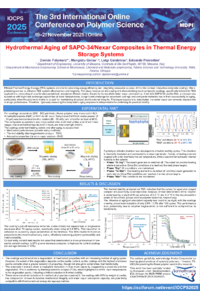
Efficient Thermal Energy Storage (TES) systems are vital for advancing energy efficiency and integrating renewable sources. Within this context, innovative composite coatings offer a promising avenue to enhance TES system effectiveness and longevity. This study focuses on developing and characterizing novel composite coatings, specifically tailored for TES applications, consisting of a sulfonated pentablock terpolymer (Nexar) matrix, known for its excellent water vapor permeability, filled with SAPO-34 zeolite filler, a microporous substance with high heat exchange capabilities at lower temperatures. A significant challenge for adsorbent coatings and composite materials lies in their susceptibility to aging, particularly when the polymeric matrix is crucial for maintaining structural and functional integrity. Prolonged exposure to adsorbates like water vapor can severely degrade the coating's performance. Therefore, assessing the composite's aging response is crucial for confirming its practical viability.
In this work, we subjected SAPO-34/Nexar composite coatings, with varying zeolite concentrations, to hydrothermal aging to verify their stability. The aging protocol involved hundreds of wet (30°C, 80% RH) and dry (40°C, 20% RH) cycles within a controlled climatic chamber. We evaluated the coatings' mechanical properties (including pull-off strength and scratch resistance) and adsorption/desorption capacity (by means of DVS analysis), both before aging and after specific aging durations. The mechanical properties of the coatings decrease with an increasing number of cycles: a decline that is most pronounced at lower zeolite concentrations. The 90 wt% zeolite composition offers superior mechanical stability over cycles, while exceeding this percentage leads to a degradation of properties due to the reduced amount of polymer binder. DVS analysis indicated only a minimal reduction (between 2.9% and 3.5%) in adsorption capacity. These findings highlight that a balanced composition is crucial for the practical viability of high-filler content SAPO-34/Nexar coatings in long-term TES applications.
Keywords
composite coatings
aging
zeolite
sulfonated polymer matrix
thermal energy storage
Poster
sciforum-137738 POSTER IOCPS PALAMARA.pdf
Optimizing Graphene Oxide/NBR Nanocomposites Through Interfacial Hydrogen Bonding for Enhanced Mechanical, Dielectric, and Optical Performance
Polyethersulfone/coreshell-Fe3O4/ZnO Membranes for the Efficient Removal of Salts and Pb(II) from Environmental Wastewater