Event submissions
Published

This submission belongs to the session S3. Polymers and Supramolecular Chemistry of the event The 29th International Electronic Conference on Synthetic Organic Chemistry
Published date
14 Nov, 2025
Academic Editor
'%3e%3cpath%20d='M12.6657%2010.9104C12.4185%2010.325%2012.0599%209.79327%2011.6097%209.34482C11.1609%208.89508%2010.6293%208.5365%2010.0442%208.28888C10.0389%208.28626%2010.0337%208.28495%2010.0285%208.28233C10.8446%207.69279%2011.3752%206.73249%2011.3752%205.64904C11.3752%203.8542%209.92103%202.39999%208.1262%202.39999C6.33136%202.39999%204.87715%203.8542%204.87715%205.64904C4.87715%206.73249%205.40774%207.69279%206.22393%208.28364C6.21869%208.28626%206.21345%208.28757%206.20821%208.29019C5.62129%208.5378%205.09463%208.89284%204.64265%209.34613C4.1929%209.79493%203.83432%2010.3266%203.58671%2010.9117C3.34345%2011.4845%203.21226%2012.0987%203.20023%2012.7209C3.19988%2012.7349%203.20233%2012.7488%203.20744%2012.7619C3.21255%2012.7749%203.22022%2012.7867%203.22998%2012.7968C3.23975%2012.8068%203.25142%2012.8147%203.26431%2012.8202C3.2772%2012.8256%203.29105%2012.8284%203.30504%2012.8284H4.09109C4.14874%2012.8284%204.19459%2012.7825%204.1959%2012.7262C4.2221%2011.7148%204.62823%2010.7676%205.34617%2010.0497C6.08899%209.30683%207.0755%208.89808%208.1262%208.89808C9.17689%208.89808%2010.1634%209.30683%2010.9062%2010.0497C11.6242%2010.7676%2012.0303%2011.7148%2012.0565%2012.7262C12.0578%2012.7838%2012.1037%2012.8284%2012.1613%2012.8284H12.9474C12.9613%2012.8284%2012.9752%2012.8256%2012.9881%2012.8202C13.001%2012.8147%2013.0126%2012.8068%2013.0224%2012.7968C13.0322%2012.7867%2013.0398%2012.7749%2013.0449%2012.7619C13.0501%2012.7488%2013.0525%2012.7349%2013.0522%2012.7209C13.0391%2012.0947%2012.9094%2011.4855%2012.6657%2010.9104ZM8.1262%207.9024C7.52486%207.9024%206.9589%207.6679%206.53312%207.24211C6.10733%206.81633%205.87283%206.25037%205.87283%205.64904C5.87283%205.0477%206.10733%204.48174%206.53312%204.05596C6.9589%203.63018%207.52486%203.39567%208.1262%203.39567C8.72753%203.39567%209.29349%203.63018%209.71927%204.05596C10.1451%204.48174%2010.3796%205.0477%2010.3796%205.64904C10.3796%206.25037%2010.1451%206.81633%209.71927%207.24211C9.29349%207.6679%208.72753%207.9024%208.1262%207.9024Z'%20fill='%235D1EE1'/%3e%3c/g%3e%3c/svg%3e) Julio A. Seijas
Julio A. SeijasCitation
Olga P. Kolesnikova, Denis A. Ivanov, Igor V. Kryukov, Nikolai Kh. Petrov, Influence of the Cucurbit[7]uril Structure on Photophysical Properties of the Encapsulated Styryl Dye, in Proceedings of The 29th International Electronic Conference on Synthetic Organic Chemistry, 14 November–28 November 2025, MDPI: Basel, Switzerland, doi: 10.3390/ecsoc-29-26963
Share
Email
Facebook
Twitter
LinkedIn
Influence of the Cucurbit[7]uril Structure on Photophysical Properties of the Encapsulated Styryl Dye

Olga P. Kolesnikova 1,2
'%3e%3cpath%20d='M12.6647%2010.9104C12.4176%2010.325%2012.0589%209.7933%2011.6088%209.34485C11.16%208.89511%2010.6283%208.53653%2010.0432%208.28891C10.038%208.28629%2010.0327%208.28498%2010.0275%208.28236C10.8437%207.69282%2011.3743%206.73252%2011.3743%205.64907C11.3743%203.85423%209.92005%202.40002%208.12522%202.40002C6.33038%202.40002%204.87618%203.85423%204.87618%205.64907C4.87618%206.73252%205.40677%207.69282%206.22296%208.28367C6.21772%208.28629%206.21248%208.2876%206.20724%208.29022C5.62031%208.53783%205.09365%208.89287%204.64167%209.34616C4.19192%209.79496%203.83334%2010.3266%203.58573%2010.9117C3.34247%2011.4846%203.21128%2012.0987%203.19925%2012.721C3.1989%2012.735%203.20135%2012.7489%203.20646%2012.7619C3.21157%2012.7749%203.21924%2012.7868%203.22901%2012.7968C3.23877%2012.8068%203.25045%2012.8148%203.26334%2012.8202C3.27623%2012.8256%203.29007%2012.8284%203.30406%2012.8284H4.09012C4.14776%2012.8284%204.19362%2012.7825%204.19493%2012.7262C4.22113%2011.7148%204.62726%2010.7676%205.34519%2010.0497C6.08802%209.30686%207.07452%208.89811%208.12522%208.89811C9.17592%208.89811%2010.1624%209.30686%2010.9052%2010.0497C11.6232%2010.7676%2012.0293%2011.7148%2012.0555%2012.7262C12.0568%2012.7839%2012.1027%2012.8284%2012.1603%2012.8284H12.9464C12.9604%2012.8284%2012.9742%2012.8256%2012.9871%2012.8202C13%2012.8148%2013.0117%2012.8068%2013.0214%2012.7968C13.0312%2012.7868%2013.0389%2012.7749%2013.044%2012.7619C13.0491%2012.7489%2013.0515%2012.735%2013.0512%2012.721C13.0381%2012.0947%2012.9084%2011.4856%2012.6647%2010.9104ZM8.12522%207.90243C7.52388%207.90243%206.95792%207.66793%206.53214%207.24215C6.10636%206.81636%205.87185%206.2504%205.87185%205.64907C5.87185%205.04773%206.10636%204.48177%206.53214%204.05599C6.95792%203.63021%207.52388%203.3957%208.12522%203.3957C8.72655%203.3957%209.29252%203.63021%209.7183%204.05599C10.1441%204.48177%2010.3786%205.04773%2010.3786%205.64907C10.3786%206.2504%2010.1441%206.81636%209.7183%207.24215C9.29252%207.66793%208.72655%207.90243%208.12522%207.90243Z'%20fill='%235D1EE1'/%3e%3c/g%3e%3c/svg%3e)
Denis A. Ivanov 2
Igor V. Kryukov 2
Nikolai Kh. Petrov 1,2
1. Moscow Center for Advanced Studies, Kulakova Str, 2, Moscow, Russia
2. Photochemistry Center of the Russian Academy of Sciences, Federal Scientific Research Centre "Crystallography and Photonics" RAS, 119421, Moscow, str. Novatorov, 7A-1
Abstract
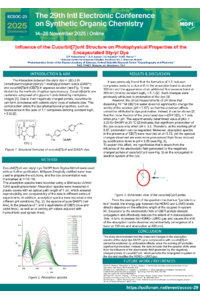
The interaction between the styryl dye 4-{(E)-2-[4-(dimethylamino)phenyl]vinyl}-1-methylpyridinium iodide (DASPI) and cucurbit[7]uril (CB[7]) in aqueous solution was studied by optical spectroscopy methods. Cucurbit[n]urils are cavitands composed of n glycoluril units linked by methylene bridges [1]. Due to their negatively charged portals, cucurbiturils can form complexes with cationic styryl dyes of suitable size. This complexation alters the dye photophysical properties, such as fluorescence in the case of 1:1 complexes (binding constant logK₁ = 5.5) [2].
It was previously found that the formation of 1:2 inclusion complexes leads to a red shift in the absorption band to around 330 nm and the appearance of an additional fluorescence band at 450 nm (binding constant logK₂ = 5.1) [2]. Such changes were previously attributed to protonation of the dye [3].
However, the direct measurements of pH show that dissolving 10⁻⁵ M CB[7] in water does not significantly change the acidity of the solution (pH = 5.67), so that the observed effects cannot be attributed to dye protonation. Indeed, it can be shown [2], that the molar fraction of the protonated dye ≈1 only when pKa > pH.
The experimentally determined value of pKa=3.23 for DASPI at 23°C [2], so that significant protonation of the dye occurs only when pH≲3.5. Therefore, at the working pH of 5.67, protonation contributes is neglected.
To explain the effect, we hypothesize that the effect arises from the influence of the electrostatic field generated by the negatively charged portals of cucurbit[7]uril on the conjugated π-electron system of the dye.
Keywords
styryl dyes
cucurbit[7]uril
inclusion complexes
fluorescence
influence of electrostatic field
Manuscript
chemproc-sciforum_143533_S3_original_article-done.pdf
Poster
poster.pdf
Synthesis, Characterization, and Antibacterial Evaluation of Dinuclear Organotin(IV) Complexes Derived from Oxalyldihydrazone-Based Ligands
Design, Synthesis, molecular docking and biological evaluation of some novel 1,2,3,4-tetrahydropyrimidine-2-(1H)-ones (DHPMs) analogues: Antibacterial, antifungal and antioxidant activity.